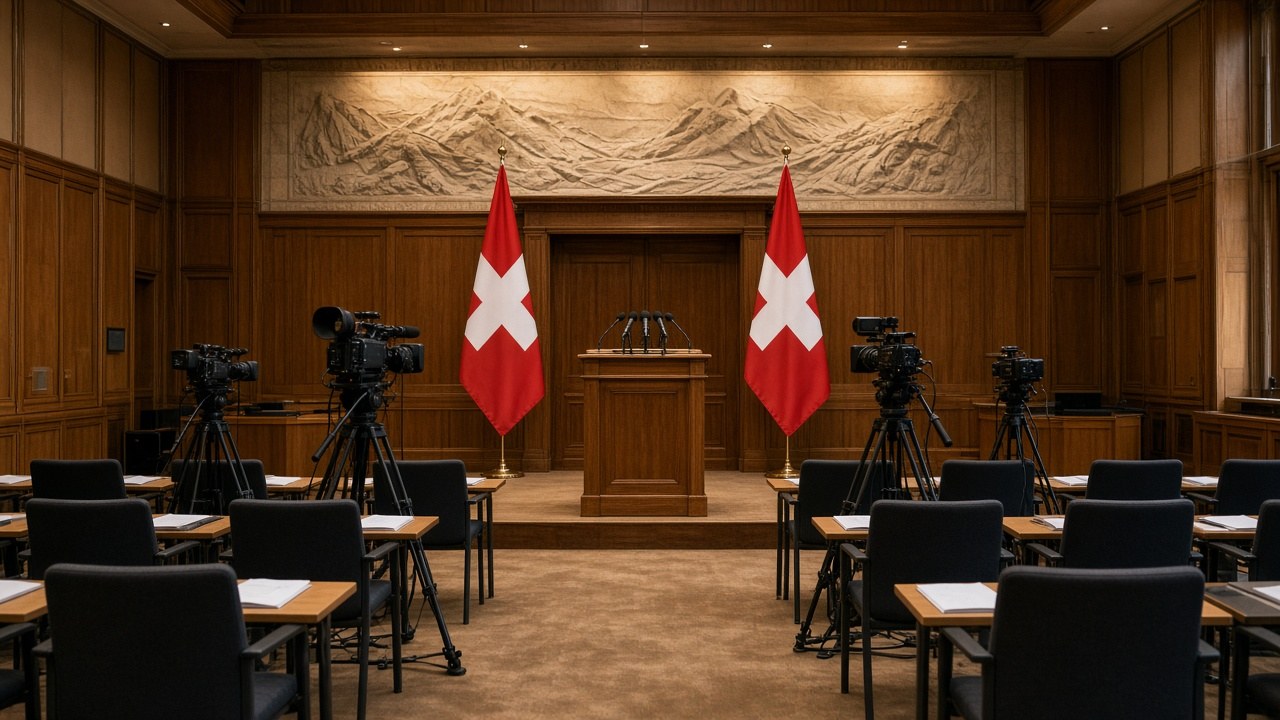
BERN. Guy Parmelin, the economics minister who holds Switzerland’s rotating presidency this year, announced on Friday that he will leave the Federal Council at the end of December, after eleven years in the seven seat government. Visibly relaxed and joking with journalists, the 66 year old told a packed media room in Bern that the decision had nothing to do with his health, despite months of rumours about back problems.
“The passion for the job is no longer as strong as it was at the start,” Parmelin admitted. He said he wanted to make way for “new blood in these times of great uncertainty”, and promised to keep working until 31 December, “at 11.59pm at the very latest”. After that, he added with characteristic dry humour, he would spend six months clearing out his office.
A winegrower in the Bundeshaus
Parmelin, a winegrower from Bursins in the canton of Vaud, joined the Federal Council in December 2015 as the successor to Eveline Widmer-Schlumpf. He first led the defence ministry, then moved to the economics ministry in 2019, the department he still runs. He held the rotating presidency twice: in 2021, the year of the pandemic and of the abandoned EU framework talks, and again this year.
His record in office is tied to trade. He guided Switzerland through the Covid crisis in 2021, managed the politically delicate end of the framework negotiations with the European Union, and leaves having signed the free trade agreements with India and Mercosur, the latter now heading for a referendum. His final year was dominated by the tariff fight with Washington and by the treaty package with Brussels that parliament is debating this autumn.
The party claims the seat
The Swiss People’s Party, by far the largest in parliament, said it deeply regretted the resignation and thanked Parmelin for what it called his great commitment to the country. It also made its claim explicit within hours: under the informal concordance formula that shares the seven seats among the strongest parties, the SVP will stand its own candidate, pledged to independence and neutrality, limits on immigration and respect for the popular vote.
The machinery is already dated. Cantonal party sections must report their candidates to the search committee, led by former National Councillor Caspar Baader, by noon on 23 October. Hearings follow, the committee delivers its proposal to the parliamentary group leadership by 13 November, and the group nominates its official ticket on 20 November. The United Federal Assembly elects the new federal councillor on Wednesday, 9 December.
Tributes came from across the spectrum on Friday, most of them praising a collegial style that made Parmelin one of the more popular figures in a polarised government. The practical questions begin immediately: who takes the economics portfolio, and whether the new councillor changes the balance of a government heading into the final year before the 2027 federal elections.
Parmelin leaves at a moment of unusual flux. The Senate passed the EU package only hours before his announcement, the neutrality initiative was buried five days earlier, and the succession race that now opens could produce a first: no woman has ever sat in the Federal Council for the People’s Party. The names already circulating, from Natalie Rickli to Céline Amaudruz, suggest that possibility is being taken seriously.
For the winegrower from Bursins, the last word on Friday was about the vines rather than the votes. Eleven years in the Bundeshaus, he said, is long enough. The office will be cleared by the middle of next year. The argument over who inherits it has already begun.