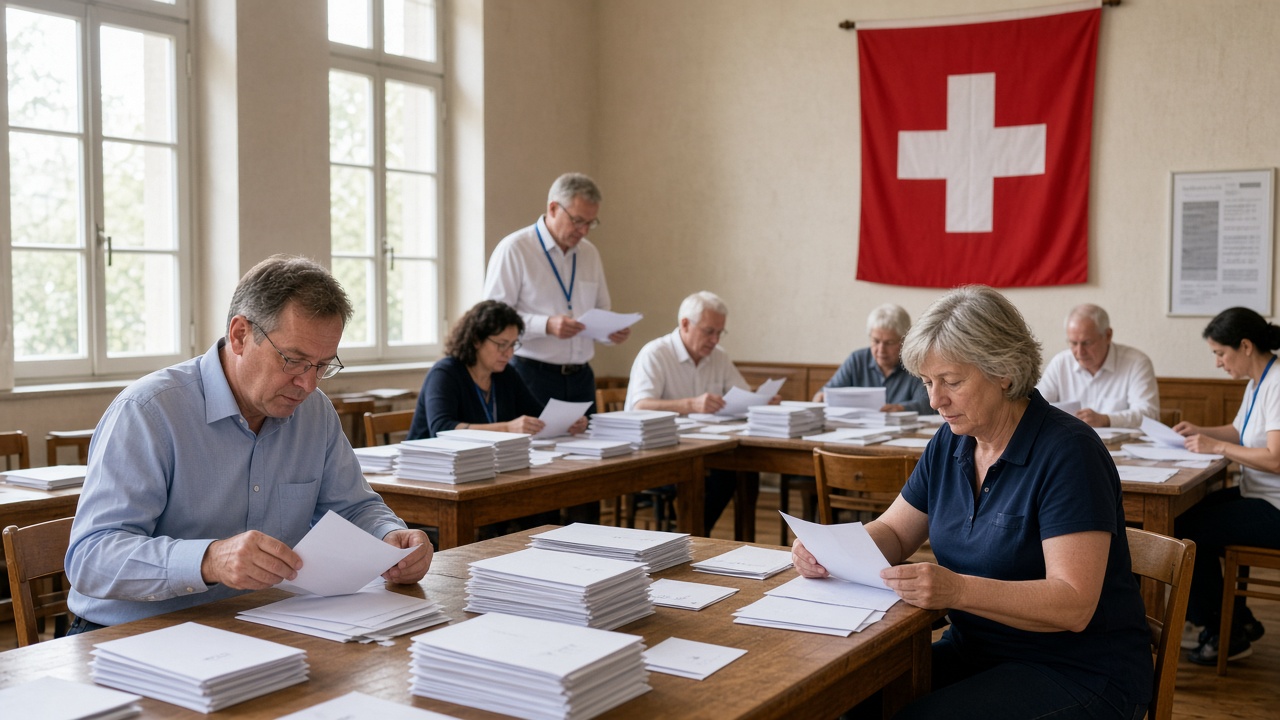
BERN. The strictest reading of Swiss neutrality ever put to a national vote has been rejected by 70.2 per cent of the electorate, and by every single canton. Final results from the Federal Chancellery on Sunday evening confirmed what the projections had said since noon: the neutrality initiative failed to win a majority of the people and missed the required majority of the cantons by a distance no Swiss campaign has closed in years. The food security initiative on the same ballot fell even harder, rejected by 72.5 per cent of voters.
The geography of the defeat is as striking as its size. Not one of the 26 cantons voted Yes. The closest result came in Ticino, where 51.8 per cent voted No. Schwyz, the heartland of the initiative’s backers, rejected it by 57.9 per cent, and Appenzell Innerrhoden by 59.7 per cent. Every other canton said No by sixty per cent or more, most of them by margins well above seventy. For a proposal that needed to win half the cantons, the map is a shutout.
What the initiative asked, and what voters heard
The proposal, launched by the Pro Suisse association and carried by the Swiss People’s Party, would have written a narrower neutrality into the Federal Constitution: permanent and armed, with a ban on joining any military alliance and a ban on sanctions against belligerent states unless the United Nations had ordered them. It was born of the argument over 2022, when Bern adopted the European Union’s sanctions against Russia. Voters have now answered that argument by keeping the constitution as it is.
The campaign’s arc will be studied for years. The first poll in August put rejection at 54 per cent. The final survey eleven days before the vote put it at 63 per cent. The ballot itself landed at 70.2 per cent against, which means the No camp kept growing all the way through the count. Pollsters at gfs.bern have long noted that initiatives tend to lose support once their texts are debated in full. Few campaigns have illustrated the rule so cleanly.
Money did not bend the result. The Yes committee declared CHF 3.84 million, more than double its opponents, and Christoph Blocher, the former federal councillor whose fortune sat behind the campaign, conceded the vote days before it happened and said he spent another CHF 1.8 million anyway, to keep the argument alive. The argument is alive. The initiative is not.
The government reads a mandate
Federal Councillor Ignazio Cassis, who led the government’s campaign against the text, repeated the sentence he has used since August: Switzerland has been and is neutral, and it will remain neutral. What changes on Monday morning, officials say, is nothing, and that is the point. The constitution continues to leave the Federal Council and parliament the discretion to apply neutrality case by case, including the adoption of sanctions that stop short of war.
Legal scholars read the margin as a verdict on the attempt to freeze a foreign policy instrument into constitutional concrete. Helen Keller, professor of international law at the University of Zurich, put the paradox plainly during the count: the Swiss are all in favour of neutrality, but everyone understands something different by it. Sunday settled which understanding governs. It is the one already in use.
Business, which warned for months that the text would mark Switzerland as a sanctions safe haven, claimed the result as a defence of the country’s reputation. Monika Rühl, director of economiesuisse, said voters had rejected a corset that would have restricted cooperation with partner countries. Switzerland, she said, does not want to be seen as a war profiteer or as a state that helps others circumvent sanctions.
The other initiative fell further
The food security initiative, which asked the constitution to require at least 70 per cent of food consumed in Switzerland to be produced at home within ten years, was rejected by 72.5 per cent. It began the summer in a statistical dead heat and ended as the heavier defeat of the two. The driest summer on record did not rescue it. The Farmers’ Union, the constituency the text claimed to defend, campaigned against what it called a state mandated menu, and two thirds of voters agreed that the target was unrealistic.
Attention now turns to the file that was always waiting behind this vote. On Monday the Council of States opened its three day debate on the EU treaty package, and it did so with a fresh answer to the question Brussels asked all September: whether Switzerland was about to lock itself out of the sanctions cooperation the package deepens. The European Parliament’s warning this month now reads as a precaution that was not needed.
The Yes committees held their post mortems on Sunday night, before the posters came down. The People’s Party, which has lost heavily at the ballot box before and won the next election anyway, was already reframing the defeat as proof that the political class fears the question. The No camp called it a mandate for the government’s European course. Both readings will be tested again in November, when the pension reform referendum gives the country its next Sunday of envelopes.
What Sunday settled is narrower and larger than the campaign that produced it. Narrower, because nothing in Swiss law changes on Monday. Larger, because the electorate was offered a definition of what Switzerland is, and declined it in every canton from Geneva to Appenzell. The country voted for neutrality as it is practised, not for neutrality as the initiative wanted it written.