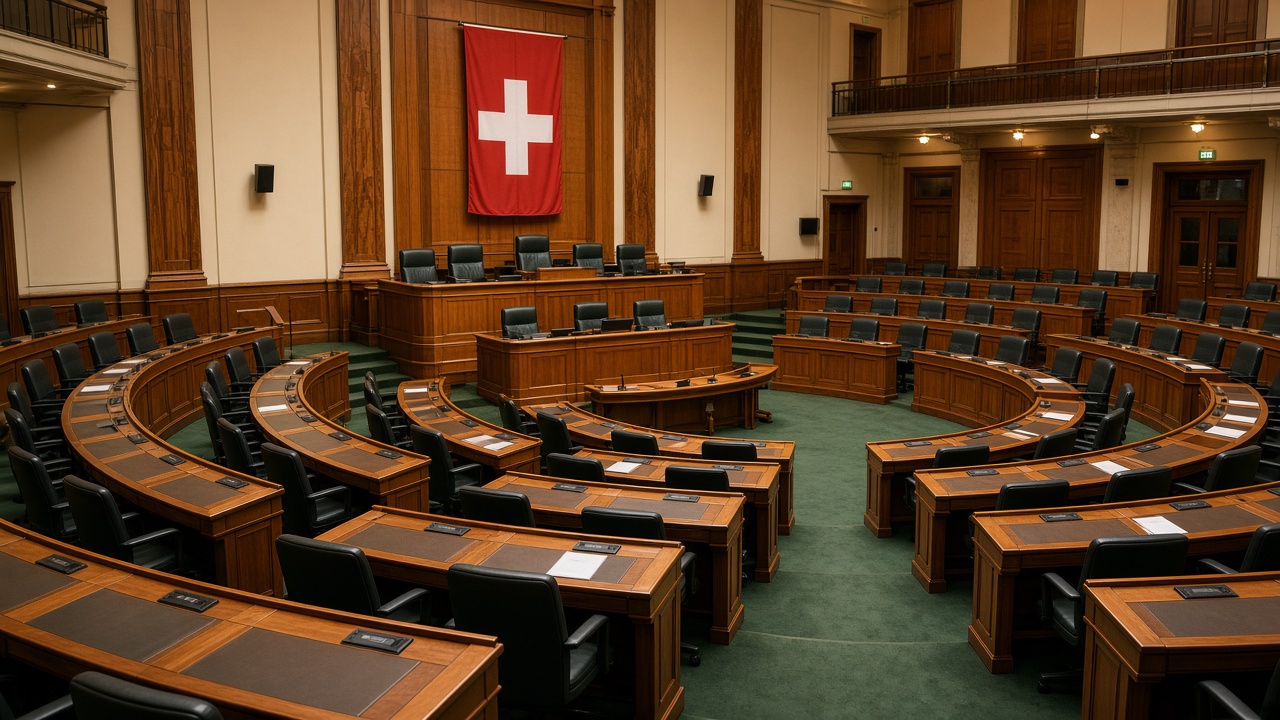
BERN. The morning after the referendum, Swiss politics moves straight to the file the referendum was always really about. On Monday at 10am the Council of States opens its debate on the Bilaterals III treaty package with the European Union: three days on the floor, a night sitting planned for the second day, and an attendance that tells its own story. Three members of the seven seat Federal Council will sit in the chamber, Ignazio Cassis, Beat Jans and Guy Parmelin, the foreign, justice and economics ministers, for a package Parmelin negotiated with Ursula von der Leyen over two years.
The package itself is broad to the point of sprawl: the stabilisation of the existing bilateral treaties, new agreements on food safety and health, the institutional questions of dynamic law adoption and dispute settlement, wage protection and the safeguard clause for excessive immigration. One conspicuous absence will shape the week: the electricity agreement, the file the energy sector wants most, is not ready and is not part of what the Senate debates. What remains is still close to 2,000 pages, and parliament cannot amend a comma of it. It can approve or reject, and it can decide how the country is asked.
That last power is where the real fight sits. The substance was largely settled in committee: the foreign affairs committee recommended approval by 9 votes to 3 with one abstention on 4 September, and the economic affairs committee, more sceptical, still produced a workable majority. But on Wednesday the political institutions committee tabled a parliamentary initiative that would tie the whole package to a constitutional amendment, requiring not just a majority of voters but a majority of cantons to ratify. Double yes, or nothing.
The double majority question is the debate’s centre of gravity because it is really two arguments wearing one legal costume. The first is juridical: whether a treaty package of this significance must constitutionally face the mandatory referendum reserved for constitutional change, or whether the ordinary optional referendum, 50,000 signatures and a simple majority, suffices. Experts called before the committees have disagreed in print for months. The second argument is political arithmetic. A simple majority of voters is winnable for the Yes camp on current polling. A majority of cantons is a different map entirely, and everyone in the chamber knows which side benefits from which rule.
The People’s Party will oppose the package in principle and the double majority is its instrument; a scattering of Liberal conservatives shares its sovereignty concerns. The government’s majority runs from the Social Democrats through the Centre to most of the Liberals, the same alignment that carried the foreign affairs committee. The Greens will spend the week extracting environmental and wage protection commitments for the implementation law, the only place parliament can actually legislate.
Brussels is watching with unusual openness. The European Parliament’s foreign affairs committee backed the package this month by 53 votes to 3, and paired its approval with a warning that a Yes in the neutrality referendum would strain precisely the cooperation the package deepens. If Sunday delivers the expected heavy No, the Senate’s debate opens with that wind behind it. The sequence is not coincidental. The Federal Council scheduled the treaty debate for the morning after the vote because the two questions were always one.
The timetable beyond this week is long. The National Council takes its turn in the winter session. The referendum question, settled or not, will shadow every stage. Ratification, if it comes, belongs to 2027 at the earliest. But the shape of the answer starts forming on Monday morning, in a chamber that cannot change a comma and can only decide how Switzerland says yes, or no.