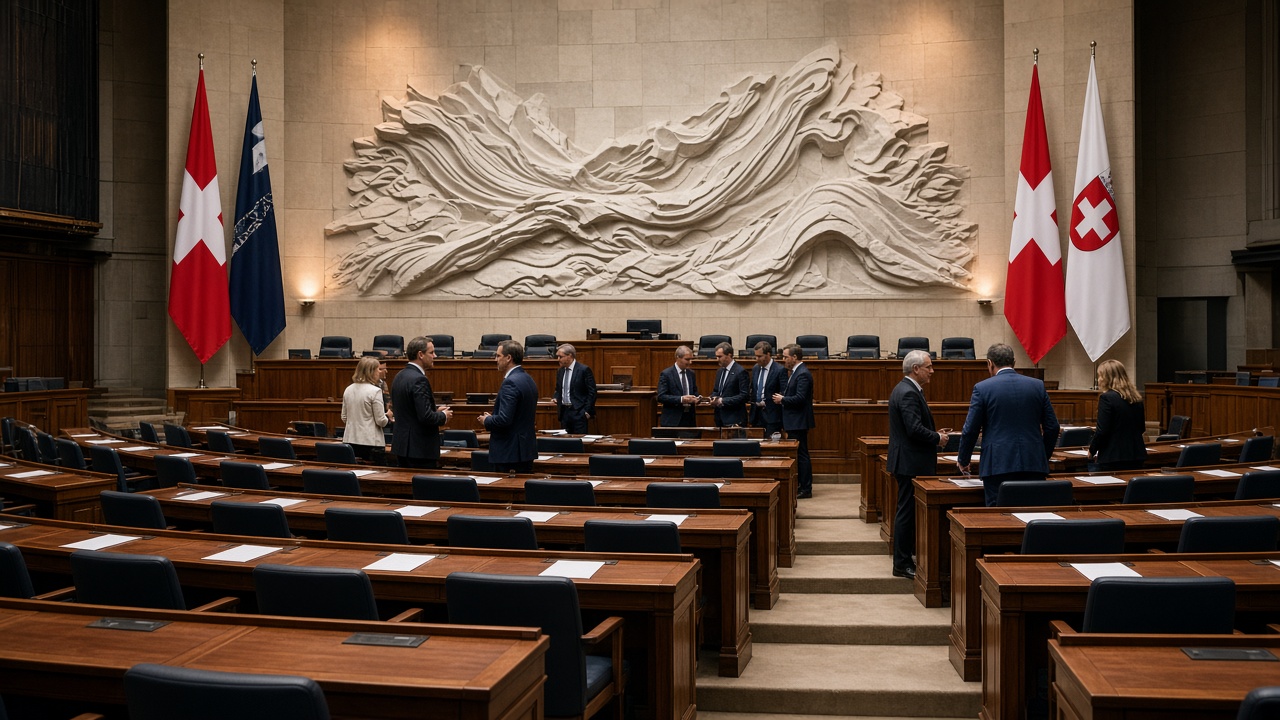
BERN. A year after the economics minister signed it in Brazil, and three months after the House of Representatives rejected it, the EFTA-Mercosur free trade agreement has completed its passage through the Swiss parliament. The House approved the accord last week, days after the Senate passed it by 35 votes to 7, both chambers pairing their consent with CHF 517 million in support for Swiss agriculture spread over six years from 2028. The signature gatherers are next. The referendum clock starts when the decree is published, and the committees are already forming.
The deal itself links the four EFTA states, Switzerland, Norway, Iceland and Liechtenstein, to the core Mercosur bloc of Argentina, Brazil, Paraguay and Uruguay, a market of nearly 300 million consumers. For Swiss industry it promises the phased removal of tariffs that currently penalise machinery, pharmaceuticals, watches and precision instruments against competitors who already enjoy preferential access. For Swiss agriculture it opens managed quotas in sensitive products, beef above all, which is precisely why the June vote in the House failed and why the autumn version arrived with half a billion francs attached.
The CHF 517 million was the price of the U-turn, and everyone involved says so plainly. The money, framed as six years of adjustment support from 2028, converted enough rural and centrist votes to reverse the summer defeat. The Senate’s 35 to 7 margin showed how thoroughly the compromise reordered the politics: a deal rejected as a threat to Swiss food production in June was approved in September by the chamber closest to the farmers, once the farmers’ compensation was written into the same decree.
Now the question leaves parliament. Under the referendum rules, opponents have 100 days from publication to collect 50,000 valid signatures and force a nationwide vote. The expectation on all sides is that they will try. The coalition taking shape pairs the farm organisations that were not bought off by the compensation package with the food sovereignty left and the environmental groups that fought the food initiative beside them this autumn. The same weekend that ends the neutrality campaign will see the first Mercosur signature sheets at the market stalls.
History offers the government comfort, but not certainty. Swiss voters have approved free trade agreements before, and the business lobby will outspend the opponents several times over. But the electorate that votes on Mercosur will have just spent a month hearing, in the food initiative debate, that Swiss self sufficiency is 46 per cent and falling, that the drought proved the fragility of supply chains, and that the farmer is an endangered species. The No campaign’s task is to attach the trade deal to that mood. The Yes campaign’s task is to keep the argument on tariffs, where the numbers favour it.
The government’s calendar is now fixed by mechanics rather than politics: publication, the 100 day collection window, verification, and only then a vote date, realistically not before the second half of 2027. Ratification among the partners runs in parallel, and the European Union’s own stalled Mercosur process will be cited by both camps as evidence for their case, proof on one side that the deal is controversial everywhere, proof on the other that EFTA can move while Brussels deliberates.
For Bern, the sequence matters as much as the substance. The EU package dominates the autumn, the neutrality vote ends on Sunday, and Mercosur was meant to be the quiet success of the season, the proof that Swiss trade policy still delivers. It may yet be. But the decree has not been published, the signatures have not been counted, and the vote in parliament was the easy part. The vote in the country is the one that counts.