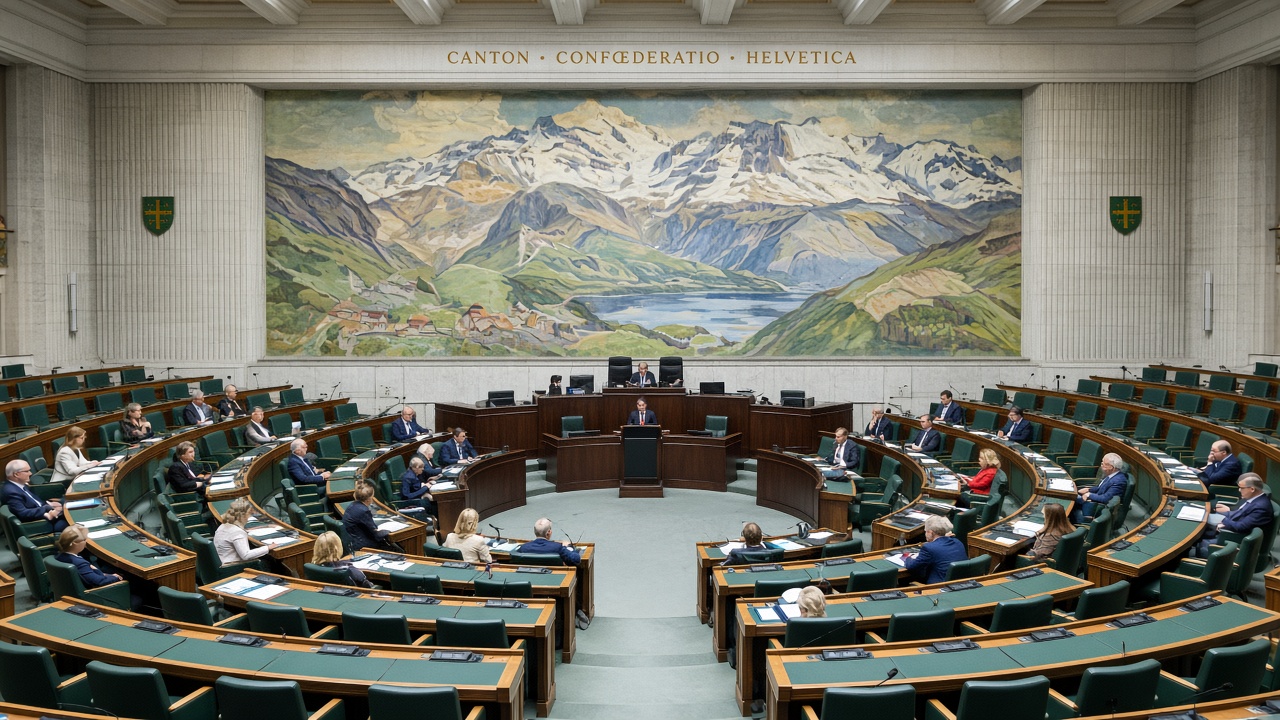
BERN. The ink on the Senate’s 90 per cent vote is barely dry, and the campaign to undo it has already begun. Centre right members of the National Council are preparing a compromise that would require UBS to back its foreign subsidiaries with 75 per cent core equity instead of 90, when the lower house takes up the Lex UBS in the winter session in December. The bill’s opponents lost the battle in the Council of States last week by 29 votes to 16. They intend to refight it in a chamber they consider friendlier.
The most concrete plan comes from Hans-Peter Portmann, the Zurich Liberal, who has drafted a proposal to back foreign participations with 75 per cent CET1 capital and will present it to the Liberal parliamentary group in the coming days. Marcel Dobler, his party colleague on the National Council’s economic affairs committee, says the Senate’s 90 per cent goes too far: for hypothetically more safety, he argues, the rule creates disproportionate additional costs, and the belief that full equity backing brings full safety is an error. In a bank run, he notes, even that does not help.
The committee calendar is set
The economic affairs committee of the National Council takes up the bill on 26 and 27 October. Thomas Matter, the People’s Party parliamentarian and banking entrepreneur, wants the hearings reopened before any vote: the committee, he says, should hear UBS and representatives of the financial centre again, alongside finance minister Karin Keller-Sutter, on what the Senate’s decision would actually do. His party is weighing a compromise proposal of its own. The last compromise to reach a chamber floor, the committee’s half equity, half AT1 design, was thrown out by the Senate. The lower house gets to write the next one.
The numbers being fought over have not changed. Current law requires foreign units to be backed at 60 per cent, a quarter of which can be met with AT1 bonds. The government proposed 100 per cent hard equity and lost by a single vote in the Senate. Peter Hegglin’s 90 per cent amendment, with a seven year transition, is what survives. UBS says that outcome would force it to hold about 16 billion dollars of additional core capital, on top of the increases already absorbed since the Credit Suisse rescue, and has called it an excessive tightening of rules that are already among the strictest in the world.
Not everyone reads the Senate vote as a defeat for good policy. Corinne Zellweger-Gutknecht, the Basel law professor close to the government’s position, called it a successful political compromise and noted that the majority showed the Senate’s intent to strengthen the UBS parent bank. The bank’s shareholders were less philosophical: the shares, which had climbed this autumn to levels not seen since the financial crisis on hopes of the AT1 compromise, gave ground after the vote. Strategists at Oddo BHF called the outcome precisely the scenario management had always wanted to avoid, while adding that the last word has not been spoken.
The talk that will not go away
Behind the parliamentary arithmetic runs a louder current of speculation. The SonntagsBlick reported at the weekend that at least eight international banks have signalled interest in merger talks with UBS, and that parts of the market are openly pricing the possibility that the bank could one day redomicile. UBS dismisses the relocation question whenever it is asked, and the government dismisses it as a negotiating tactic. Neither denial has stopped the talk, because the talk is useful to everyone conducting it.
The government’s position is that the argument ended in 2023, when the state had to engineer the rescue of Credit Suisse over a single weekend. Keller-Sutter has said for two years that foreign subsidiaries must be sellable in a crisis without the parent dragging the country into another bailout, and that only hard equity guarantees it. The National Bank and the financial market regulator Finma backed her 100 per cent line. The Senate’s 90 is close enough to claim vindication, and far enough to keep the fight alive.
The calendar from here is slow and full of exits. The committee reports in November, the full National Council debates in December, and if the chambers disagree the bill shuttles between them into 2027. A referendum is possible at the end of it. Five business associations have already warned that a rule written for one bank will be paid for by the whole economy, and the Senate answered them last week. The lower house gets the next answer.
The Senate has priced the argument at 90. The lower house is already bidding 75, and the bank would take 50 with AT1 if it could get it. Somewhere between those numbers sits the law that will govern the last global bank Switzerland has. The winter session decides who blinks first.