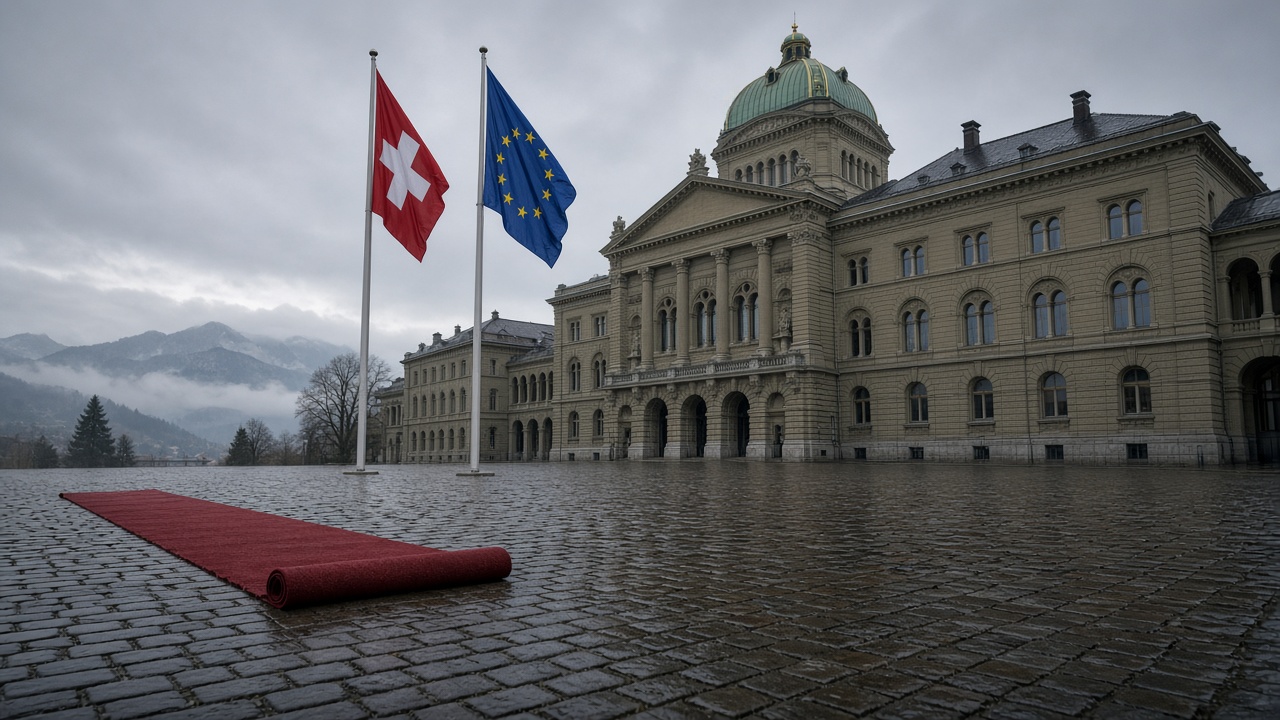
BERN. The National Council's foreign affairs committee has finished its reading of the stabilisation treaties with the European Union and sent them to the winter session. On Wednesday it approved the package by 15 votes to 9, with one abstention, and voted 15 to 10 for an optional referendum. An optional referendum needs a majority of the people. It does not need a majority of the cantons.
The committee sat from 16 to 18 November, after earlier meetings in October and on 5 and 6 November. What it has now closed is the stabilisation part only: the agreements under which Switzerland already takes part in the EU internal market, covering land and air transport, free movement of people, and trade in industrial and agricultural goods. Electricity, food and health are later files. Parliamentary services said a clear majority sees stable relations with the EU as a strategic necessity, best secured on the bilateral path Switzerland already uses. A minority rejects the package as a whole, above all the duty to adopt EU law as it changes and to accept the role of EU judges. The NZZ read the 15 to 9 as a vote in which only the Swiss People's Party stood against.
Why the cantonal majority is the real argument
The heavier split is not whether the treaties should be approved in committee. It is how Switzerland would vote on them. The Council of States wants a mandatory referendum, people and cantons together. On Monday the National Council's political institutions committee voted 14 to 11 the same way. The foreign affairs committee, which leads the file, waited for that report and then went the other direction. Its majority says an optional referendum is the form the constitution already provides for a package of this kind. Its minority says the treaties cut so deeply into Switzerland's internal order that only a mandatory vote will do.
The same committee rejected, by 16 to 8 with one abstention, a parliamentary initiative that would have written the approval into the constitution and forced a mandatory vote that way. Political scientists, the NZZ reported on Thursday morning, reckon a popular yes of about 57 per cent is what it usually takes before a cantonal majority becomes likely. A vote that wins narrowly with the people can still fail in the small cantons. That arithmetic is why both sides are spending their effort on the hurdle rather than on a fresh draft of the treaties.
Bern expects the full National Council to come out, narrowly, for a simple popular majority. If the two chambers still disagree, a reconciliation conference settles it behind closed doors, and a single vote in that room can decide the hurdle. Gerhard Pfister, the former Centre president, has a way around that room. His minority motion, which reaches the House in December, would put the Kompass initiative, or a counter-proposal, to the people and the cantons first. The initiative, from the EU-sceptical association Kompass Europa, demands a mandatory referendum for the treaties. If voters and cantons accept it, the package then needs both majorities. If they reject it, the people alone decide. Pfister told SRF he would rather the public set the rule than leave a close parliamentary split to a conference of 13 members from each foreign affairs committee. He expects that conference, on the present line-up, to come out against a cantonal majority.
The June 2027 ballot has slipped
A popular vote in June 2027 is no longer a realistic plan. The NZZ reported on Thursday that the Council of States will not clear its differences with the National Council in the winter session, so there will be no final vote of parliament in December. The last federal ballot before the national elections of autumn 2027 is in June. Miss that, and the treaties wait until 2028. This site reported the same slippage on Monday. Wednesday's committee finish does not pull the date forward. It makes the winter session the moment the House has to pick a side.
What else was nailed down
On the substance, the committee mostly followed the Senate and then tightened a few domestic points. It voted unanimously to strengthen the role of parliament when Switzerland adopts changing EU law and when a dispute goes to settlement, and it added a line making information and consultation requests from parliamentary committees binding. It backed, by 16 to 9, a parliamentary office in Brussels that the Senate has already approved, so that Bern hears earlier about EU legal projects that will matter here.
On free movement it wants a confident domestic implementation that uses the room in Swiss law and does not write rules that contradict the agreement. It took over most of the political institutions committee's proposals and made some further changes to the Senate text. Several minorities want a harder line against immigration into social assistance. Others would reject the free-movement agreement outright. On land and air transport the majority again followed the Senate, after looking at the protection of the national timetable and at the EU air rules Switzerland already applies. A minority would refuse those agreements and strike parts of the implementing law. The majority's case is that being inside the European transport system is a practical gain for people who travel. The minority's case is the duty to take the law as Brussels changes it.
Three other votes from the same sitting
The committee also adopted, by 13 to 10, a motion asking the Federal Council to start an international process on serious risks from artificial intelligence, in the frame of the Road to Geneva and the Geneva AI Summit of 2027. The majority called it a chance to shape the rules and to strengthen international Geneva. The minority said innovation, not risk and binding rules, should be the point. A motion demanding that Bern withdraw its unilateral concessions to the United States, announced on 29 June 2026, failed by 12 to 9 with one abstention. The majority said the American midterm results should not pull Switzerland off the goal of a trade agreement. The minority said one-sided concessions without a return are not worth keeping. A proposed letter asking for more humanitarian money for the Palestinian territories failed by 13 to 10 with one abstention. The majority said Switzerland's existing effort makes the letter pointless. The minority pointed to Gaza.
None of those three votes is the winter session. The treaty vote is. The Federal Council has wanted an optional referendum from the start. A committee has now agreed, by 15 to 10, and another committee of the same house has disagreed. Readers who want a date should hold 2028 lightly and the winter session firmly. The package is ready for the National Council. The cantonal majority is not settled.