BERN. Six months into the war between the United States and Iran, Switzerland has relearned the first lesson of every energy crisis: availability and price are different problems. Fuel has kept flowing. What has changed, steadily and expensively, is what it costs, and what might happen in a cold January.
The closure of the Strait of Hormuz continues to distort global markets. Heating oil has climbed to about CHF 140 per 100 litres in late August, and Dutch TTF futures, the benchmark for European and Swiss gas, stood at 64 euros per megawatt hour on 26 August, up more than 130 per cent since the start of the year.
Prices remain far below the records of the 2022 crisis. The anxiety this autumn is quieter and more specific: Europe enters the heating season with unusually thin reserves. Strong summer electricity demand, drought that constrained hydropower and nuclear output across the continent, and supply outages have combined to leave average EU gas storage at 62 per cent in late August, well below the seasonal norm.
Switzerland’s own assessment, published by the government on 19 August, said in plain bureaucratic language that securing supplies for the coming winter was proving challenging. A taskforce with the gas industry now monitors the situation.
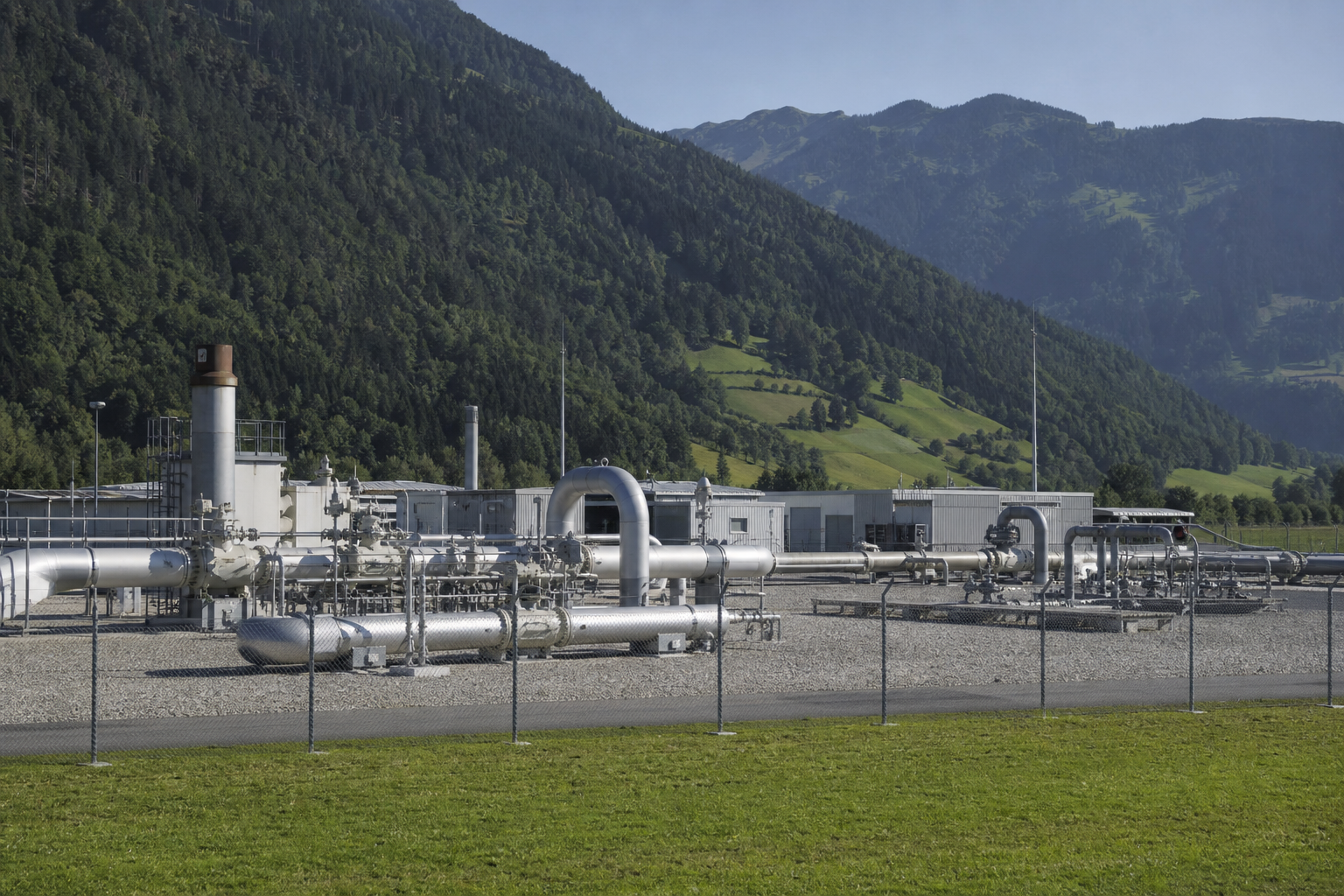
The concrete answer has an unlovely name. ITA.SWAPtion.26, announced on 20 August, would allow Switzerland to redirect gas flowing through the transit pipeline from France to Italy, sending it north instead, if imports via Germany were disrupted. Available from October 2026 to March 2027, the mechanism could cover around 10 per cent of Swiss winter demand and is aimed primarily at industrial and commercial consumers.
The logic is geography. Switzerland has no gas production, no LNG terminal and no storage of its own; every cubic metre arrives through its neighbours, and the main artery runs through Germany. The Italian transit line is the spare route, and spare routes are only useful if someone has paid to make them available before they are needed.
The electricity side offers the brighter contrast. Reservoirs recovered to 84 per cent of capacity after the late August storms, and the winter reserve arrangements agreed after the last crisis are in place. Gas is the exposed flank, used for heating by roughly one household in five and by industries that cannot easily switch.
Utilities stress that a normal winter, with normal German transit, would make ITA.SWAPtion.26 an insurance policy never claimed. A long cold spell, a supply interruption or another escalation around Hormuz would change that quickly, and the price of claiming it would be set by a market already 130 per cent above January.
Bern’s planners are candid about the limits. Ten per cent of demand is a cushion, not a shield. The rest of the answer is the familiar Swiss triad: save where possible, buy early, and hope the winter is kind. The gas is not Swiss, and neither is the pipeline. But the winter is.