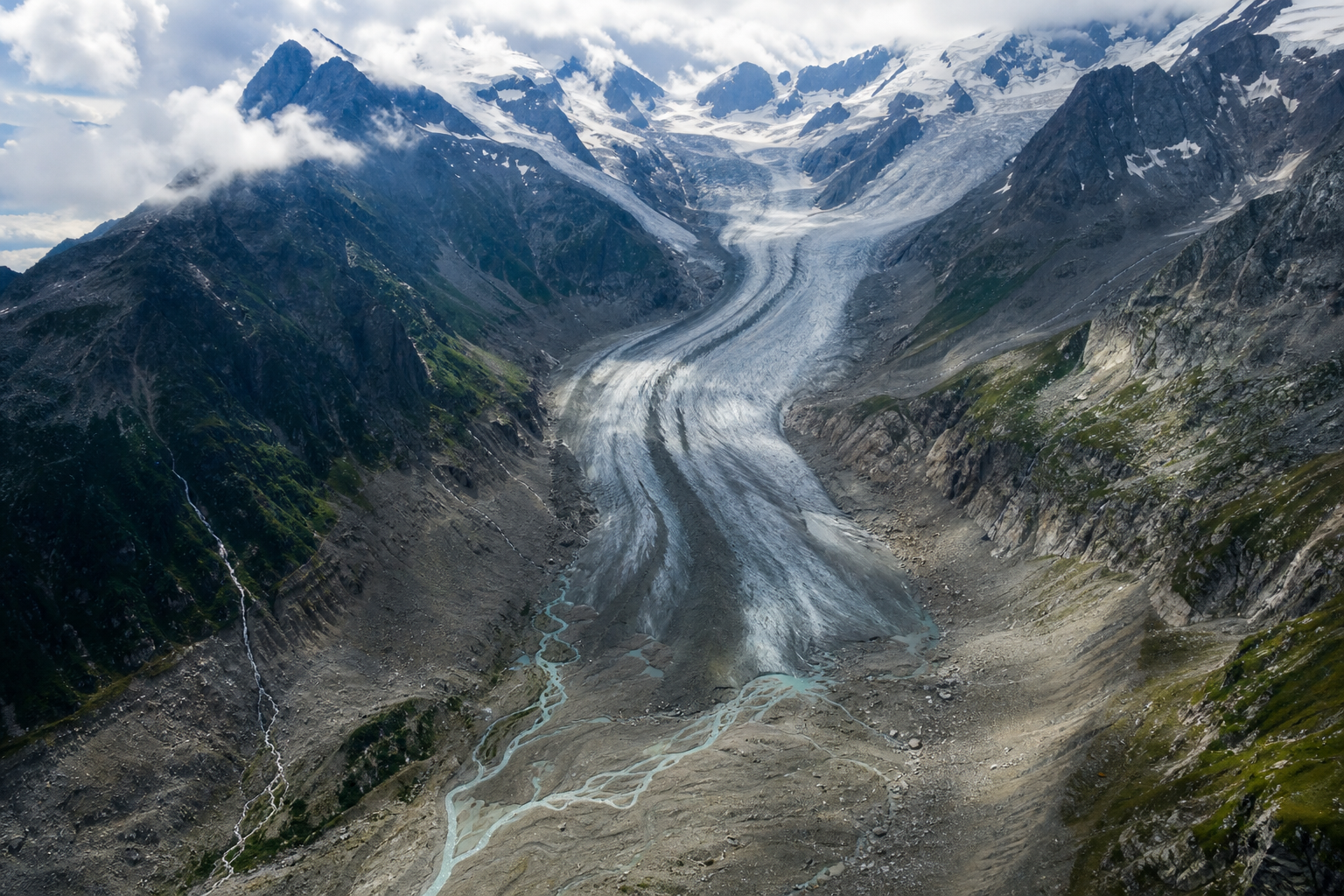
BERN. By the last week of September, when field teams read the ablation stakes for the final time this season, the Rhone glacier had surrendered another slice of itself to the sun. Across the monitoring network the story repeated itself: a summer that began with thin winter snow and ended with ice laid bare from the Ticino valleys to the Bernese Oberland.
The GLAMOS programme, which tracks more than a hundred Swiss glaciers, puts the season's loss at roughly two and a half per cent of remaining volume. That is less than the catastrophic melt of 2022, when six per cent vanished in a single year, but it extends a run in which the country has given up close to a quarter of its ice in barely two decades.
The mechanism is no longer mysterious. Warmer air lifts the altitude at which snow can survive the summer, exposing darker, older ice that absorbs more sunlight and melts faster in a self-reinforcing cycle. MeteoSwiss recorded the freezing level above 5,000 metres on several days this summer, a threshold that was once considered exceptional.
What vanishes at 3,000 metres does not remain an alpine matter. Glacier meltwater sustains the late summer flow of the Rhone and the Aare precisely when rain is scarcest, topping up reservoirs and cooling the rivers from which irrigation channels run down into the Valaisan vineyards and orchards.
Federal policy has moved more slowly than the ice. The monitoring programme runs on a modest budget shared between the universities and the federal offices, while the larger adaptation strategy, covering water allocation and hazard planning, is still working its way through cantonal consultation and parliamentary committees. The Federal Office for the Environment has promised a consolidated water strategy by the end of the decade, though officials concede that measurement will always outpace legislation.
In Valais the politics of meltwater have become practical. Communes that once quarrelled over grazing rights now negotiate over who may draw from shrinking streams in August, and the canton has begun to map priority uses, with drinking water first and snowmaking for ski slopes, controversially, well down the list. A pilot scheme for shared reservoirs between neighbouring communes is being drafted in Sion.
The direct costs of measuring the decline are small: a few million francs a year for stakes, lasers and survey flights. The costs of living with it are not. Insurers and cantonal engineers are repricing flood and debris flow risk in valleys where destabilised moraines now hang above roads, railways and, in a few places, entire villages.
“People ask when the glaciers will be gone, and I have stopped pretending the question is abstract,” said a glaciologist at ETH Zurich who has surveyed the same stakes for twenty years. On current trajectories, the researcher added, many of the smaller Valais ice bodies will not see out the middle of the century.
The ecological consequences compound quietly. Cold adapted invertebrates are retreating upslope with the meltwater streams they inhabit, proglacial lakes are forming behind moraines of uncertain stability, and fine sediment once locked in ice is washing into reservoirs, consuming capacity that hydropower operators can ill afford to lose.
The next formal reckoning comes in spring, when the winter snow balance is weighed against the melt season to come. A heavy winter can disguise the trend for a year. The teams no longer expect it to reverse. MeteoSwiss seasonal outlooks, watchful for a repeat of the blocking highs of recent summers, feed the cantons' water planning from May onwards.
Beyond Switzerland the same instruments are reading the same verdict in Austria, Italy and France, where alpine states have begun to coordinate water planning as the ice reserve of the Alps dwindles. The Swiss figures matter disproportionately, because so much of Europe's river water begins in these catchments.
For now the stakes go into the ice each March and come out again each autumn, and the columns of figures lengthen. The glaciers, indifferent to policy cycles, are keeping their own accounts.