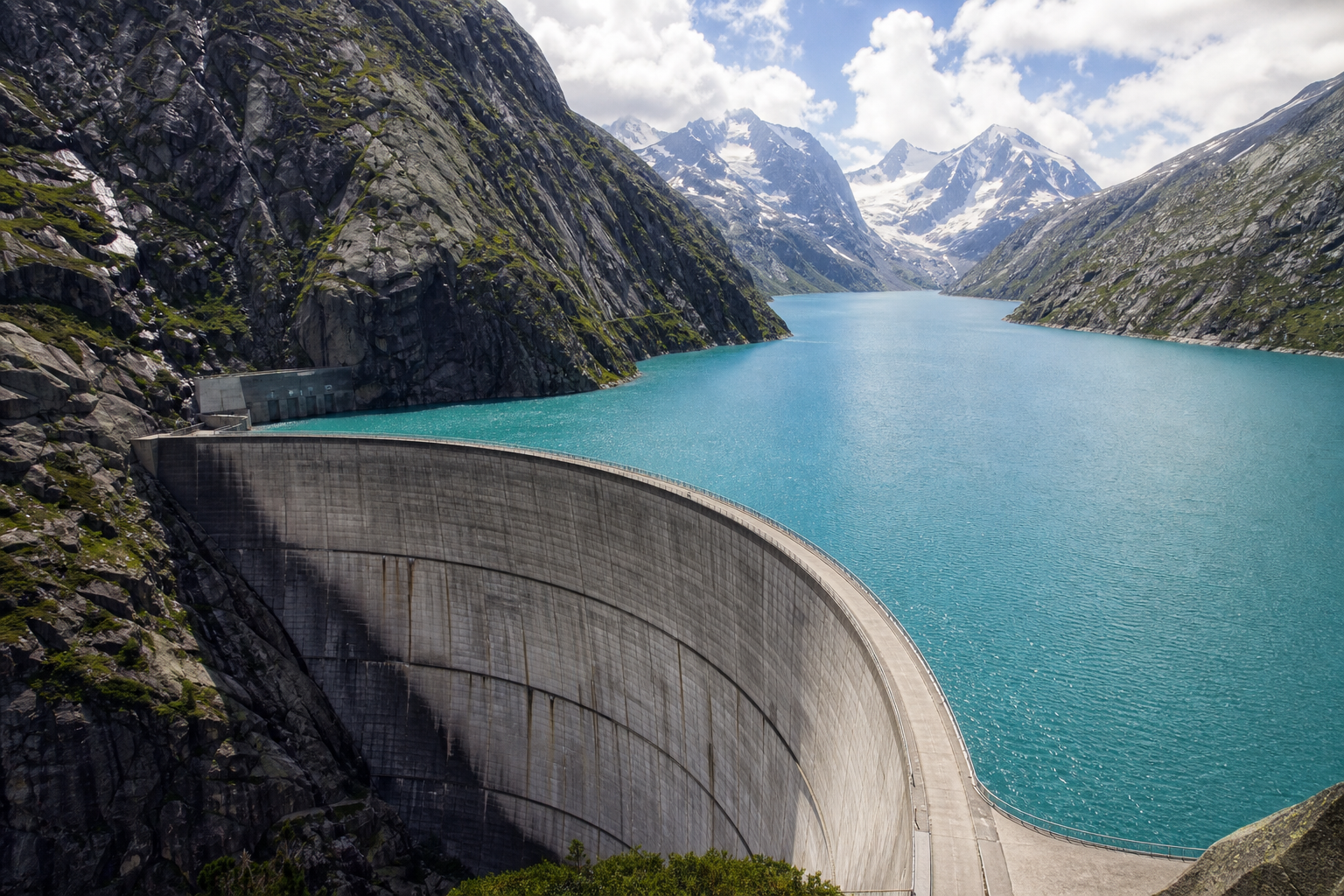
BERN. On the wind-scoured plateau above the Val d'Hérémence, where the Dixence once ran milky with ground rock, Swiss engineers are confronting a paradox of their own success. The great dams of the Alps were built to harvest the melt of a frozen landscape, and that landscape is now melting on a schedule the concrete was never designed for.
The Federal Office of Energy counts storage capacity of roughly 4.4 billion cubic metres across the country's reservoirs, the strategic reserve that carries the grid through dark and windless weeks each winter. As the glaciers retreat up the valleys, inflow that once arrived reliably in high summer is shifting into spring, when demand is low and the turbines of the Rhone valley are already turning.
The answer taking shape in canton Valais is altitude. Projects on the drawing board include raising the Grimsel system in the Bernese Oberland, adding some 20 metres to the Mauvoisin dam and creating new storage at Trift, on ground the Trift glacier still occupied a generation ago.
Hydropower supplies close to 56 per cent of Swiss electricity in a normal year, and the operators argue that every metre of additional dam height buys flexibility. Water held back in October can be released in January, when imports from France and Germany command their highest prices and the national margin is thinnest.
The engineering is less exotic than the setting. Raising a gravity dam means new concrete keyed into old, fresh anchor galleries and a construction season that runs from the last spring snowmelt to the first autumn storm. At Grande Dixence, at 285 metres the tallest gravity dam in Europe, crews already work in conditions closer to mountaineering than to building.
The policy scaffolding is the federal Energy Act, which offers investment contributions for large hydropower, and the winter reserve, under which the state pays plants to hold water back for the cold months. Parliament has signalled support for faster approval of alpine storage schemes, though every project still faces cantonal environmental review and the near certainty of appeal.
Local politics are finely balanced. Communes prize the royalties, which can run to several million francs a year for a valley municipality, yet they live with the heavy lorries, the blasting and the sight of fresh concrete against a familiar skyline. In Hérémence and in the Fieschertal, recent votes on ancillary works have passed by narrow margins after long and occasionally ill-tempered assemblies.
The costs are formidable. The Mauvoisin raise alone is priced in the hundreds of millions of francs, and the wider programme across Valais and Graubünden is counted in the low billions spread over two decades. Axpo, Alpiq and the cantonal utilities are expected to carry the burden, recouped through the market and, where projects qualify, through federal contributions.
“We are buying time with concrete, because the glaciers will not wait for a planning appeal,” said a senior engineer involved in the Valais schemes. The remark captures the industry's temper: urgency laced with caution, since a misjudged investment in a drying catchment could strand capital for a century.
The environmental stakes cut in both directions. Higher dams flood more alpine pasture and alter the sediment flows on which fish and downstream wetlands depend, yet regulated releases can also steady rivers during heatwaves, as operators demonstrated in the drought summer of 2022. Cantons are demanding guaranteed ecological flows in every new licence, and the negotiations over cubic metres per second are as intricate as the concrete design.
The next milestones are administrative rather than spectacular. Environmental impact assessments for Mauvoisin are expected to conclude within two years, and construction could begin late this decade if the appeals process permits. Austria and France face the same arithmetic in their own high valleys, and Swiss planners read their filings with close attention.
Whether the race is won will not be measured in years alone. It will be measured in metres of water held against the season, and in whether a country that built its prosperity on white gold can keep enough of it in reserve for the winters after the white has gone.