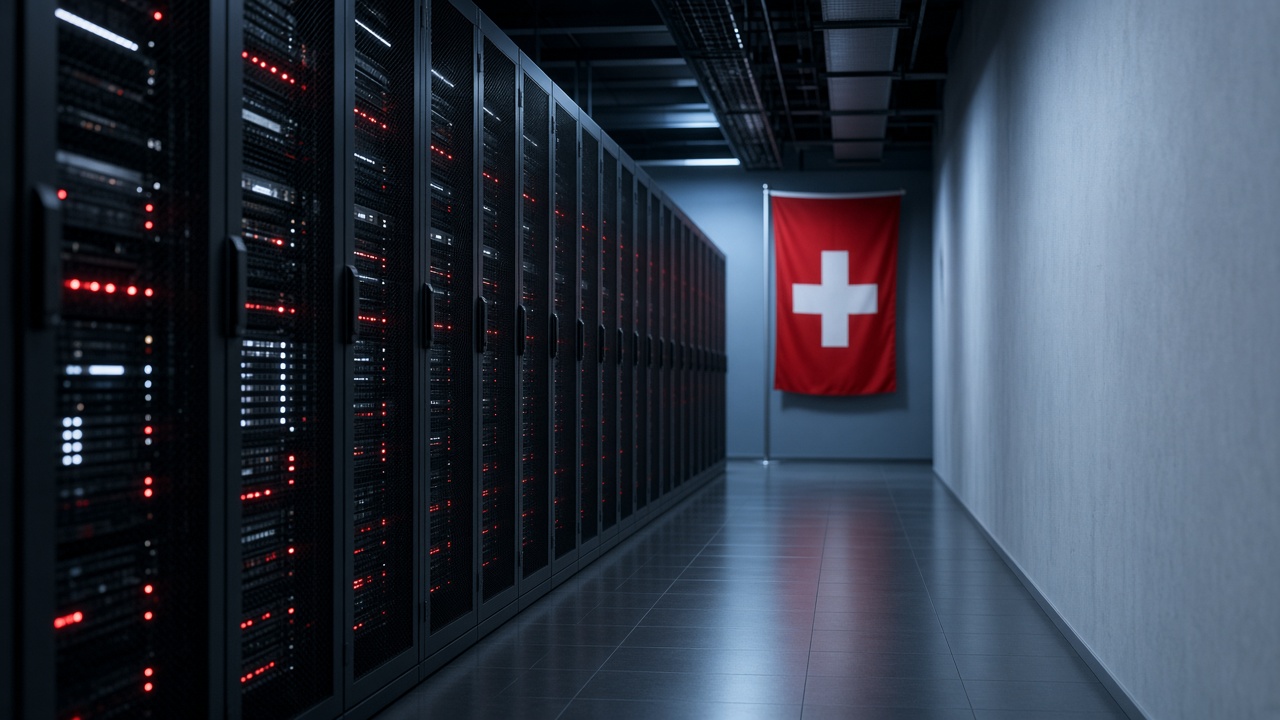
GENEVA. On 27 September, Swiss voters decide whether a strict definition of neutrality should be written into the constitution. Running alongside that argument is a harder one, conducted mostly in Geneva think tanks and Zurich laboratories: what does neutrality mean when the decisive weapons of the century are not armies but artificial intelligence, cloud services and digital infrastructure, almost all of them controlled by the United States and China?
Jean-Marc Rickli, head of global and emerging risks at the Geneva Centre for Security Policy, states the problem without decoration. If you are in the middle, you get caught in the crossfire. The two powers are accelerating the development of ever more capable AI systems, he says, even at the expense of security, and the rise of autonomous agentic models, systems able to plan and act without human intervention, makes the danger of mistakes and escalation tangible in a way the world has not faced before.
Maxime Stauffer, co founder of the Simon Institute for Longterm Governance in Geneva, describes a quieter collapse. States and non state actors have exchanged cyberattacks for years, he notes, under a rough equilibrium between offence and defence. AI is now breaking that equilibrium. The result is a threat landscape that shifts faster than the diplomacy meant to contain it.
Neither capital shows interest in slowing down. President Donald Trump says openly that whoever wins AI wins, and that he intends the United States to keep its lead. Beijing dismisses calls for restraint as fearmongering from a Cold War playbook. The Swiss State Secretariat for Security Policy has written its own concern into the record: the growing influence of American and Chinese companies over the economic and military capabilities of states, it says, is jeopardising strategic stability.
The law, at least, is clearer than the politics. Marco Roscini, professor of international law at the University of Westminster and a specialist in neutrality and armed conflict, points out that the law of neutrality was codified before cyberspace and still binds: the UN Charter, the Hague Conventions and the Geneva Conventions apply whatever the technology, a point the International Court of Justice established in 1996. For Switzerland that carries a concrete obligation. In a war between the United States and China, Bern would have to take feasible measures to stop either side conducting hostilities from infrastructure on Swiss territory. Cyberspace, Roscini says, is not an abstraction. Clouds, cables, satellites, data centres and servers all have a physical location.
The deeper dilemma, argues Eugenio Benincasa, a senior cybersecurity researcher at the Center for Security Studies at ETH Zurich, is not neutrality at all but sovereignty. The law of neutrality binds the state, not private companies, and Switzerland has always traded with belligerents while remaining formally neutral, as it did during the Second World War. Its relationships with Washington and Beijing follow the same pattern: substantial business with both, alignment with neither. But dependence on foreign technology, he says, limits the country’s room for manoeuvre, whatever the constitution says.
His prescription is selective rather than total. Switzerland should reduce dependencies in the most sensitive sectors: critical infrastructure, public administration, defence, intelligence and healthcare. Where Swiss alternatives do not exist, it should prefer European ones. In practice, asymmetric assessments are already made: several Swiss public institutions, the armed forces among them, have decided against Palantir’s data analytics software over sovereignty concerns, while Chinese telecommunications equipment has proved far harder to replace. Complete technological independence, Benincasa says, is a utopia.
Where neutrality may still pay is the oldest Swiss trade: the table and the room. Stauffer argues that Switzerland’s status still creates space for high trust dialogues that others cannot easily host, citing communication channels for incidents involving autonomous systems and red lines on the use of AI against critical infrastructure as candidates. The foreign ministry has not confirmed any official Swiss mediation between Washington and Beijing on artificial intelligence. It rarely confirms such things early, or at all.
The vote on the 27th will settle the constitutional question, and the final poll says it will be settled by a wide margin. It will not settle the technological one, which tightens regardless: Brussels is already warning that a strict reading of neutrality would complicate sanctions alignment, while Swiss exporters squeezed from the west are looking east again. Neutrality was written for territory. The question of this century is whether it covers the cable, and Switzerland is answering it one procurement decision at a time.