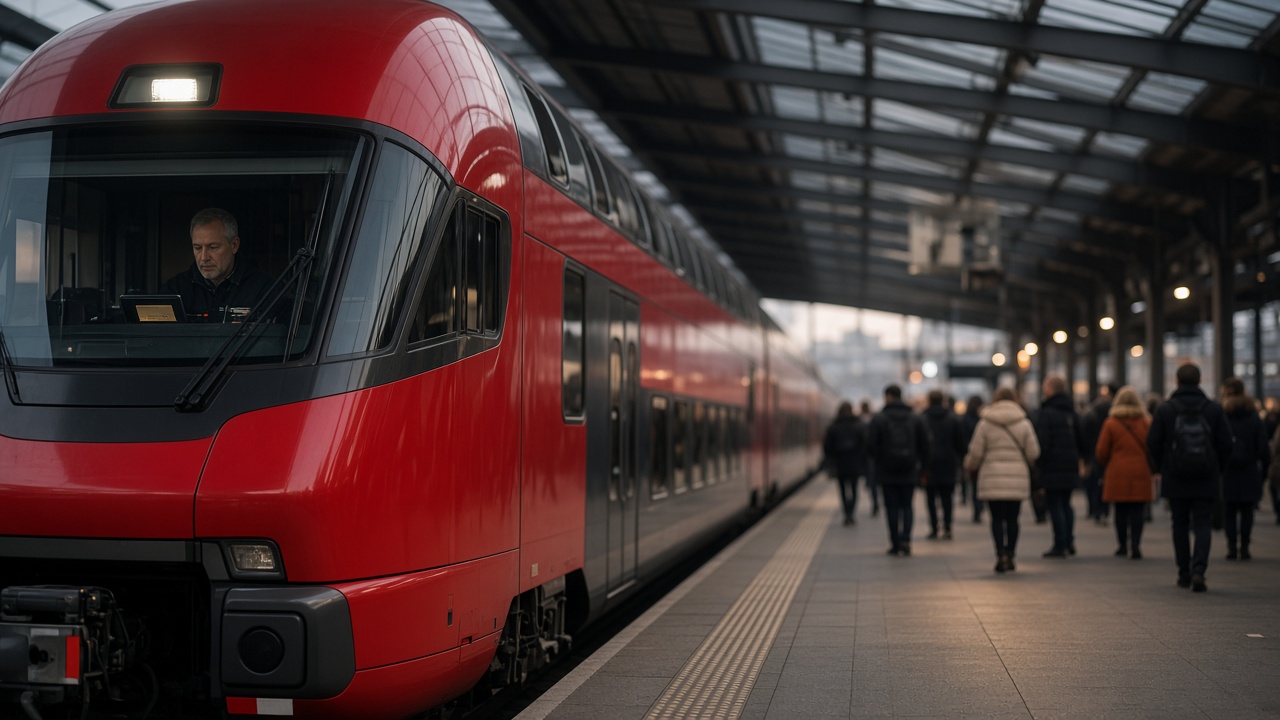
BERN. Digitising the Swiss rail network by 2045 will cost about CHF 7 billion. Swiss Federal Railways and the Federal Office of Transport confirmed the figure on Thursday, after a report in the Neue Zürcher Zeitung. The number is not a new project invented this week. It is the bill for a strategy the federal office has already ordered, and it is several times the sum currently written into the next expansion step.
That step is the 2027 message, which sets aside CHF 1 billion for digital rail infrastructure. SBB called it an important first step and said it is nowhere near enough. On the company’s reckoning, the following stage in 2031 needs a further tranche of about CHF 6 billion. The demand is that parliament be told the whole sum at the start, rather than discover the rest of the bill once the first billion is spent.
Signals that move into the cab
The work is the European Rail Traffic Management System, and in practice it means cab signalling, ETCS Level 2, on the main network. Drivers would see the information they now take from lineside signals on a display in the cab, in real time. Trains can then run closer together. A layer of partial automation, closer to a car’s cruise control than to a driverless railway, can smooth speed and save energy. The federal office’s phrase for the prize is technology instead of concrete: more capacity, or a more stable timetable, without building a new track for every extra train.
SBB spokeswoman Fabienne Thommen said the benefit appears only when the pieces work together. Cab signalling is one piece. The others are a new railway radio, digital interlockings, and a link between the infrastructure and the trains themselves. A large part of the safety-critical equipment is due for replacement anyway. The argument from the railways is that replacing it like for like, and digitising it later, would waste the one moment when the kit has to be changed.
Where it already runs
Parts of the country are already on cab signalling: the Lötschberg, Gotthard and Ceneri base tunnels and their approaches, stretches by Lake Geneva, the Valais, and the line between Olten and Bern. The federal office approved a joint implementation plan from the rail companies at the end of 2025. The full main network is expected to take about thirty years. Metre-gauge and special lines are on the same road, with equipment adapted to them.
Andreas Windlinger, speaking for the federal office, called the SBB cost estimates plausible. The draft of the Verkehr ’45 programme puts CHF 1 billion toward cab signalling in each of the 2027 and 2031 stages. He said the extra money depends on voters agreeing to continue the VAT per-mille that funds rail infrastructure. The rest of the digital bill, on the office’s account, would come through the ordinary service agreements that pay for maintenance and renewal, so the expansion pot itself would not shrink.
Passengers will not see a new train from this. They are meant to see a timetable that holds, and fewer weekends lost to the replacement of old signal boxes one at a time. The GA travelcard still rises in December. The digital railway is a longer invoice, and Thursday’s confirmation was that the invoice has a total on it: about CHF 7 billion, most of it not yet in a bill before parliament.