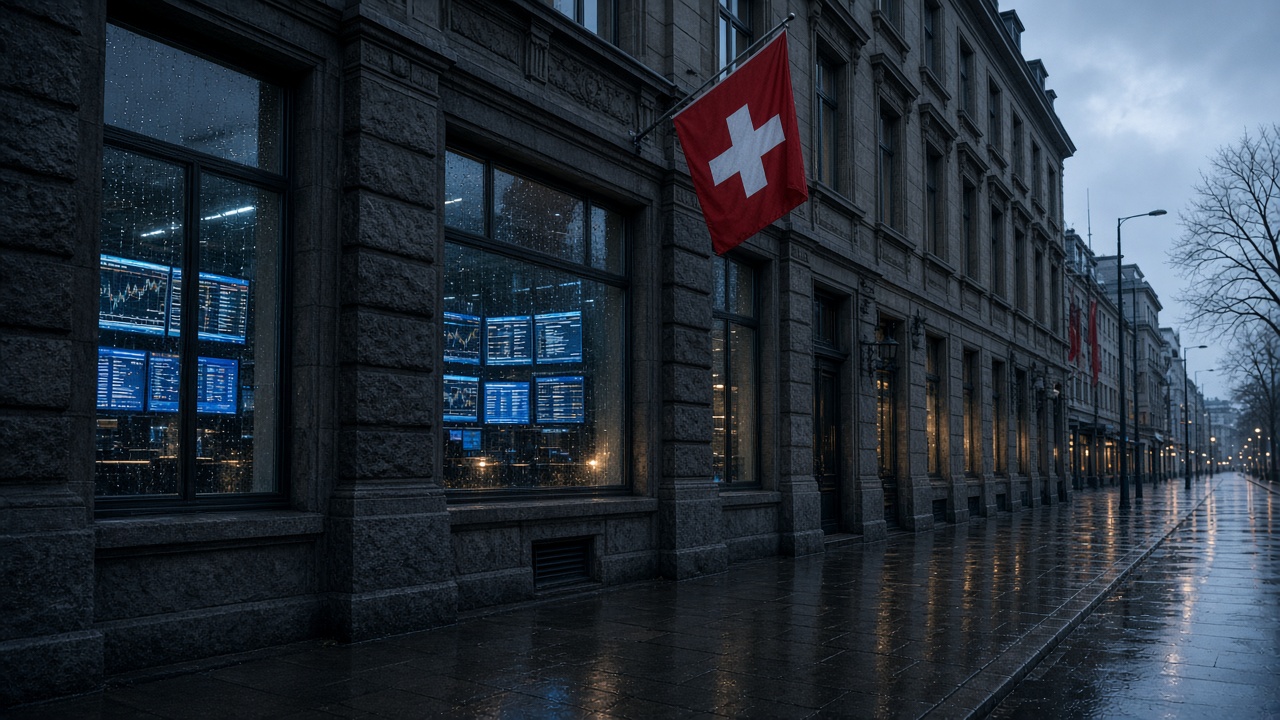
ZURICH. The Swiss franc held its ground on Thursday after the Federal Reserve left American interest rates unchanged and declined to promise what comes next. USD/CHF traded around 0.8285 in European morning dealing, a little below Wednesday’s peak of 0.8313 and still above the 0.8270 area that had capped the dollar earlier in the month. For Swiss exporters that is a small mercy. For anyone waiting on a weaker franc, it is not a turn.
The Fed’s decision on Wednesday was the one markets had priced, by a vote of 10 to 2. The target range stays at 3.75 to 4 per cent. Governors Lisa Cook and Beth Hammack dissented in favour of a rise. The statement described an economy growing at a “strong pace” and conceded that inflation is “still elevated”. Chair Kevin Warsh then told reporters he believes inflation can be brought back to 2 per cent without, in his phrase, throwing sand in the gears of growth or pushing unemployment up. He would not confirm a move in December.
A hold that was read as slightly softer
Traders had wanted a steer and did not get one. The refusal to guide December was taken as less hawkish than the dissenters, and the upgraded growth line, might have implied. Bets on rate rises in 2027 were trimmed. A December rise is still the favourite, priced near a 78 per cent chance, but it is no longer treated as a promise. The dollar index sat around 102.3. The euro was near $1.114. Two-year Treasury yields eased during the press conference. Into Wednesday’s decision the franc had already given back part of Monday’s gain. Thursday did not hand it back.
Swiss data did not help the currency either. The ZEW survey of economic expectations, published on Wednesday, fell in October to its weakest since March. That is a six-month mood, not a print on output, but it lands while the National Bank is still at a zero policy rate and in no hurry to move. A softer Swiss outlook and an American central bank that can wait is a mix that usually leans against the franc. This week it has only leaned.
Zurich opens higher, with two Swiss records
The SMI was up about 1 per cent in the morning, trading around 14,700. Novartis and Sandoz printed fresh record highs. UBS, a day after a $2.7 billion quarterly profit and a faster buyback, was bid, up close to 1 per cent and near CHF 39. The index is not celebrating a change in Swiss rates. It is pricing an American pause, a set of results that did not disappoint, and the hope that the next central bank in the diary does the same.
That central bank is the European Central Bank, which announces at 14:15. The deposit rate is expected to stay at 2.50 per cent, even with inflation in the euro area still high. Christine Lagarde’s press conference will be watched for the path, and for the side question of her own future. She has said she will not leave before 2027. Her regular term runs well beyond that. Markets have speculated anyway about an early move to the World Economic Forum. A surprise on rates would move EUR/CHF. A confirmation of the hold would leave the franc where the Fed left it.
Oil eases, which matters more than it looks
Crude was the other Swiss-relevant price on Thursday morning. Brent and WTI fell by about 1.5 per cent, to around $113.60 and $101 a barrel, after the Wall Street Journal reported that Vice President JD Vance had written to Mohsen Rezaei, secretary of Iran’s Supreme National Security Council, in an attempt to revive talks. Prices had risen on Wednesday after a Houthi attack on the Ras Tanura refinery in Saudi Arabia, a reminder that the war under way since late February still has a second front. Cheaper oil, if it lasts, takes a little pressure off Swiss inflation and off the National Bank’s reason to worry. It does not, by itself, set the franc.
The level that matters today is still the one on the screen: about 0.83 dollars to the franc, a dollar that has stopped climbing for a moment, and a Swiss equity market willing to rise while it waits for Frankfurt. The National Bank meets in December. Between now and then the franc will take its cue from whatever Warsh and Lagarde decide they are prepared to say out loud.