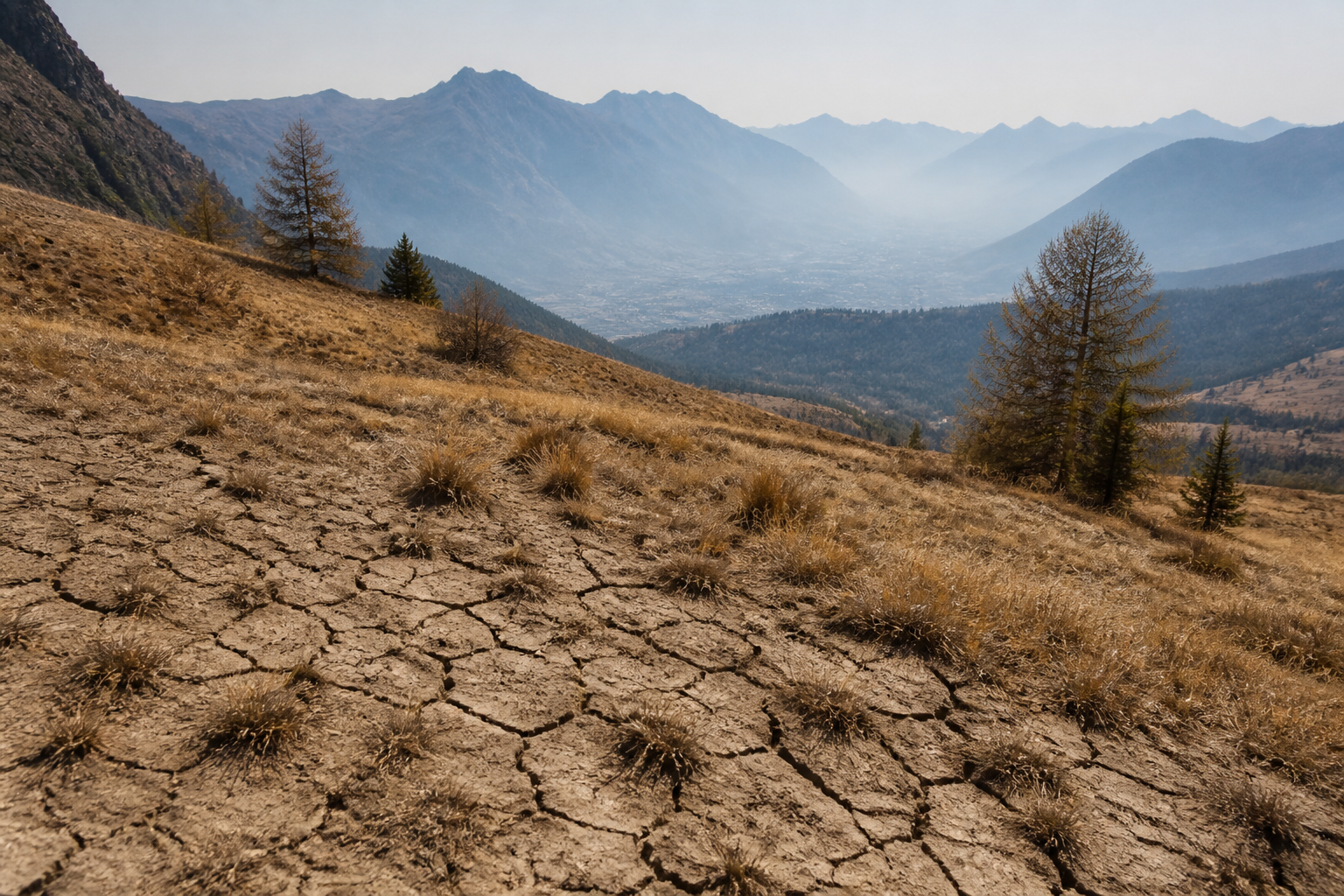
BERN. At 3,000 metres above Zermatt, the legs of a cable car pylon stand in ground that has been frozen for millennia. That ground is warming, and with it are warming the assumptions on which a century of alpine construction was erected.
The measurements are unambiguous. The PERMOS monitoring network, which reads borehole temperatures and creep rates at high altitude, has logged warming at depth across the decade, and the active layer, the ground that thaws each summer, is deepening. Hot summers now reliably coincide with clusters of rockfall along the great faces. At some boreholes the warming at ten metres of depth now approaches half a degree per decade, beyond anything the instruments recorded in the 1990s.
The physics is simple and unforgiving. Ice acts as the cement in steep alpine rock and debris; as it thaws, slopes that have stood since the last glaciation begin to move. The collapse that buried much of the Valaisan village of Blatten in 2025, though a glacier event rather than pure permafrost, concentrated minds across the mountain cantons on the same underlying driver.
Policy is scrambling to catch up. Cantonal hazard maps, the documents on which building permits and insurance rest, are being revised to incorporate thaw, and federal guidance for construction on frozen ground, once a specialist footnote, is becoming standard reference for engineers. Insurance companies, which fund part of the national natural hazard research, have made clear that premiums in the mountains will follow the maps.
The inventories are sobering. Valais and Graubünden have catalogued hundreds of installations on or near permafrost: lift pylons, mountain huts, avalanche barriers, masts and water pipelines. The mountain railways association is funding its own studies, and hut wardens have been trained to report leaning door frames.
The remedies are bespoke and expensive. Foundations can be anchored deeper into bedrock, thermosyphons can passively draw heat out of the ground to keep it frozen, and in the worst cases infrastructure must be moved. The Monte Rosa hut, completed in 2009 with a foundation designed for changing ground, is now cited in engineering lectures as the shape of the future. Monitoring a single critical pylon with sensors and annual surveys costs tens of thousands of francs a year, cheap against the price of a failure.
The bill lands on many desks. Lift companies fund their own pylons, cantons and communes pay for protective works, and the federal government contributes where the public interest in safety is direct. A serious retrofit at a single lift station can cost millions of francs.
“We used to design for a frozen foundation; now we design for one that thaws,” said a permafrost researcher involved in the monitoring network. The sentence, the researcher added, now opens most conversations with engineers.
The stakes are measured in lives as well as money. Huts close when their ground becomes suspect, hiking routes are rerouted away from unstable faces, and the tourism economy of the high valleys, already shifting its season, must now price in vigilance as a permanent cost. Search and rescue services have adjusted their own protocols, treating hot spells in the high mountains with the caution once reserved for storms.
What happens next is better maps, and more of them. The cantonal hazard map revisions are due within the next few years, satellite radar is being added to the monitoring toolkit, and a prioritised retrofit programme for the most exposed installations is under discussion between the cantons and the federation.
The problem is alpine, not Swiss. From the Ötztal to the Mont Blanc massif, the same thaw is undermining the same kinds of infrastructure, and the alpine clubs and engineering societies of four countries now share data as a matter of routine. France has begun a national audit of lifts on frozen ground, and Austria's provinces have made permafrost checks a condition of new lift concessions.
The mountains, engineers like to say, were never as solid as they looked. The task of the coming decades is to build for the mountain as it is becoming, not for the one on the postcards.