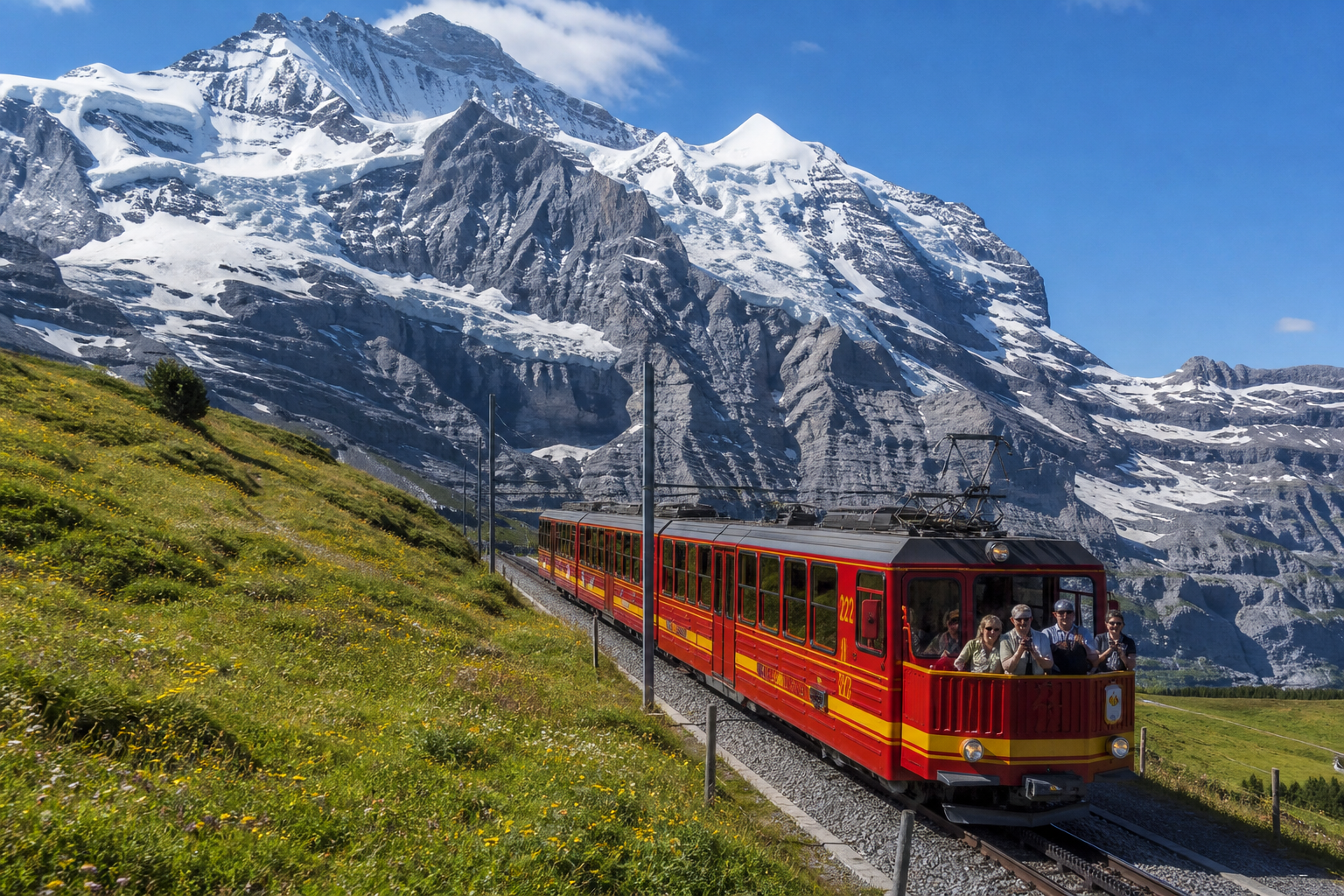
INTERLAKEN. Switzerland’s best known mountain railway group has confirmed what the empty seats on its trains suggested all spring: the war in the Middle East is cutting deep into alpine tourism, and the Jungfrau Railway Group expects the conflict to leave a visible mark on its 2026 result.
Presenting its half-year assessment on Friday, the Interlaken-based group reported visitor numbers down 5.7 per cent across all three of its business segments in the first four months of the year. The Jungfraujoch, the “Top of Europe” and the company’s flagship, suffered most, welcoming 181,900 guests, a fall of 12.3 per cent on the same period of 2025.
The Experience Mountains segment, which includes Grindelwald-First and the Harder Kulm funicular above Interlaken, counted 216,900 visitors, down 9.6 per cent. Winter sports held up best, with 932,200 skier visits between January and the end of April, a decline of 3.3 per cent on the previous season.
The company names its reasons without hedging: the ongoing hostilities, the airspace restrictions that come with them, rising kerosene prices and growing uncertainty, particularly in the Asian markets that supply the Jungfraujoch’s tour groups. When long-haul connections through the Gulf wobble, the effect arrives in the Bernese Oberland within weeks.
The timing could be worse, and in 2025 it was. Last year the group welcomed a record 3,909,700 guests across its operations, and the Jungfraujoch passed a million visitors for the seventh time, with group travel back at pre-pandemic levels and China largely returned. That cushion matters now: the group describes bookings for the coming months as good and points to a customer base spread across more markets than a decade ago.
Management nonetheless warns that, depending on the duration and intensity of the conflict, the 2026 business result will suffer. The medium-term financial targets to 2030, reaffirmed in January, formally stand, but the company concedes they are unlikely all to be met in the current financial year.
The wider industry is watching the same sky. Swiss tourism economists have spent the summer trimming forecasts for arrivals from Asia and the Gulf, and hotels from Lucerne to Zermatt report the same pattern as the railways: Europeans and Americans keep coming, the long-haul tour group does not. For operators whose fixed costs do not move with demand, a soft summer cannot be made up in autumn.
There is a stubborn consolation available in the Bernese Alps. The product being marketed, snow on the Jungfrau in a warming world, is not getting easier to find elsewhere, and the group’s 2030 strategy assumes exactly that scarcity. The mountains are unchanged. The flight paths that feed them are not.
The full half-year report, with the first revenue and profit assessment of the war’s cost, lands at the end of August. Investors will read it for one number above all: how much of the missing 12.3 per cent the summer has managed to win back.