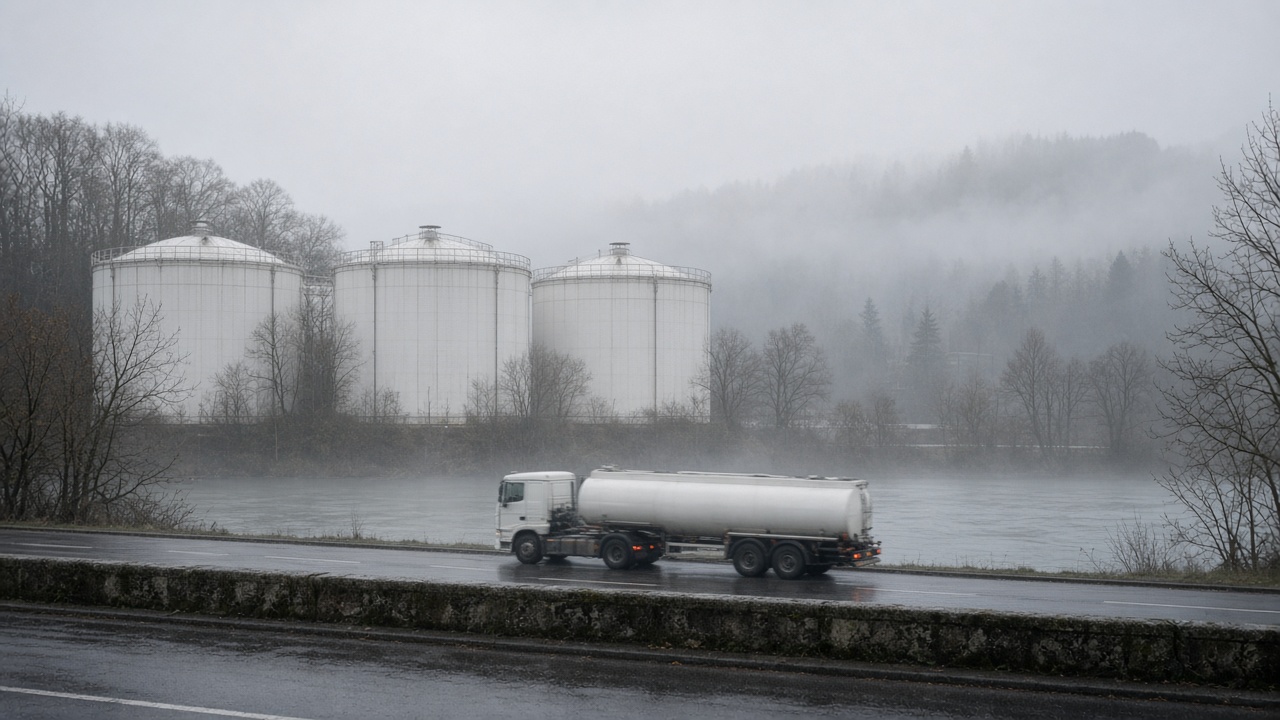
BERN. The federal supply office has opened Switzerland’s heating oil reserve. On Tuesday the delegate for national economic supply, Roland Pfister, authorised withdrawals of up to 30,000 cubic metres, about 30 million litres, until 6 December. That is roughly 2 per cent of compulsory heating oil stocks. He also raised the diesel quota by 30,000 cubic metres, to 75,000 cubic metres in all. The Federal Office for National Economic Supply said further volumes may be taken until 6 December.
The reason is not an empty market. It is a low river, and refineries abroad that are not delivering on time. The office said transport is jammed because the Rhine has been low for months, and because foreign refineries, particularly in Germany and France, are short. Rhine barges and the refinery at Cressier, in Neuchâtel, are the country’s two main routes for mineral oil. When the barges can carry only part of a load, or cannot sail, the other carriers, rail and road among them, are pushed to their limit.
This is the fifth time since September that compulsory oil stocks have been used to prop up supply. Jet fuel is already being drawn for the airports. Petrol, the office said, is still available, but the supply is tight. At the start of November the same office had described petrol and heating oil as secure and under strain, and heating oil as very tight. Tuesday’s decision is the point at which that strain became a release.
Why the household tanks are the other half of the story
The release is a bridge for the trade, not a refund for the oil people did not buy in the autumn. Dealers had been warning that the danger is a rush. Andreas Flütsch, who runs Migrol, told the Neue Zürcher Zeitung he had not seen the Rhine this restricted for so long in about thirty years in the trade. He said a cold snap, or a further fall in the price, could send owners to order at once, and that the trade would then need the compulsory stocks. Agrola has warned of a risk to diesel and heating oil supply in the coming weeks.
The tanks in the houses explain the timing. One in three residential buildings in Switzerland is still heated with oil. Migrol said nationwide heating oil sales at the end of September were about 30 per cent below the year before. Coop Pronto said private tank levels picked up a little in October and were still below the long-run average. The Migrol price index has roughly doubled since the start of the year. On 14 October it touched CHF 175.20 for 100 litres, the highest in three years, after prices jumped with the war that began in March. Owners waited for a cheaper fill. Winter does not wait with them.
What 30 million litres does, and what it does not
Thirty thousand cubic metres is a large number in a headline and a small share of a national reserve. Two per cent is the office’s own comparison. It is meant to cover a gap of weeks, through 6 December, while barges, rail and the Cressier refinery catch up. It does not refill every delayed household tank, and it does not set the price on the board. Unleaded 95 fell back under two francs a litre on Monday, the first time since early September. Heating oil is a different product, bought by the hundred litres and stored for months. A cheaper petrol price and a tight heating oil supply can both be true on the same Tuesday.
Consumer prices rose 1.5 per cent in the year to October, the fastest rate in almost three years, and heating oil, petrol and diesel did most of the lifting. A release from stocks can keep oil moving. It does not unwind that index. Diesel withdrawals of up to 45,000 cubic metres had already been authorised until 22 November. Tuesday’s step adds 30,000 cubic metres to that diesel quota and opens heating oil on top.
What to do before the cold arrives
Three dates matter more than the percentage. The heating oil permission runs to 6 December. The National Bank’s next scheduled assessment is on 10 December, with October’s oil-driven inflation still the number it has to explain. And the Rhine does not follow either date. If the water stays low and owners order together, the office has already shown it will come back: five releases since September is a pattern. Anyone with an oil tank should treat a delivery slot as the scarce thing, not the last centime on a quote. The compulsory stock is there so that the slot can still be filled. It is not a promise that the price will follow petrol under a round number.