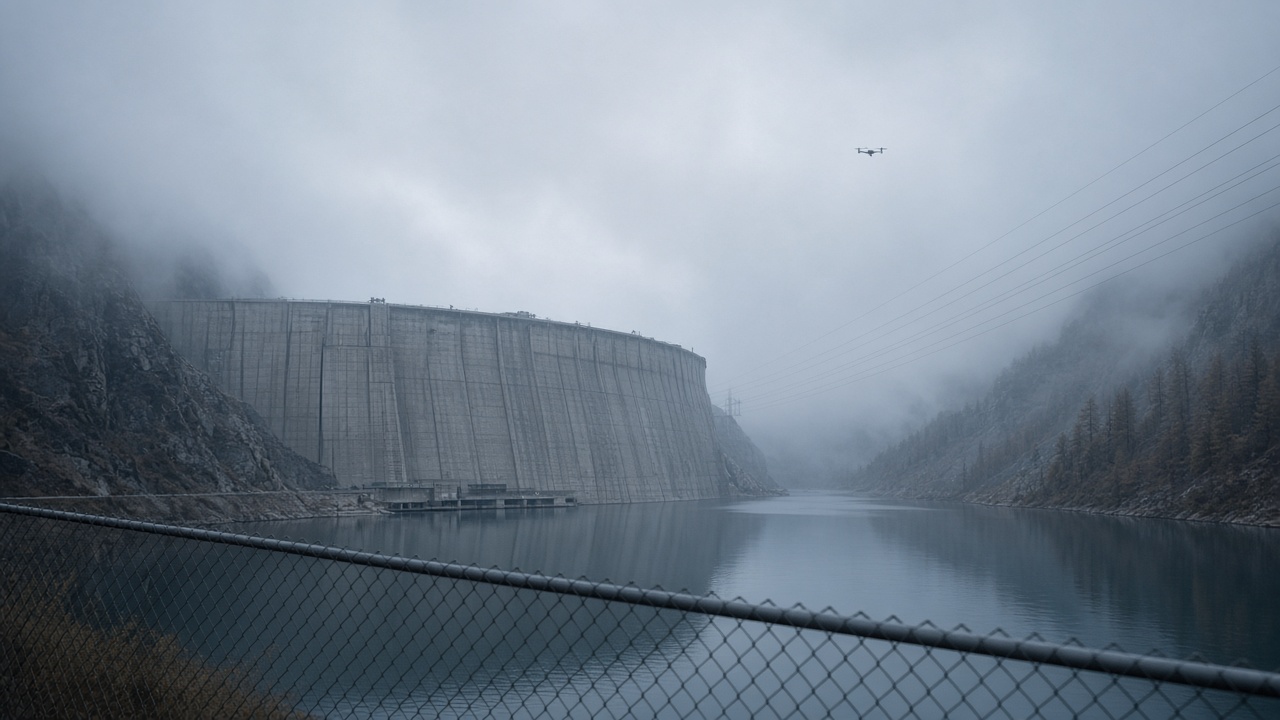
BERN. The federal government is preparing a legal duty for the companies that run critical energy sites to protect them against sabotage and drones. The Swiss Federal Office of Energy told the Keystone-SDA news agency, in an answer published on Tuesday, that it is drafting a framework that would oblige the sector to guard against physical and electromagnetic threats. There is, the office said, no further legal rule today for the physical protection of energy infrastructure. Blick reported the plan first.
The risks the government puts at the top of the list, for nuclear plants and dams, are sabotage, drones, rocket-propelled grenades and arson. That list is a classification of threats, not a finding that any one site is under attack this week. The office said the draft is meant to close gaps. It is not meant to hand companies new powers. The monopoly on the use of force stays with the state.
What an operator may already do
Operators may reinforce buildings, fit sensors and protective nets, and keep spare parts. They may not shoot down a suspicious aircraft, and they may not detain a suspect. If staff see a drone, the lawful step today is to call the police. The practical result, as the reporting describes it, is blunt: by the time officers arrive, the drone is usually gone. That gap, measured in minutes, is what parliamentarians are trying to close. They want the law changed so that, in an emergency, electricity companies could switch on interception drones or jammers.
A jammer or an interception drone is still a use of force, or something close to it, against an object in public airspace. The office’s line is that this is not a licence for a utility to become a second air force. Any change that lets a company do more than telephone the police will have to say who authorises it, for how long, and what happens if the wrong aircraft is stopped. None of that is in force on Tuesday. It is a draft, and a political demand sitting beside the draft.
The army has already drawn its limit
The defence ministry has said before that the armed forces cannot protect every power site from the air. In future the military is expected to be able to hold an area such as the Mittelland, and individual sites, against air attack for weeks at a time. It is not expected to do that everywhere at once. The government’s defence guidelines of May 2026 said that protecting all electricity supply sites to the same high standard, at the same time, will not be possible with the resources and the other tasks of the Swiss Armed Forces. Primary responsibility for protection therefore sits with the operators.
What is still open is who is in charge when an incident sits below the threshold of war: a drone over a dam that is not an attack by another state. The National Council’s security committee has asked for a national reporting centre for drone sightings. A centre would not catch the aircraft. It would stop each canton, each utility and each police force from being the only office that heard about it. Until the law says otherwise, the person who sees a drone over a reservoir still has one step that is clearly legal. Call the police, and do not try to bring the aircraft down.
What changes for people who live near a dam
Nothing in Tuesday’s account switches on a new siren or a new patrol. The change, if parliament accepts it, is about who must harden a site and who may interfere with a drone. Households that depend on the dam for power have an interest in the first half of that. The second half is a question of rights: private staff with a jammer are not the police, and the office has been careful to say so. The useful thing to watch is the text of the draft, when it exists, and whether it draws a line between nets and sensors on one side and weapons on the other. That line is the whole argument.