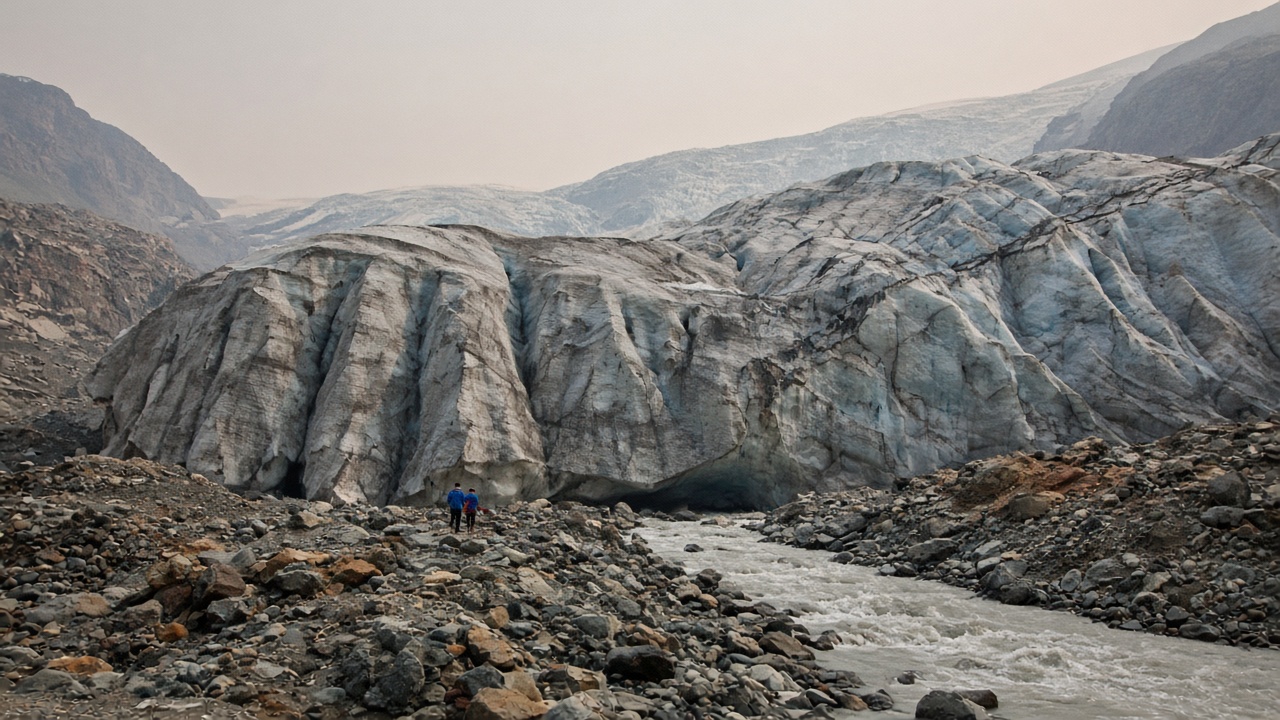
ZURICH. On 29 June, the Rhone Glacier reached what glaciologists call Glacier Loss Day: the moment when the winter’s snow is gone and the glacier begins to shed its own ice. Only once since records began has the day come earlier, on 26 June 2022, the year that rewrote every assumption about Alpine ice. The counting of what followed is still under way.
The concept is bookkeeping with consequences. Snow that falls in winter protects the ice beneath it through the spring; once it has melted away, the glacier itself is exposed to the sun, and every hot day after that is paid for in ancient ice. The earlier the day falls, the longer the glacier’s own body is on the table.
This year the bill arrived fast. One monitoring site on the Rhone Glacier recorded a loss of about 1.5 metres of ice during two weeks of extreme heat, and melt rates across the network ran at nearly twice the 2010 to 2020 average. The drivers were the same pair as always: a meagre winter snowpack, followed by two heatwaves in the hottest summer since 1864.
What the melt means below
The consequences do not stay at 2,500 metres. Meltwater briefly mimicked the extremes of 2022, swelling rivers that were otherwise running at record lows and giving hydropower reservoirs a deceptive midsummer fill. What looks like a gift in July is a loan: ice that flows away as water this year does not flow next year, and the long retreat of the glaciers is a slow revision of how Switzerland stores its water and its electricity.
For the smallest ice bodies, the season is terminal. Monitoring teams expect 20 to 30 small glaciers to disappear entirely this year, unmeasured and mostly unmourned beyond the communes that named them. Even the giants lost metres of ice at low altitude, and the moraine walls they leave behind are becoming unstable in ways mountain communities are only beginning to map.
The science continues regardless. Field teams from ETH Zurich and the GLAMOS network are on the ice now, taking the end of season measurements that will produce the official mass balance in October. Satellites calibrate the picture from above; the stakes drilled into the ice, some of which melted out and had to be redrilled in August, tell it from within.
The long view
Glaciologists are careful people, and their careful conclusion is no longer disputed: even with ambitious climate policy, a large share of the Alpine ice is committed to disappear, and the question is how much can be saved rather than whether any will be lost. Research has shifted accordingly, from documenting the retreat to managing its consequences for water, tourism and slope stability.
Glacier Loss Day is a bookkeeping date that has become a memorial date. It fell on 29 June this year, the second earliest ever recorded. The final numbers arrive in October, and the winter snows, if they come, start the accounting again.