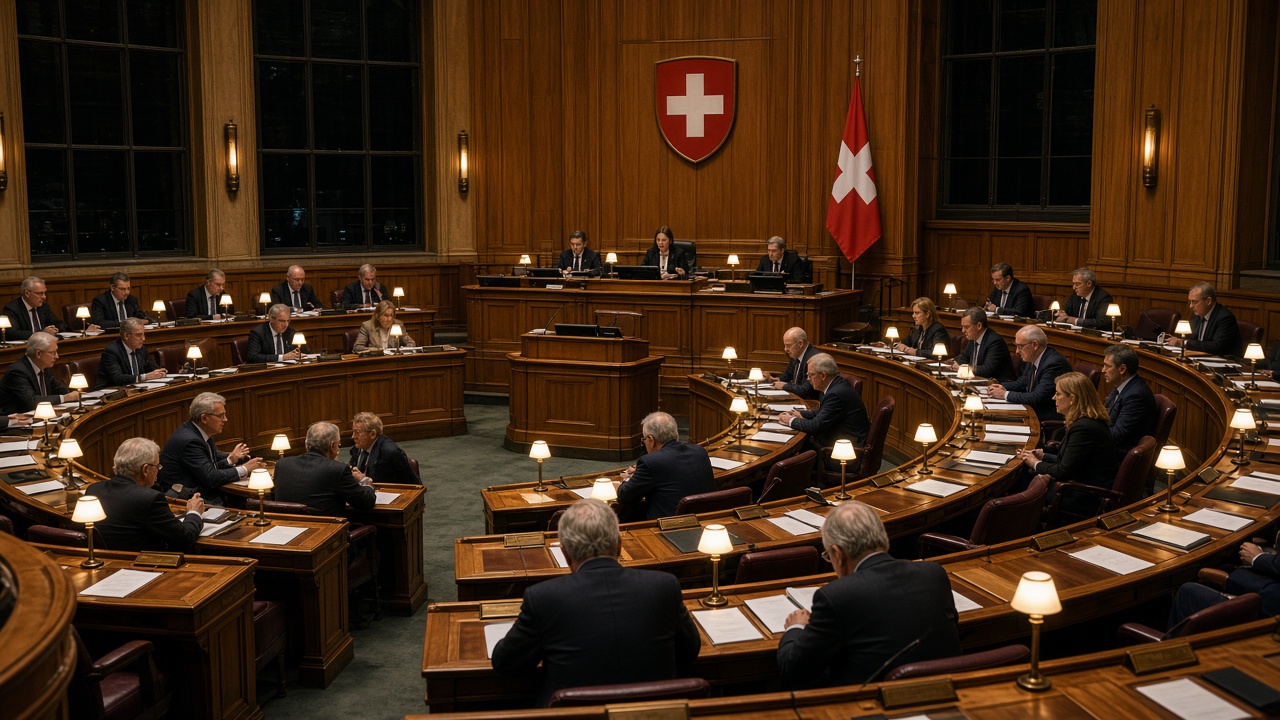
BERN. The Council of States has agreed to consider the biggest treaty package in the history of Swiss relations with the European Union. At 20.41 on Monday evening, after more than five hours of opening debate, the Senate voted 29 to 15 to enter into the detail of the Bilaterals III agreements, rejecting a motion from the People’s Party to refuse the file outright. The decision was never in serious doubt. The size of the minority, and who joined it, is the news.
The entry vote split the centre right down the middle. Against taking up the package stood the closed seven member group of the People’s Party, four German speaking members of the Centre party and four members of the Liberals. For it stood the closed seven member Social Democratic group, the three Greens, the Green Liberal representative, ten members of the Centre and eight Liberals. The government’s coalition held. The conservative wing of the Centre, which includes Peter Hegglin of Zug, Daniel Fässler of Appenzell Innerrhoden and Heidi Z’graggen of Uri, signalled that its support in the detail votes cannot be taken for granted.
Three councillors, one hour of pleading
The weight of the occasion was visible at the government bench, where three federal councillors sat through the debate instead of the customary one. Foreign minister Ignazio Cassis, economics minister and serving president Guy Parmelin, and justice minister Beat Jans shared an hour of closing arguments between them. Their message, in three accents, was the same: parliament cannot renegotiate the text, but it can decide whether Switzerland signs from a position of order or of drift.
The package they were defending was negotiated between Bern and Brussels from March to December 2024. It runs to 94 EU legal acts, 18 agreements and protocols and two joint declarations, covering the renewal of the existing bilateral treaties and new agreements on electricity, food safety and health. Most of it was signed in Brussels on 2 March 2026 by Parmelin and Commission president Ursula von der Leyen. What parliament does with it now is a domestic question, and Monday showed how domestic it has become.
Outside, the People’s Party had called its supporters to the Bundesplatz for an evening protest against what it calls the treaty of submission. Inside, its speakers gave the argument its sharpest form. Bilaterals III is a mislabel, said the SVP’s lead speaker: what lies on the table is a partial accession to the European Union without a voice, a rental contract the landlord may rewrite at will, with the tenant’s electricity cut off if he objects. The image is doing a great deal of work, and the government knows it.
The left’s price is wage protection
The more consequential warning came from the other end of the chamber. The trade union federation’s president, speaking for the Social Democratic group, repeated that the left’s Yes is conditional: if the accompanying measures on wage protection are diluted, the unions will campaign against the package, and the arithmetic of a referendum changes completely. He also confirmed that his side rejects the electricity agreement, which the Senate’s own energy committee has not finished examining. The government needs the unions more than it needs the SVP’s silence, and everyone in the room knew it.
The detail debate now runs through Tuesday and Wednesday, with a night sitting that may last until one in the morning. The contested points are the referendum question, wage protection, immigration safeguards, the dynamic adoption of EU law, state aid rules and the education and research agreements. The procedural question overshadows all of them: whether approval requires a simple majority of voters, or a double majority of people and cantons. On current polling the first is winnable for the Yes camp. The second is a different map.
Monday’s vote landed the day after Swiss voters rejected the neutrality initiative by 70 per cent, a sequence the Federal Council engineered when it scheduled the treaty debate for the morning after the referendum. The wind behind the package is real. So is the caution in the chamber: several senators who voted to enter the debate said they were voting to improve the accompanying law, not to bless the treaties.
What happens next
The Senate’s detail votes are expected on Wednesday evening. The National Council then takes up the package, probably in the new year, and its economics and foreign affairs committees have already signalled they will not simply adopt the upper house’s text. The electricity agreement travels on a slower track of its own. The earliest realistic date for a popular vote on the core package is June 2027, immediately before the national elections; most people involved expect 2028.
Brussels watched the vote with unusual openness. The European Parliament’s foreign affairs committee backed the package this month by 53 votes to 3, and the Commission has left no doubt that it considers the file closed. The Swiss argument is no longer with Brussels. It is between the two chambers, the unions and the cantons, over the terms on which the country will be asked.
The chamber cannot change a comma of the treaties. It can only decide how Switzerland is asked, and that is now the whole fight. Monday settled that the fight will happen. The 29 who voted to proceed include senators who intend to demand a double majority, senators who intend to defend wage protection to the last vote, and senators who simply refused to let the SVP’s non-entry motion stand. Whether that coalition can hold for three days of detail is the question Tuesday morning inherits.