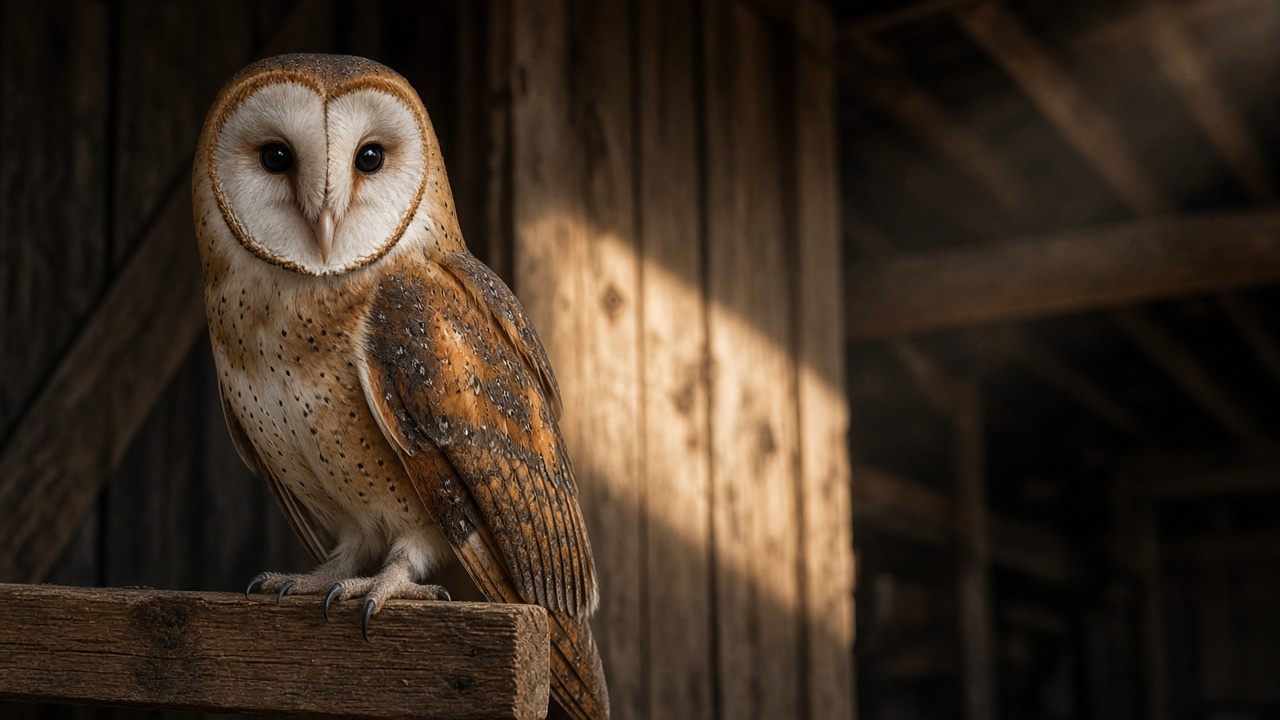
LAUSANNE. The change is slow enough that no farmer would notice it from one autumn to the next, and large enough that science cannot ignore it. Since the mid-1990s, the barn owls of western Switzerland have shifted steadily away from white: their plumage has become more reddish-brown, and the black spots flecking their feathers have grown more numerous and larger. What began as a quiet observation in a long-term nest-box study has now become one of the most precise demonstrations of evolution proceeding in the wild.
In a paper published in Nature Communications, biologists at the University of Lausanne, working with the Swiss Ornithological Institute in Sempach, combined three decades of plumage and life-history records with the whole genomes of 3,102 birds. The two melanin-based traits, colour and spottiness, turned out to be governed by a small number of genetic loci of major effect, including the MC1R gene, a classic switch in animal pigmentation, and a region on the Z sex chromosome that helps explain why females are generally redder and more spotted than males.
Not drift, selection
The decisive test was statistical. The team compared the observed changes in allele frequencies against simulations in which evolution was entirely random, driven only by genetic drift. The rise of the reddish MC1R variant overshot what drift could deliver; models that included selection matched the data. “Only simulations that included natural selection reproduced the changes we observed,” first author Tristan Cumer explained. The trend held in both sexes, and it held when birds born inside the study area were separated from immigrants, ruling out the idea that redder owls simply moved in.
Why redder is winning remains open
What advantage the darker plumage confers is the question the paper deliberately leaves open. Plumage colour in barn owls is linked to a web of fitness-related traits, from hunting strategy, white owls exploit moonlight differently, to physiology and behaviour. Shifts in prey, in climate or in other environmental pressures are all candidates, and the authors caution that the ecological driver has yet to be identified. What is no longer in doubt is the fact of the shift itself, or its speed: in evolutionary terms, three decades is a blink.
For the Lausanne department of ecology and evolution, whose researchers have followed these owls since the 1990s, the study is a vindication of patience. Long-term monitoring, unfashionable and hard to fund, is what allowed a few loci to be tied to a change visible only across a generation of birds. Switzerland’s barn owls, meanwhile, go on hunting the plateau at night, a little redder every year, carrying the proof in their feathers that evolution does not need geological time. It needs thirty years and a reason.