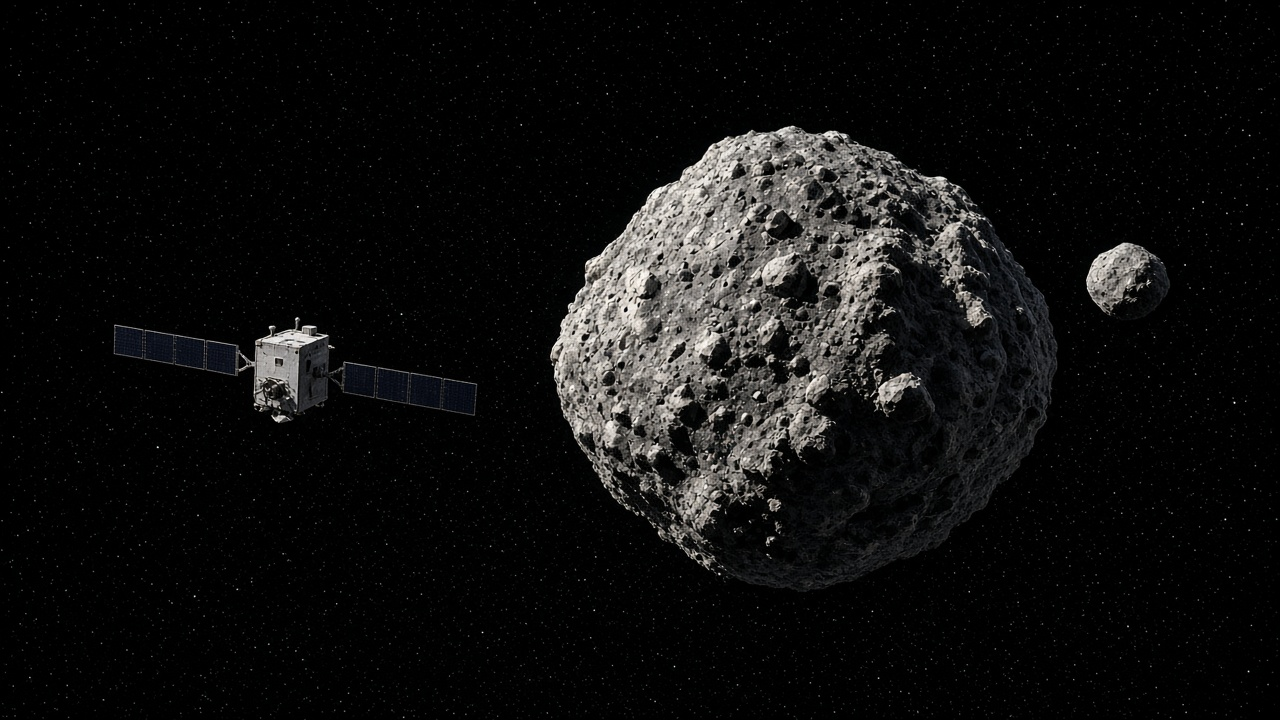
BERN. The crime scene lies 195 million kilometres from Earth, and the forensic team has just arrived. The European Space Agency’s Hera probe began the delicate braking manoeuvres that deliver it to the double asteroid Didymos and Dimorphos, four years after NASA deliberately crashed a spacecraft into the pair in humanity’s first test of planetary defence. A second braking burn follows on Thursday, with arrival in the system’s orbit due in November, a month earlier than planned.
The backstory reads like science fiction and behaved like physics. In September 2022, NASA’s DART spacecraft slammed into Dimorphos, a body about 160 metres across that orbits the larger Didymos like a moon, at 6.1 kilometres per second, just under 22,000 kilometres per hour. The impact shortened the little moon’s orbit from 11 hours and 55 minutes to about 11 hours and 22, proving that an asteroid’s course can be changed by ramming it. What DART could not measure was how well the trick worked: how much of the probe’s energy actually went into moving the rock.
That is Hera’s job, and it is a job with Bern fingerprints on it. A team around astrophysicist Martin Jutzi and John Wimarsson at the University of Bern, with Sabina Raducan of the International Space Science Institute, simulated the DART impact on computers. Their calculations suggest Dimorphos is not a solid boulder but a loosely bound rubble pile, and that the impact did not simply punch a crater but deformed the entire moon. “The result will provide a better basis for determining how much energy and momentum are required to deflect an asteroid of a given mass,” Jutzi told the Keystone-SDA news agency. “This will then allow us to determine how efficiently an asteroid can actually be deflected.”
What Hera will measure
Launched from Cape Canaveral on 7 October 2024, Hera flew past Mars in the spring of 2025 and has spent two years falling outward toward its target. The first braking burn last week ran for 93 minutes. “Arrival is a challenging phase for the mission,” Jutzi says. In November, the Early Characterisation Phase begins at a distance of about 30 kilometres, close enough for the first usable images. “We hope to be able to make a rough assessment of the effects of the DART impact from these.” By December, Hera closes to around 10 kilometres.
The crucial missing number is mass. Only when Hera has weighed Dimorphos can the Bern team calculate the deflection efficiency precisely, in effect auditing the collision that the simulations predicted. If the images show a moon reshaped through and through, the rubble pile model holds, and future deflection missions will be designed around it.
The odds of needing this
Nobody involved pretends the threat is imminent. Objects 10 to 20 metres across strike Earth every few decades and mostly break up harmlessly. The dangerous sizes are rarer: “An object 100 or 200 metres in size might strike the Earth every 10,000 to 20,000 years,” Jutzi says, but such an impact would be regionally devastating. Planetary defence is insurance with a very long premium period, and Switzerland, which has built instruments for deep space missions for decades, is paying its share of it.
For Bern’s space community, the arrival crowns a strong autumn, weeks after ETH opened the Swiss GeoLab for Earth observation in Root. Between watching the ground from the sky and watching the sky for what may fall from it, Swiss space science now covers both directions.