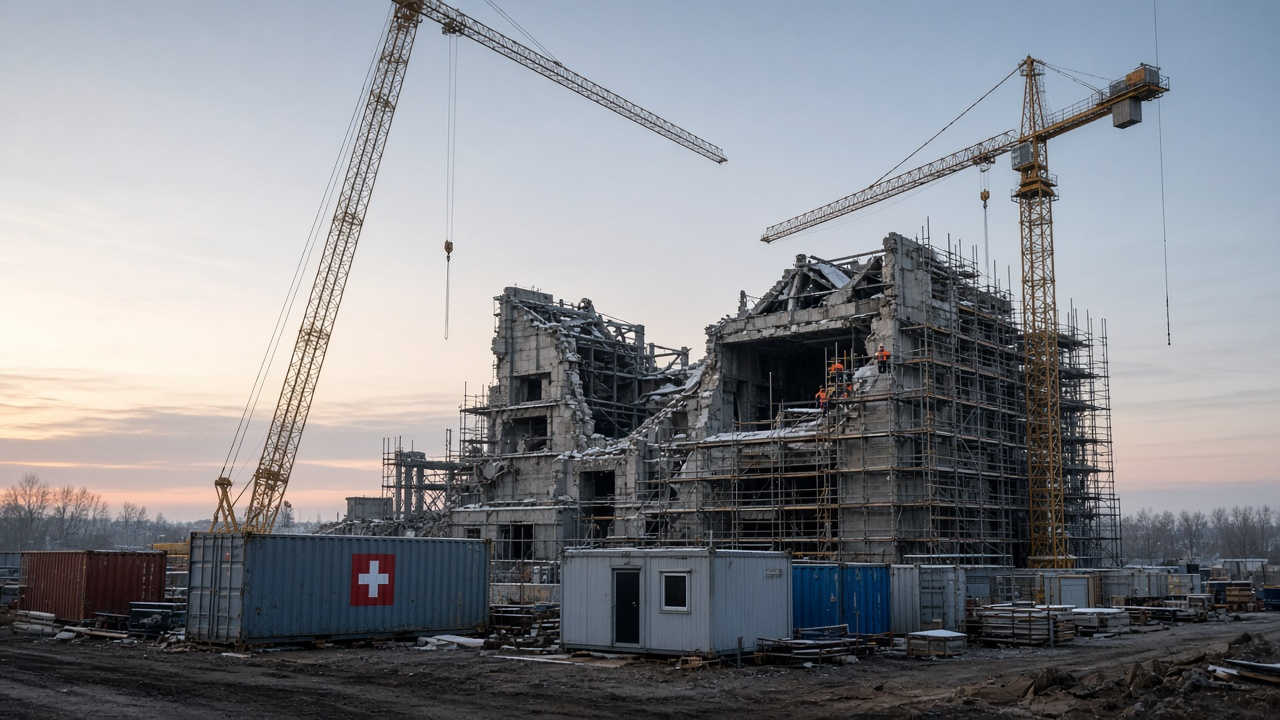
BERN. The bilateral agreement on cooperation in the reconstruction of Ukraine entered into force on Friday, sixteen months after it was signed and one day after the referendum deadline expired unused at midnight on Thursday. No committee came forward to challenge the treaty, which the National Council and the Council of States both approved in the summer session. The Federal Council confirmed the entry into force on Friday morning.
The agreement, signed on 10 July 2025, establishes the legal basis for Swiss financial assistance tied to concrete deliveries. Under its mechanism, the Ukrainian government identifies the goods and services it needs, and the Swiss Confederation then procures them from Swiss companies through public tender. The companies implement the projects on the ground, through their own branches in Ukraine.
Eight Projects, CHF 135 Million
The machinery is already moving. On 2 October the Federal Council approved a further eight projects under the Ukraine country programme, with funding totalling CHF 135 million in the energy, public transport and water sectors. The projects were chosen in a competitive process open to Swiss companies with operations in Ukraine, with budgets between CHF 3 and 30 million each. Participating firms must finance at least 10 per cent of the project costs themselves.
Proposals were assessed against criteria agreed by the Ukrainian and Swiss sides in advance: relevance, development impact, technical feasibility, risk, the efficient use of funds and what the administration calls Swissness, the share of Swiss expertise and equipment in the delivery. The final selection was made in collaboration with the government in Kyiv, in line with Ukraine’s own priorities.
The model is deliberate. Rather than transferring money, Bern ties assistance to procurement, which keeps a substantial share of the funds inside the Swiss economy while delivering infrastructure Ukraine has asked for. Officials point to the Ukraine Recovery Conference hosted in Lugano in 2022 as the moment Switzerland committed to this approach, and to the international cooperation strategy for Ukraine as its funding frame.
A Quiet End to the Referendum Window
That no referendum was requested is itself part of the story. The treaty passed both chambers with comfortable majorities, and the deadline that expired on 8 October was watched by diplomats in Kyiv and Brussels as a test of how contested Swiss support for Ukraine remains. In the event, the silence held. Support for reconstruction, unlike the debates over weapons exports and neutrality, commands a broad majority in Bern.
Industry has welcomed the entry into force. Machine builders, electrical engineers and construction groups see a structured pipeline of work in a market where Swiss firms were previously exposed without a legal frame. Humanitarian organisations have responded more cautiously, welcoming the funding while warning that tenders must be designed so Ukrainian firms and workers are not crowded out of their own reconstruction.
The first tenders under the approved projects are expected in the coming months. The State Secretariat for Economic Affairs, which runs the selection process together with the Swiss Agency for Development and Cooperation, says implementation reports will be published so that both parliament and the public can follow where the CHF 135 million lands.
For Kyiv, the date matters beyond the money. With the agreement in force, Switzerland joins the group of states whose reconstruction commitments have outlived their own domestic ratification fights. For Bern, the mechanics now begin: tenders, contracts and the slower work of rebuilding substations, tram lines and water mains, one Swiss invoice at a time.