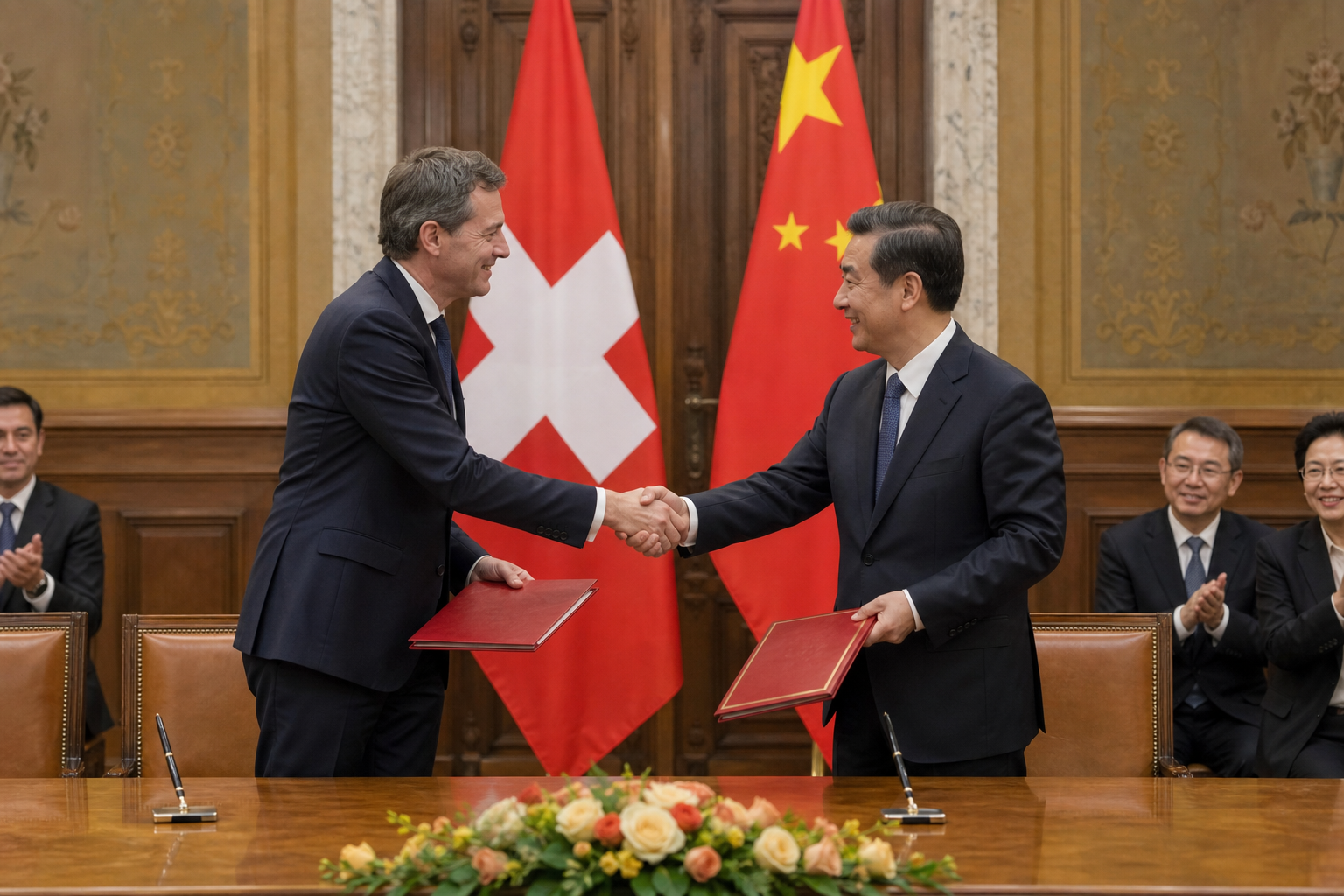
BERN. Switzerland and China have concluded a sweeping upgrade of their free trade agreement that would eventually lift 99.8 per cent of Swiss exports to China into duty free treatment, the two governments announced in Bern on Thursday. Economics minister Guy Parmelin and China’s commerce minister Wang Wentao signed a memorandum of understanding after talks that had been running, with long pauses, since the original deal took effect.
The existing agreement, signed in 2013 and in force since 2014, made Switzerland the first continental European economy with a free trade deal with Beijing. Yet it currently leaves 46.2 per cent of Swiss goods exports to China outside duty free treatment. The revised text would lift coverage from 53.8 per cent to 99.8 per cent over time, closing almost the entire gap.
The timetable now runs through politics rather than diplomacy. Both governments expect the formal signature this year. The agreement then needs the approval of the Swiss parliament, where debates over labour rights and environmental safeguards proved contentious in earlier rounds and are expected to be so again. Roughly three quarters of the new tariff exemptions would take effect as soon as the agreement enters into force, with the remainder arriving through staged reductions.
For Swiss industry the stakes are concrete. China is among the country’s three most important trading partners, and the sectors with most to gain are the ones that define the export economy: watches, machinery, precision instruments and pharmaceuticals, alongside food producers who have long complained that the 2013 schedules left their best products at a disadvantage against competitors from countries with newer deals.
The announcement lands in a deliberately unsettled trade landscape. American tariff policy has pushed every mid sized exporter to reconsider its map of market access, and Bern has spent the year arguing that Switzerland must not depend on any single partner. A deeper agreement with Beijing is the clearest practical expression of that doctrine, and its critics in parliament will quote the same doctrine back at the government.
Business federations welcomed the breakthrough within the hour, while urging companies to read the annexes before booking the champagne. Trade lawyers point out that the commercial value of such deals is decided in product schedules, rules of origin and certification procedures, and that utilisation rates of the existing agreement have historically lagged its headline coverage, especially among smaller firms without dedicated customs teams.
Opposition is assembling along predictable lines. The left wants binding, enforceable sustainability provisions rather than declaratory chapters. Some farm organisations fear precedent more than competition, worrying that concessions granted to Beijing will be cited in every future negotiation. The government’s answer is that the alternative to updating the deal is watching rivals eat into positions Swiss exporters spent decades building.
Parmelin framed the agreement as an insurance policy for the export economy at a moment when long standing commercial assumptions are being stress tested elsewhere. Wang Wentao spoke of a relationship built on mutual benefit, language diplomats noted for its familiarity rather than its novelty. Both sides avoided the word dependence, which is precisely the word the parliamentary debate will use most.
The immediate milestones are clear: formal signature, parliamentary approval and entry into force. Companies will then need to map the schedules product by product and decide where duty free access changes their pricing, their sourcing or their Chinese distribution. The tariff breakthrough could strengthen Swiss exports measurably. Its value will be counted in shipments and market share, not in the 99.8 per cent that made the headline.