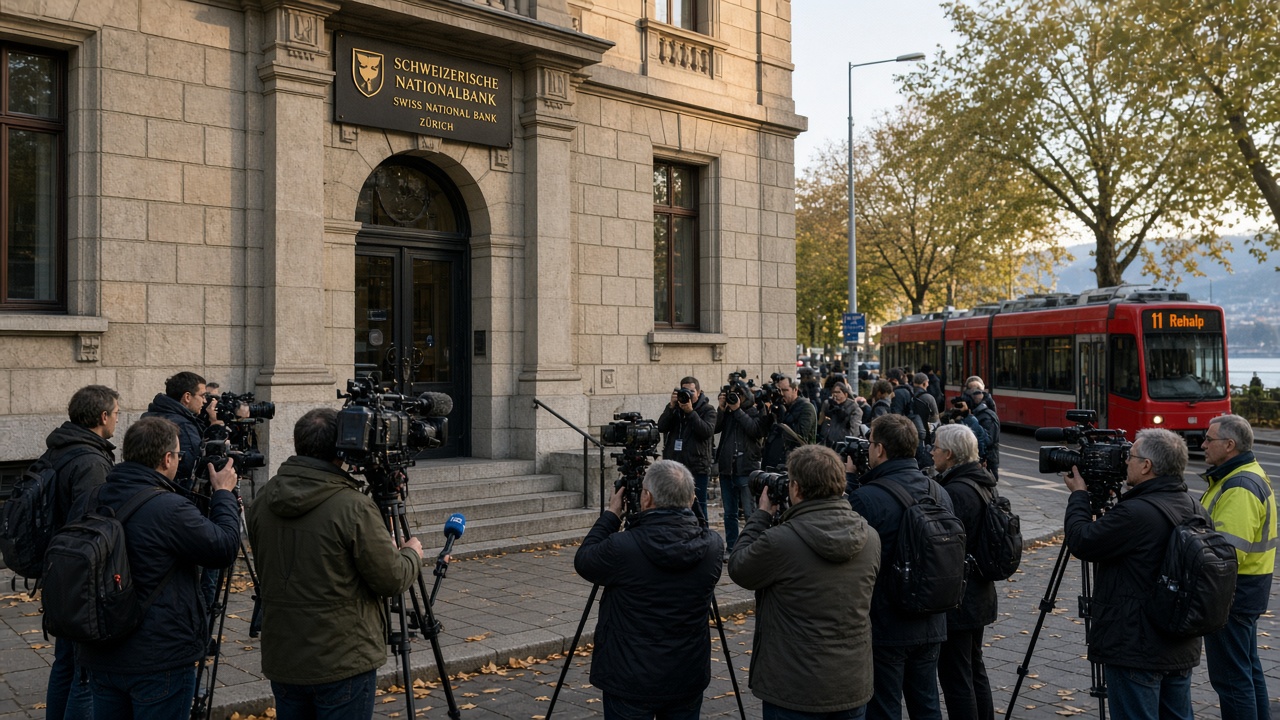
ZURICH. The Swiss National Bank held its policy rate at zero on Thursday, as every forecaster expected, and then spent an hour explaining why the next move is more likely to be up than down. The statement was a study in continuity: the rate has stood at zero since June 2025, the new inflation forecast assumes it stays there for the entire three year horizon, and the bank repeated that it remains willing to intervene in foreign exchange markets if monetary conditions require it. The market heard something else. By Thursday afternoon, traders were pricing a first rate rise in December as a coin toss, and a move by early 2027 as close to certain.
The numbers behind the decision are calm. Inflation rose from 0.6 per cent in May to 0.8 per cent in August, driven by oil products, with goods prices rising year on year for the first time since May 2024. The new conditional forecast puts average inflation at 0.7 per cent for 2026 and 0.8 per cent for both 2027 and 2028, inside the zero to two per cent range the bank defines as price stability throughout. On the bank’s own arithmetic, there is no case for moving. On the market’s reading of the same arithmetic, the case is building.
A weaker franc does the quiet work
The franc has depreciated by around 3 per cent on a trade-weighted basis since the June assessment, touching a 17 month low against the euro this week. Chairman Martin Schlegel was careful to describe the move as consistent with the widening interest rate gap abroad, and to repeat that a weaker franc feeds import prices. What he did not say, and what every economist in the room supplied for him, is that the depreciation is doing the work a rate cut might once have done, and that it removes the last argument for ever returning below zero.
The external backdrop has shifted under the SNB. The Federal Reserve and the European Central Bank have both raised rates in recent weeks, moving in the opposite direction from the pause markets once expected. Each rise abroad widens the gap that weighs on the franc, and each point of franc weakness nudges Swiss import inflation higher. Schlegel called uncertainty very high and said zero was appropriate, before adding the two words traders seized on: at the moment.
Speaking to CNBC after the decision, Schlegel declined to be drawn on December. The pricing does the drawing for him. Futures markets now imply roughly even odds of a quarter point rise at the 11 December assessment, and a probability above 90 per cent that the first increase arrives by early 2027. A year ago the same markets priced zero deep into 2028. The re-pricing has happened without a single SNB rate move, which is precisely how the bank prefers its cycles to begin.
The dissenting detail in the forecast
Inside the forecast sits a quiet tension. The conditional projection assumes the policy rate stays at zero for the whole horizon, and still produces inflation of 0.8 per cent in 2028, near the middle of the target band. If oil stays expensive and the franc stays soft, that 0.8 has room to climb. Several bank economists noted on Thursday that the SNB’s own numbers now read like a justification for the rise the assumption excludes. The bank’s own research this month showed how much of Switzerland’s low inflation is a goods story, and goods are exactly where the weak franc bites first.
For households, the practical consequences arrive slowly and then suddenly. Mortgage rates referenced to the SARON remain near historic lows, and the first rise, whenever it comes, moves them by a quarter point. Savings accounts, which have paid almost nothing for two years, would begin to pay something. The big adjustments, in pensions, rents and the exchange rate that decides what a holiday costs, lag the decision by quarters, not weeks.
Exporters, who spent the spring begging for relief from a franc at a ten year high, have gone quiet as the currency slides. The machine builders report full order books, and the August purchasing managers’ index jumped to 57.1. The National Bank will not say it welcomes the depreciation. It does not have to. The forecast speaks in its place.
The next assessment lands on 11 December, between the November pension vote and the year’s end. Between now and then the bank gets two more inflation readings, one more quarter of growth data, and whatever the Federal Reserve and the ECB decide to do next. Zero held on Thursday, as it has held for fifteen months. The forecast assumes zero for three more years. The market no longer believes the forecast. One of them will be right by spring.