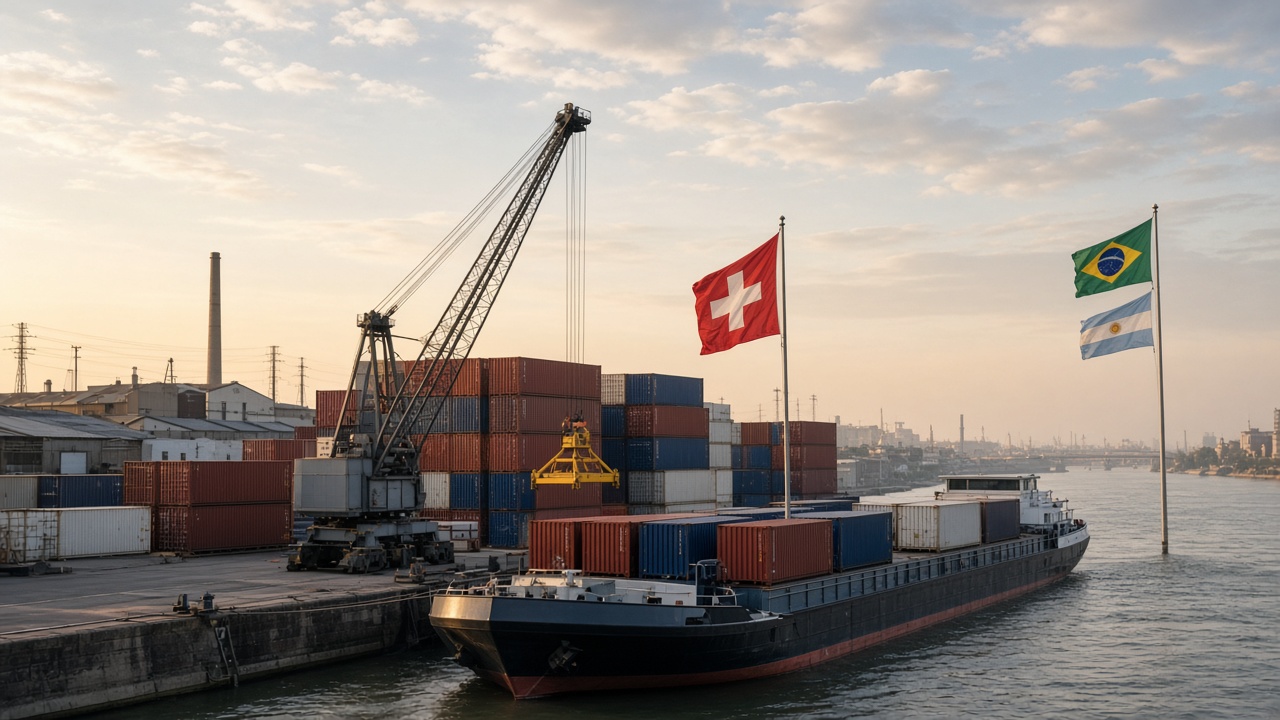
BERN. The Mercosur trade agreement is alive again. Late on Monday, the Council of States approved the EFTA free trade deal with Argentina, Brazil, Paraguay and Uruguay by 35 votes to 7, reviving a treaty the House of Representatives rejected 96 to 86 as recently as June. The resurrection has a price tag: CHF 517 million for Swiss agriculture, spread over the years 2028 to 2033, attached to the bill as the cost of making free trade politically survivable.
The money is a compromise, and everyone involved knows whose compromise it is. The farmers’ organisations had demanded CHF 880 million over the years 2028 to 2035 as their condition for peace. The Senate refused that figure and wrote its own. It also refused, for a second time, the left’s amendments tying ratification to deforestation rules and forced labour protections, the same proposals whose rejection in June cost the treaty its House majority.
Economics Minister Guy Parmelin defended the deal on two fronts at once. The difficulties weighing on Swiss agriculture this year, he told senators, are not linked to Mercosur, an agreement that in his reading benefits farm exports rather than threatening them. And the treaty, he assured the chamber, will not increase trade resulting from deforestation. Both claims will be tested again, loudly, when the file returns to the House.
The substance is considerable. The agreement, negotiated by the four EFTA states with a bloc of roughly 270 million consumers, would eventually make 96 per cent of Swiss exports to the Mercosur countries duty free. Switzerland in return grants 25 bilateral import quotas for sensitive agricultural products, meat and wine included, most of them capped and manageable by Bern alone. Customs savings are estimated at around CHF 150 million a year. Swiss exports to the four countries exceeded CHF 4 billion in 2024.
Timing is doing quiet work. Swiss industry is being squeezed by American tariffs and by raised EU duties on steel, and the argument that Switzerland cannot afford to leave any market closed has gained force by the month. The pivot toward China is one answer to that squeeze; ratifying Mercosur is another. Exporters point out, correctly, that even the tariff refunds they may win in Washington do not replace lost market access.
The farmers’ position is equally explicable. After the driest summer on record, with farm losses estimated at CHF 522 million and feed in short supply, the prospect of additional South American beef and wine quotas lands in a sector that feels besieged. The Senate’s CHF 517 million is meant to be heard as an answer to that fear. The farm lobby’s first response was to note the difference between 517 and 880 without audible gratitude.
The ratification race abroad adds a mild embarrassment. Brazil and Uruguay approved the agreement in June, Argentina’s signature is before its Congress, and Paraguay is moving its file. Among the EFTA states, it is Switzerland, the country that likes to present itself as the reliable ratifier, that has become the holdout.
What happens next is procedure with consequences. The bill returns to the House of Representatives for a second reading, and the June alliance that killed it, Social Democrats, Greens, the farm wing of the People’s Party and parts of the Centre, must now decide whether the Senate’s farm money and the summer’s drought politics have changed anything. The left is signalling it will hold. The farm wing is the design target of the compensation, and it is being worked on hard.
The session ends on 2 October, and the EU package consumes its final week, so the House may not take Mercosur again until winter. Whenever it does, the question is the same one the Senate answered on Monday. The Senate has decided that cheap beef is a fear Switzerland can manage, and lost export markets are a fear it cannot. The House gets the last word, and this time it will be voting with the price of failure spelled out in francs.