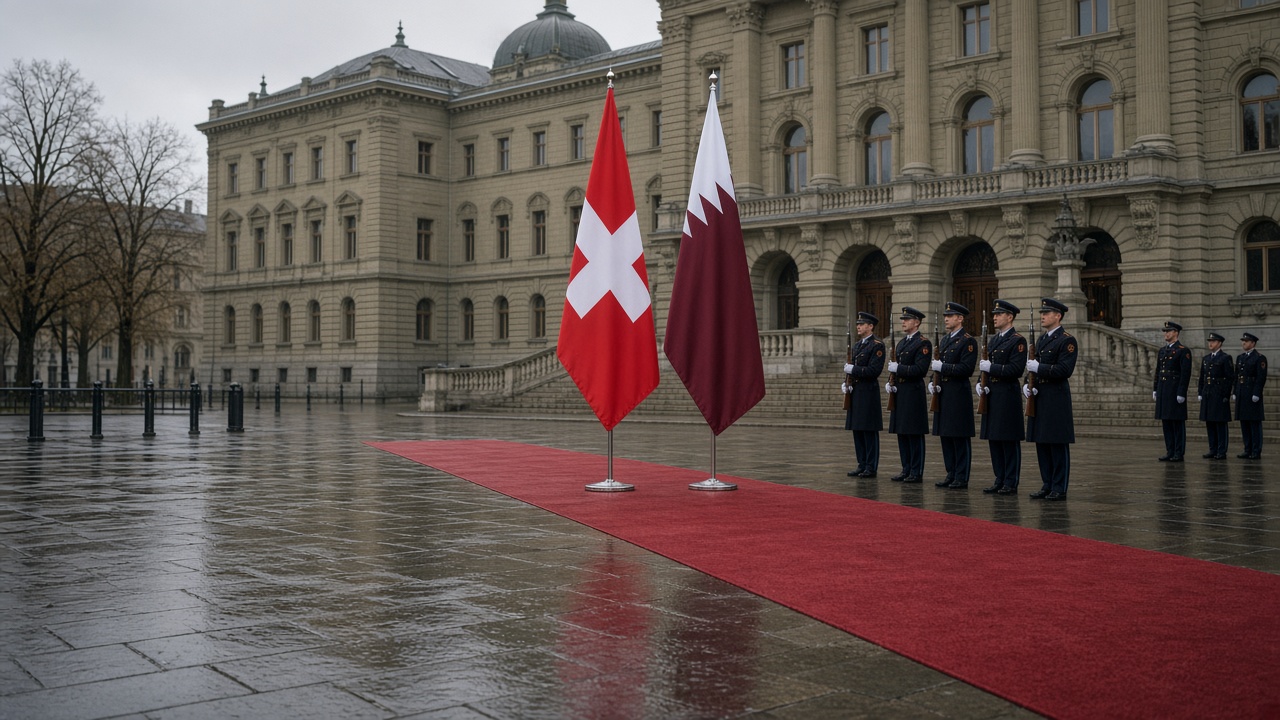
BERN. Sheikh Tamim bin Hamad Al Thani, the emir of Qatar, is in Bern on Wednesday for a two-day state visit, the first of its working days. The Federal Council is receiving him with military honours on the Bundesplatz. The official talks are at the Bernerhof. On the Swiss side of the table are President Guy Parmelin, Ignazio Cassis, Karin Keller-Sutter and Albert Rösti. On Thursday, Parmelin and the emir are due to sit with business leaders.
The government invited him, it said on 13 November, to mark relations it describes as increasingly close, both with Qatar and with the Arabian Peninsula more broadly. The stated aim is to deepen contacts in the economy, in finance and in science. Regional conflicts and mediation, international cooperation, and energy supply are on the same agenda. That is a Bern list, not a communique of results. Nothing has been signed in public this morning. The programme is the news.
Who is in the room, and why those four
Parmelin is there as president. Cassis is vice president and foreign minister, which is the natural chair for mediation and for the conflicts the invitation named without listing. Keller-Sutter runs the finance department, which is the seat for a conversation about investment. Rösti runs the department that covers energy, transport and the environment, which is why a gas exporter does not only meet the diplomat. An investment protection agreement between the two countries has been in force since 2004. A free trade agreement between the EFTA states and the Gulf Cooperation Council has been in force since 2014. Diplomatic relations date from Qatari independence in 1973. Reciprocal embassies came much later, in 2013. The visit is the political layer on top of instruments that already exist.
Energy is the item residents will feel if it ever leaves the communique and becomes a cargo. Bern has already opened a slice of the heating-oil stocks until 6 December, because the Rhine has been too low for a full barge. Qatar's place in the gas trade is the reason "energy supply" is not a courtesy line on this particular invitation. A two-day visit does not refill a Swiss tank. It is the setting in which a government that has spent the autumn counting litres sits down with a state that sells them.
What closes in the old town
The visit has a street map. Cantonal police say Bundesgasse, Kochergasse and Inselgasse are closed to all vehicles from 11:00 on Wednesday until 12:00 on Thursday. On Wednesday afternoon, from 13:00 to 19:00, Amthausgasse, Bärenplatz and Schauplatzgasse are closed as well. Cars parked against the signs will be towed. Inside the cordon, police expect more checks of vehicles and of people. During the closures, the Hotel Bellevue and the Casino car park are reached only by the Kirchenfeld bridge and Münzgraben.
City buses feel it sooner than the road closure. Bernmobil is diverting lines 10 and 19 from 10:45 on Wednesday, via Spitalgasse and Marktgasse, and the Bundesplatz stop is not served. Inbound buses can use the Bundesplatz again from 22:00 on Wednesday, after the evening rendezvous. The outbound diversion runs on until 11:00 on Thursday. Anyone with a train to catch at the station should add the loop, not the argument.
What Thursday is for
Wednesday is the state. Thursday is the firms. The Federal Council said Parmelin and the emir would meet business figures on 19 November, which is the usual second day when a visit is meant to outlast the honour guard. Readers who want a result, a memorandum or a figure in francs will not get one from the arrival. They will get a closed square, four federal councillors in one room, and an agenda that puts mediation next to energy on purpose. The square reopens. The agenda is the part that can still move.