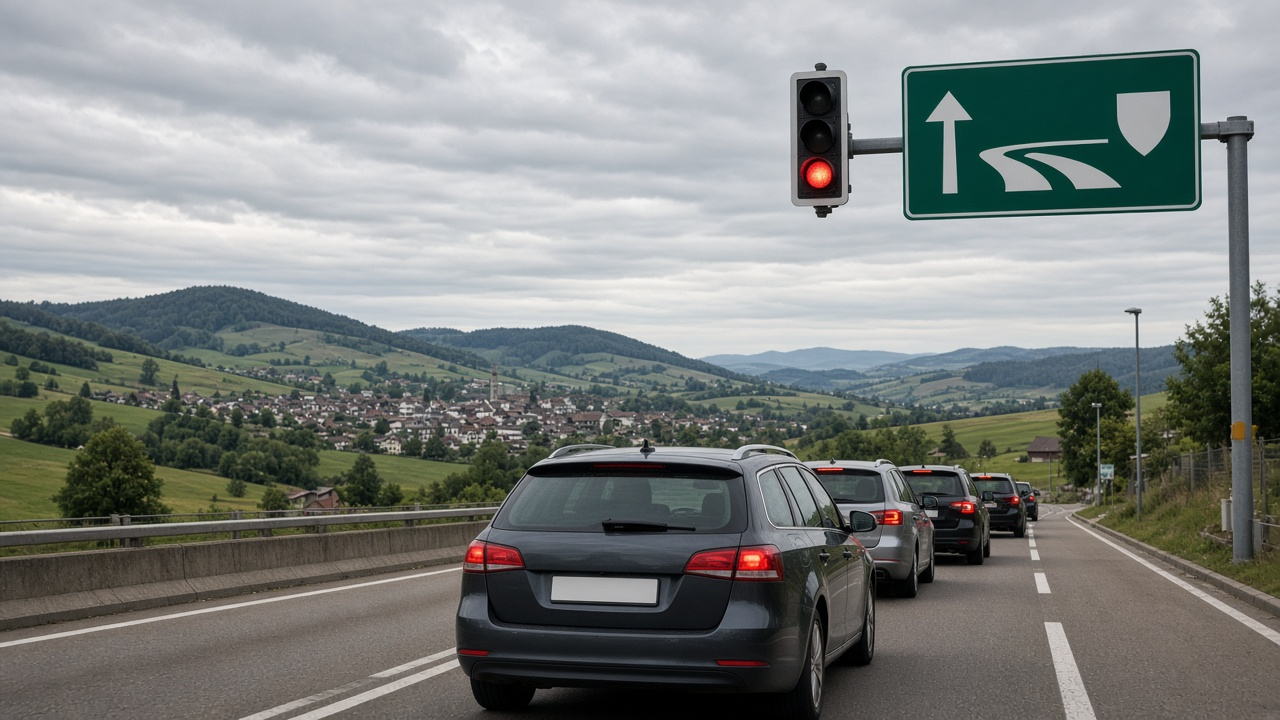
BERN. The federal government is examining traffic lights at more than 120 motorway entry ramps, the largest expansion of ramp metering ever considered in Switzerland. Documents published at the weekend show the Federal Roads Office has listed 138 installations: 15 already in operation, 13 planned, and 110 under formal review.
The principle is simple. A light on the entry ramp holds cars back and releases them onto the motorway in dosed intervals, so that the main carriageway keeps flowing instead of congealing at every merge. The system has run at Cossonay on the A1 between Yverdon and Lausanne since 2021, and fifteen installations now operate in cantons including Bern, Zurich and Aargau. In Ticino, two dosing systems already regulate the ramps toward Chiasso at Lugano Sud and Melide, with four more sites under consideration.
The political driver is the vote of November 2024, when the electorate rejected the expansion of the motorway network. With new lanes off the table, the roads office under director Jürg Röthlisberger must extract capacity from the existing asphalt, and metering is the cheapest instrument it has.
The queues move downhill
What the office concedes only in an internal memo, obtained by the Tamedia newspapers, is where the traffic goes instead. Dosed ramps mean columns on the cantonal and communal roads behind the light: through villages, past school routes and into the streets of cities that had no say in the plan, to the detriment of the pedestrians and cyclists who use them. Basel City and Schaffhausen have protested that they were not consulted, and the cities are demanding a formal seat in the planning before any site is approved.
The geography of the list explains the irritation. Nearly a quarter of the sites are in Geneva and Vaud, where only one installation operates today: five around Geneva, from Perly to Meyrin, and 23 along the A1 from Coppet to Chavornay and the A9 from La Blécherette to Villeneuve. The bulk of the remainder sits in the Zurich and Basel regions, the two conurbations whose rush hours the federal model is built to protect. Fribourg, Neuchâtel, Jura and Valais are not affected.
Does it work
The Cossonay experience says yes, with caveats. Travel times on the main line stabilised at peak hours and the merge became calmer. But cantonal police caution that every site depends on where the waiting cars can go, and the memo is honest that some ramps simply export the queue. The roads office stresses that the 110 sites are a review list, not a construction programme: each must prove feasibility and a positive effect before anything is built.
For the commuter, the change would arrive as a red light where there was none. For the transport debate, it is the admission that the post-referendum era has a price, and that the price will be paid on somebody’s local high street. The cantons intend to make sure it is not theirs.