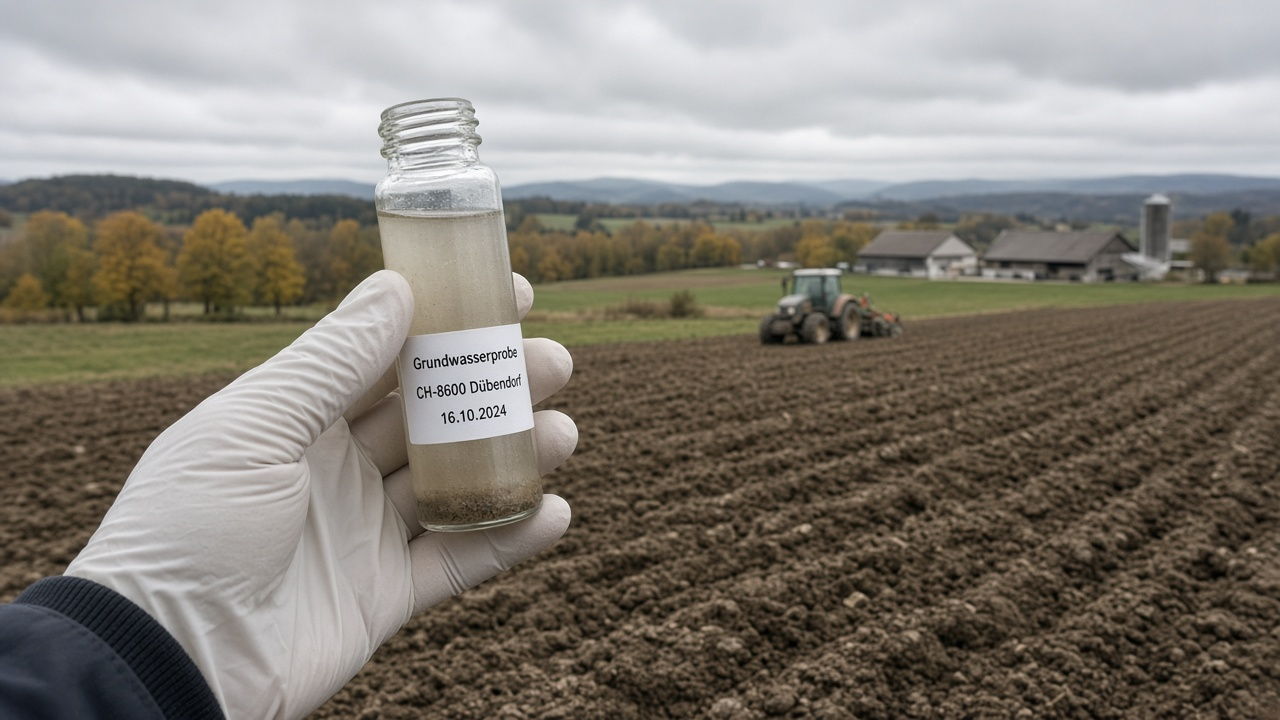
BERN. The worst single reading in six years of federal groundwater monitoring comes from Seedorf in the Bernese Seeland: 3.74 micrograms per litre of a degradation product of chlorothalonil, nearly 40 times the legal limit of 0.1 micrograms. The fungicide itself has been banned in Switzerland since 2020. Its residues, the data show, will be working their way through the water table for years to come.
The figure is part of an unprecedented public analysis published on Tuesday by WWF Switzerland. Four interactive maps, two for rivers and streams, two for groundwater, draw on the federal NAQUA and NAWA monitoring programmes and let anyone search by commune, substance or year between 2019 and 2024. Of 217 substances tested at around 550 groundwater sites, 84 were detected at least once, including glyphosate and 1,2,4-triazole, the compound that drew attention when it was found in Lake Geneva last year. “Pesticides are an invisible danger,” says Eva Goldmann, the foundation’s agriculture expert. “We want to remind people that they remain a serious problem.”
The broad picture is no better than the record. Pesticide degradation products exceed the 0.1 microgram threshold at about one in three groundwater monitoring sites nationwide, and at around 60 per cent of sites on the intensively farmed Plateau, the Federal Office for the Environment reports. In all, 24 metabolites of 12 active substances break the limit. Alongside chlorothalonil, the residues of the herbicides chloridazon, withdrawn in 2020, and metolachlor, withdrawn in 2024, appear repeatedly and widely; among the pesticides still in use, bentazone causes most of the current exceedances. The karst regions of the Jura, where water sinks quickly through fissured rock, are particularly vulnerable.
Invisible does not mean harmless
Two cautions apply. The monitoring network measures groundwater, not what comes out of the tap: drinking water is treated and separately controlled, and not every commune or water intake is covered by a monitoring site. And because stations test different substances, comparisons between cantons are only partly fair. None of that softens the direction of travel, which the WWF accuses the federal authorities of obscuring by publishing the raw data without an accessible overview, while protection standards have been weakened.
The timing is pointed. On Monday, a national drinking water conference warned that the drought that has gripped Switzerland since the record summer and persistent pollution are converging on the country’s water supplies, with less water diluting the same chemical load. Agriculture accounts for most of the substances found; the industry notes that the worst offenders are already banned and that approval rules have tightened considerably.
What can still be done
The slow physics of groundwater means improvement lags policy by years. Chlorothalonil concentrations are beginning to decline where the ban has had time to work, but a metabolite measured today may have entered the soil a decade ago. The WWF wants the reduction targets for plant protection products sharpened and finally enforced, funding shifted toward low input farming, and the data published as a matter of course rather than extracted by an environmental group.
Voters have been here before. Two drinking water initiatives were rejected at the ballot box in recent years, both times after campaigns that warned of crippling costs for farmers. The difference now is the map: it is harder to argue about an abstract burden when the burden has a commune, a concentration and a name.