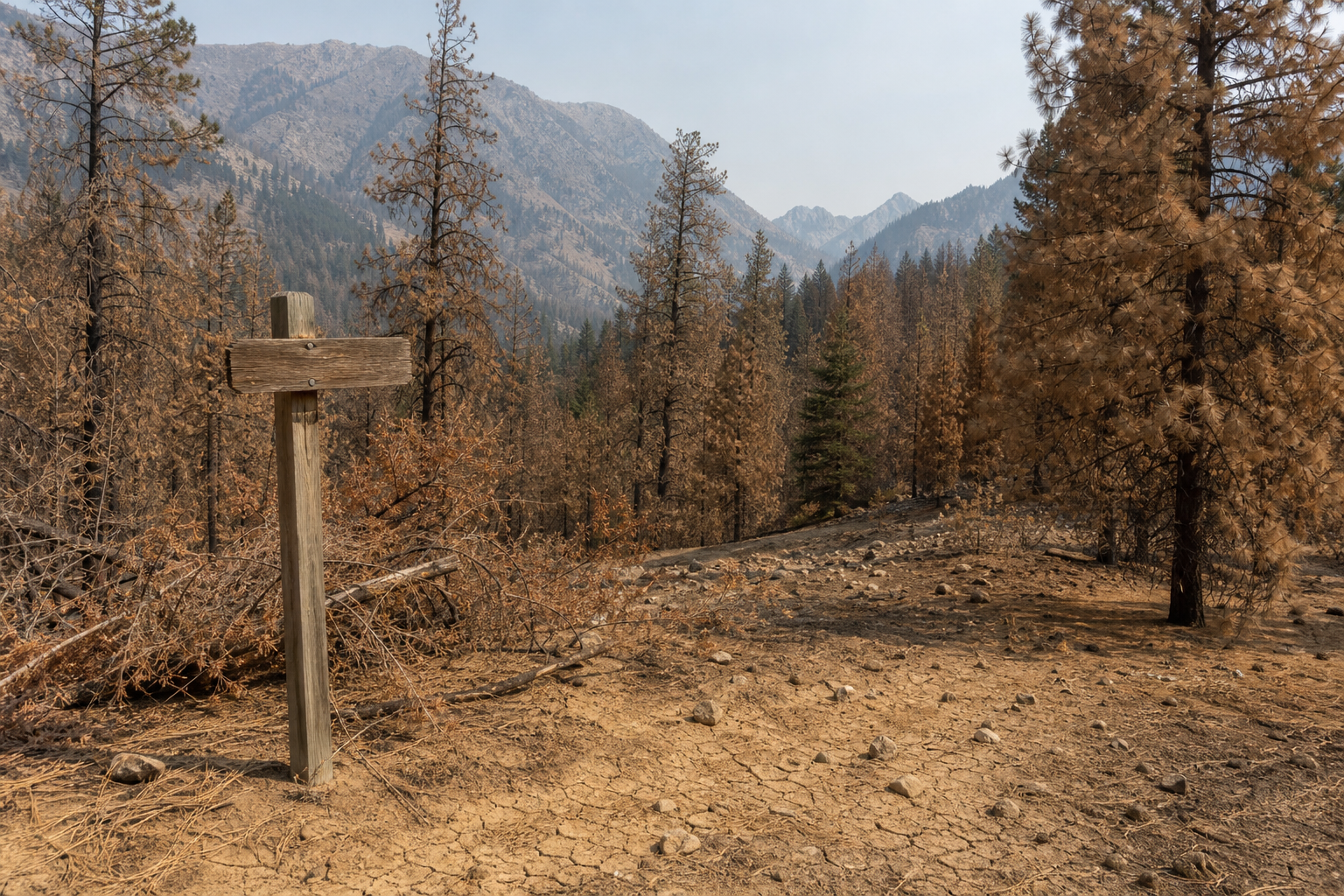
BERN. Four cantons are under the maximum forest fire danger level and the entire Alpine arc sits one notch below, the federal natural hazards bulletin said on Thursday, a reminder that the break in the heatwave has not broken the drought. Forest fire danger level 5, “very high”, now applies in Basel Country, Basel City, Valais and Zurich, with level 4, “high”, across the Alps and the northern Alpine slope.
The bulletin, issued by the federal warning system at 11am on Thursday and valid until further notice, keeps open fire bans in force across much of the country. Cantons that received meaningful rain in recent days have lifted their bans; those the storms missed, notably south of the Alps and in the Valais, have extended theirs into September.
At level 5 the official guidance turns stark. Very hot ground fires and widespread crown fires become possible, burning embers can be thrown over long distances to spark new fires, and a single lightning strike is highly likely to ignite one. The cantonal bans are not symbolic: they cover barbecues, campfires and in several communes any open flame outside private gardens.
Relief is possible but not scheduled. MeteoSwiss expects further precipitation in the coming days, which could ease the danger regionally, and the next full bulletin is due on 3 September. What forecasters will not promise is an end to the season. “We can still see individual heat days of 30 degrees or more in the lowlands in September,” said MeteoSwiss meteorologist Daniel Köbele, pointing to soils that remain bone dry and sea temperatures around Europe that are still very warm.
The calendar supports the caution. Bern and Basel each recorded a September heat day in 2024, and Basel counted five in 2023. In a summer like this one, SRF Meteo presenter Sandra Boner told viewers this week, anything remains possible, though the coming rain should damp rather than amplify whatever heat follows. The fire danger, meteorologists stress, answers to the weather pattern, not the month.
The background is a year that fire scientists already class as exceptional. A stable high pressure system over Europe has blocked much of the rainfall the continent would normally receive since the start of the year, said Julia Miller, a wildfire expert at the WSL Institute for Snow and Avalanche Research in Davos. June was the hottest ever recorded in western Europe and the third hottest in Switzerland since measurements began in 1864, and the wildfire season started correspondingly early.
Switzerland has so far been spared a large scale fire, which researchers attribute to luck as much as to discipline. Swiss building law keeps housing out of forests, which limits the risk to people, but the classic danger zones, the foehn swept valleys of Valais, Graubünden and Ticino, remain primed. A warm, dry foehn wind can turn a discarded cigarette or an equipment spark into a running crown fire within minutes.
The drought’s other ledger is filling more slowly. Alpine reservoirs have recovered to around 84 per cent of capacity after the late August storms, and utilities are now deciding how much of that water to hold for winter. Soil moisture, by contrast, takes weeks of steady rain to rebuild, and the deep dryness is precisely what keeps the fire indices pinned near their maximum.
For the coming weekend the practical advice is unglamorous: no fires in or near forests, no fireworks, report smoke immediately and follow the cantonal bulletins rather than the sky. The fire season no longer ends with August. In a year like this one, September is still part of it.