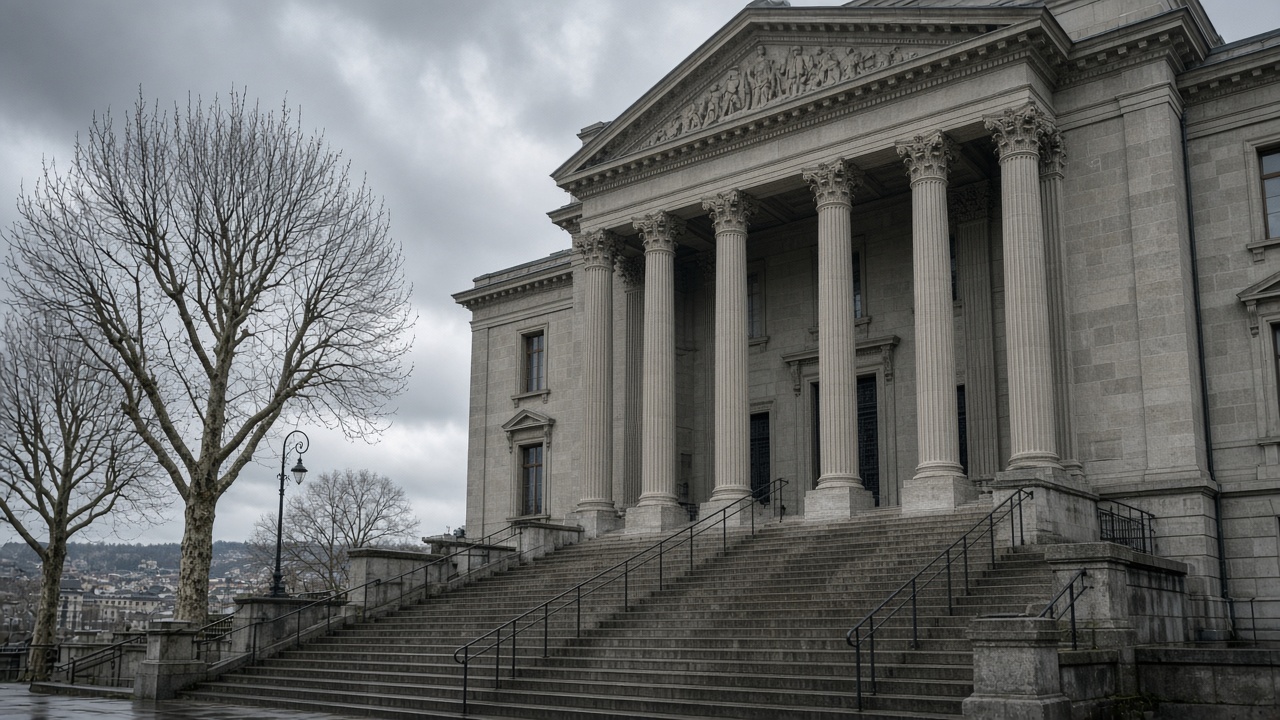
LAUSANNE. The Federal Supreme Court will hold a public hearing in Lausanne on Thursday on whether the relationship between two of its judges should undo a ruling one of them helped to make. It is the first time the court will look at the substance of a request to revise a judgment because of the affair between Yves Donzallaz and Beatrice van de Graaf. The answer will not bind every later case. It will be the test the others are measured against.
The pilot file is a decision of 29 May 2026. Van de Graaf sat. The court dismissed a citizen’s appeal. He now wants that decision set aside, on the ground that she should not have sat at all. Parties may address the court from 10:00. The judges are due to deliberate in public, and to announce a result, from 15:00. A public hearing with a public deliberation is unusual for a revision. These requests are normally decided in writing, on a circulation, behind closed doors. The court said so when it set the date.
The legal question, in one phrase
The statute forbids a “lasting cohabitation” between federal judges, a dauernde Lebensgemeinschaft, because two judges who share a life cannot be treated as two independent votes. Donzallaz, who sits without a party card, and van de Graaf, an SVP judge since 2019, have said the relationship ran from the spring of 2025 to Easter 2026. The court has to decide whether that was the kind of partnership the law names, and whether it made van de Graaf biased in the May case. If the answer is yes, the May judgment can fall. If it is no, the citizen keeps the loss.
About a dozen further revision requests were filed after the relationship became public. The SonntagsZeitung has put the pending total at 15. In the middle of October the court refused to enter the first of them, because a deadline had been missed. Thursday is the first time the judges will discuss the relationship itself, rather than a missed date. Reporting on the underlying case has described a man convicted of attempted homicide. The court’s own notice describes a citizen whose appeal was dismissed on 29 May with van de Graaf on the bench. Thursday’s hearing is where those descriptions either meet or do not.
Parliament is already in the file
The hearing sits inside a larger argument about who gets to stay on the court. Because of the affair, parliament moved the full renewal of the Federal Supreme Court from the autumn session to the winter session. Both judges are standing again. The court’s own plenary has already refused to propose the current president, François Chaix of the FDP, and has put forward Thomas Müller of the SVP instead. That break with the president is without a recent precedent. A judgment on bias does not decide the election. It will be in every briefing the judicial commission reads before it.
The commission, which prepares that election, asked the Fribourg criminal-law professor Marcel Niggli for an opinion on whether the relationship met the legal test. The opinion is covered by official secrecy. The SonntagsZeitung nevertheless reported its core finding: a lasting partnership exists once two people are spoken of, and felt, as a couple in ordinary language. On that reading, the judges are likely to have breached the rule. The paper also reported that the two judges did not accept Niggli as the expert. Leo Müller, the Lucerne Centre councillor who chairs the commission, has confirmed that the commission filed a criminal complaint, against persons unknown, over the leak. The court itself has filed a separate complaint over reporting that tracked a closed plenary as if a reporter had been in the room.
What Thursday can and cannot settle
Five judges will sit on the revision. They can uphold the May decision, or they can open the door to undoing it. They cannot, in one afternoon, clear the winter election, the criminal complaints, or the requests still in the pile. A publication ban obtained at the Zurich commercial court was reported to run until the morning of this hearing. From 10:00 the argument is in a public room, which is the point of holding it that way. Anyone who wants the law of judicial bias in Switzerland, as opposed to the gossip of it, has a time and a courtroom. The winter session in Bern is where the jobs are decided. Thursday in Lausanne is where the rulings are.