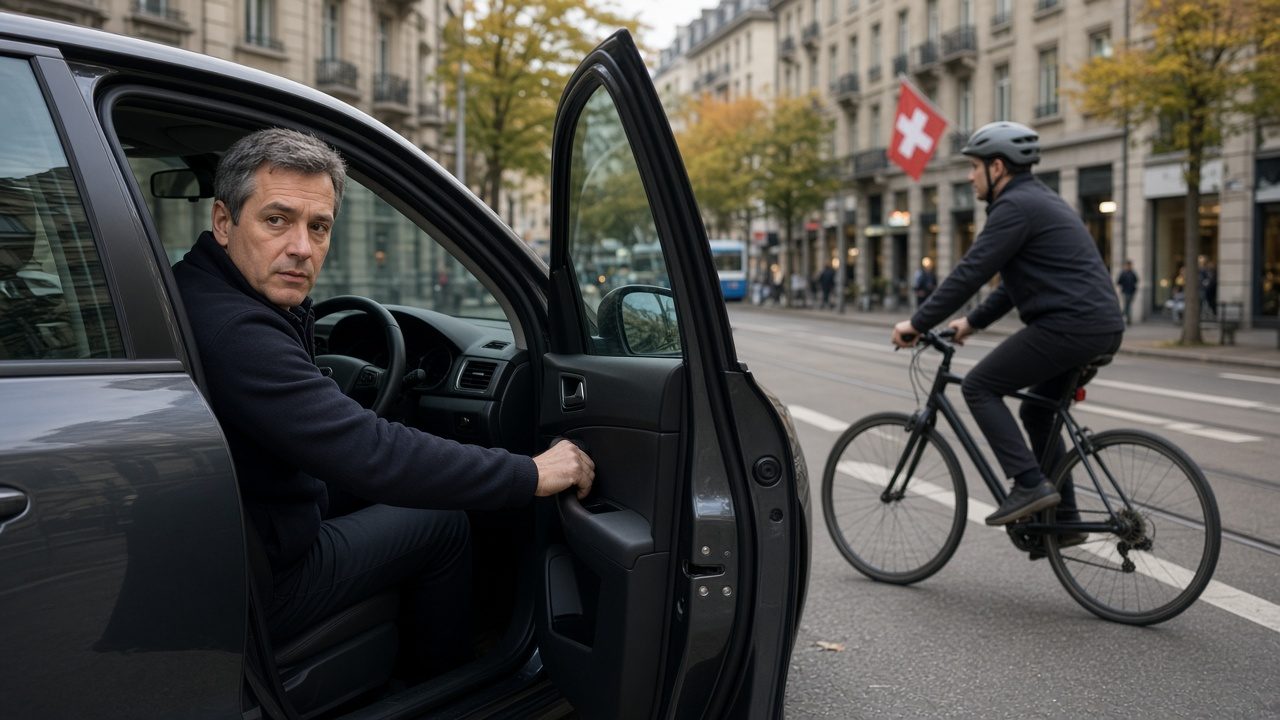
BERN. A Lucerne member of the National Council wants Switzerland to prescribe by law how motorists open their car doors. Hasan Candan has proposed making the so-called Dutch Reach compulsory: opening the door with the hand furthest from the latch, which turns the upper body and forces a glance over the shoulder before the door can swing into the road.
The target of the proposal is dooring, the collision in which a cyclist rides into a door opened without a look. Road safety statistics list it among the most common causes of urban cycling injuries, and among the most avoidable: the cyclist has no escape line, the driver had every chance, and the injuries land hardest on the rider’s head and shoulders.
The technique takes its name from the country that normalised it. Dutch driving schools have taught the far-hand method for decades, in a nation where the bicycle has priority in practice long before it has it in law. The reach costs nothing, needs no equipment and adds roughly three seconds to leaving a car.
The counterarguments
Not everyone in the Council is persuaded. Critics answered that a state which regulates how a hand reaches for a handle has lost its sense of proportion. The road traffic act already obliges every road user to act with due care, they note, and one more unenforceable rule will change nothing on the street. The debate has divided members well beyond the usual party lines.
Cycling organisations answer that the law already prescribes smaller things: the seat belt, the child seat, the hands-free rule for telephones. A defined technique, they argue, is easier to teach and to test than a general duty of care, and driving schools could fold it into the first lesson at no cost to anyone.
What the proposal can realistically do
Legal scholars point out that the practical effect would lie less in fines than in liability. Once a technique is codified, a driver who doors a cyclist after opening with the near hand has breached a specific duty, which matters greatly in the civil and insurance proceedings that follow such collisions. The rule’s real audience is the claims adjuster as much as the motorist.
The proposal now goes to the transport committee, where it will be weighed against the autumn’s larger road safety questions. Whatever its fate, it has already achieved the first thing such motions are for: this week, far more Swiss drivers know what the Dutch Reach is than did last week.