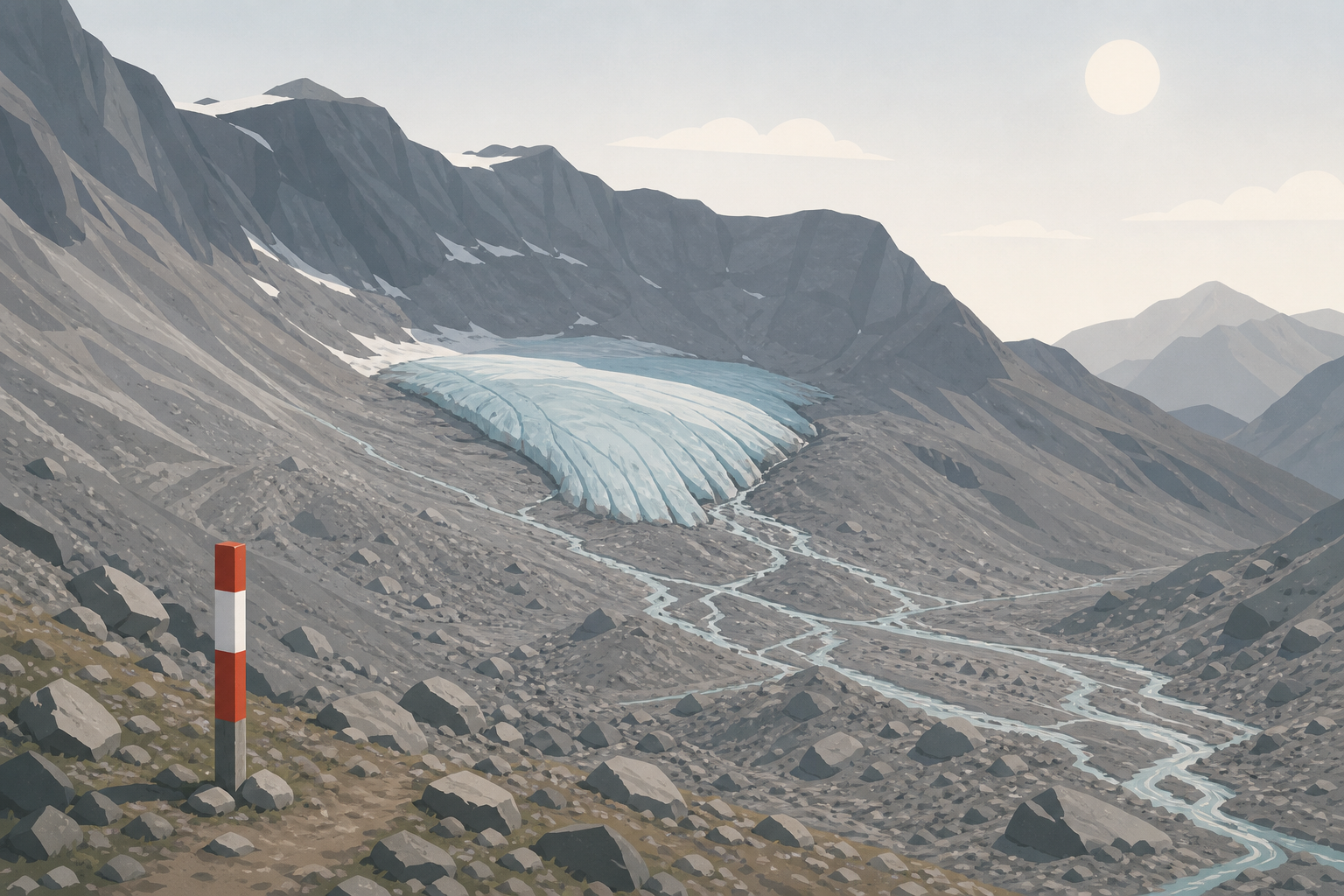
BERN. The hot summer is taking a historic toll on Switzerland's glaciers. The melt season is on course to be the second most severe since records began, and between 20 and 30 small glaciers are expected to lose their remaining ice and disappear entirely, according to the glaciologist Matthias Huss.
Huss, who leads the Glacier Monitoring in Switzerland network, GLAMOS, said two unfortunate factors had combined. The glaciers emerged from winter with unusually little protective snow, and intense heat set in early in the summer. The snow cover that shields the ice melted away on 29 June, the second earliest date ever recorded.
Small glaciers are the most exposed. “I expect many small glaciers to disappear this year,” Huss said, while cautioning that an exact figure is difficult until the measurement season ends in September. His current estimate is 20 to 30.
The large glaciers are in no less trouble, only slower to show it. At low altitude the big tongues, including the Aletsch and the Rhone glacier, have lost metres of ice thickness in a single season. Monitoring teams describe bare, grey ice where reflective snow should still lie in August.
The long run figures give this summer its context. More than 1,100 of the country's small glaciers have vanished since the early 1970s. The survivors have lost 40 per cent of their volume since 2000 alone, shrinking from 75 cubic kilometres to about 45 by the end of 2025. On current trajectories, Switzerland could be nearly glacier free between 2050 and 2070, with only a few giants surviving to the end of the century.
What disappears matters far below the snow line. Glaciers act as the country's second reservoir, releasing stored ice as meltwater precisely in the hot, dry weeks when rivers run lowest. Hydropower, which supplies more than half of Swiss electricity, leans on that flow. “Today, glaciers melt all summer long, providing a steady stream of runoff,” said Giovanni De Cesare, who heads the Hydraulic Constructions Platform at EPFL. “When they are gone, we will have to rely directly on precipitation, rain and snowfall, which is much less predictable.”
This year, paradoxically, the melt has been so extreme that it propped up river flows and hydropower output through the heatwave. That is borrowed water, released from ice accumulated over centuries and never to be replenished. Each summer like this one spends down the reserve that made the dry weeks manageable.
The ecological shift is visible in the streams themselves. Researchers studying glacier fed rivers find them turning clearer, calmer and warmer as the ice retreats, with algae spreading where grey, turbulent meltwater once kept everything scoured and cold. The grey streams are turning green, a change measured in samples from hundreds of valleys.
Mountain communities are adapting in pieces: protective covers on a few tourist exposed patches of ice, new reservoir projects higher up, early warning systems for the floods that collapsing ice and permafrost can release. Covers, scientists note, can slow melting locally. They cannot be stretched across an Alps worth of glacier.
The definitive balance sheet for the summer will be drawn up at the end of September, when GLAMOS teams take their final measurements across the monitoring network. The expectation, Huss says, is already fixed: a loss second only to the record year, and a map of Switzerland with two to three dozen fewer glaciers on it.