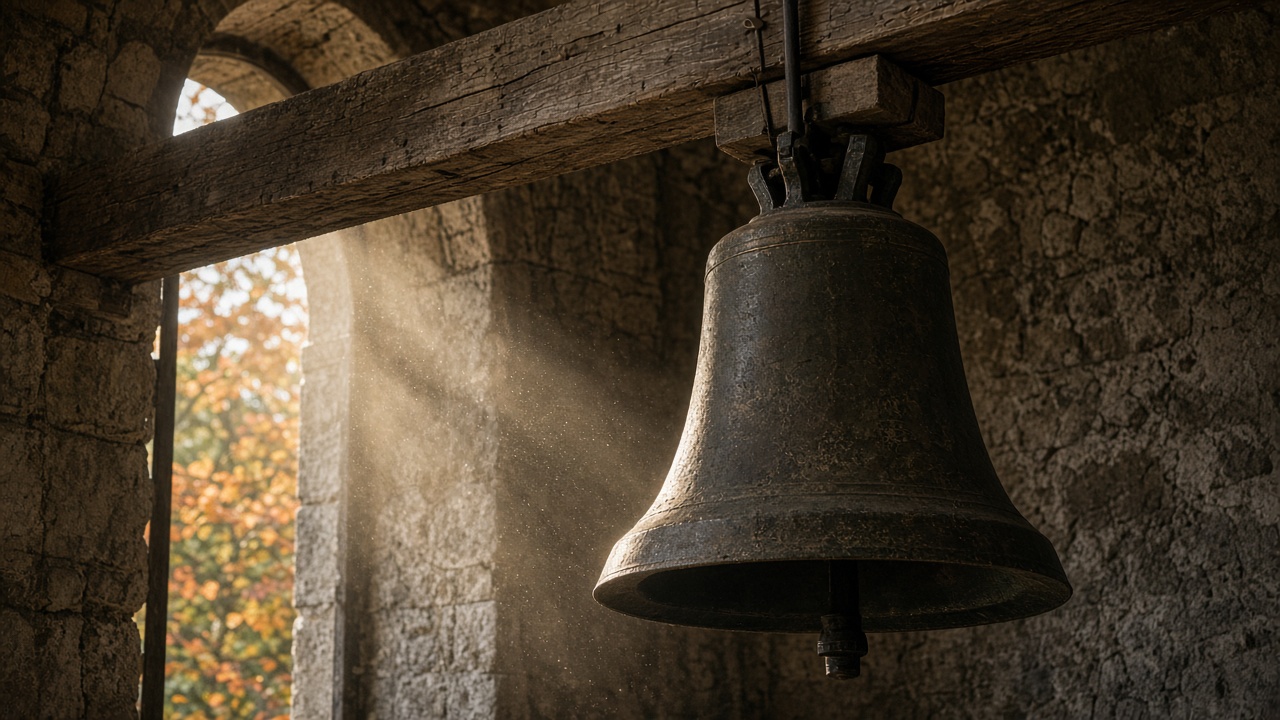
HERISAU. About fifty churches in eastern Switzerland are struggling to ring properly after this summer’s heat. The bronze did not fail. The wooden beams that carry the bells dried, shrank and in places cracked, so that bells dropped and hammers no longer reached them. Tower technician Sandro Fraefel told RTS it has been a record year for this kind of repair. In the worst cases the whole timber frame can shift by as much as ten centimetres.
At the Catholic church in Schänis, in canton St Gallen, the bell sounds less often than the parish is used to. “The wood shrank as it dried, the bell dropped, and the hammer can no longer strike it,” Fraefel said. A swinging bell is several tonnes of bronze. If the frame has moved, the bell can meet the wall. That is why he checks the structure, not only the clapper.
A few turns of a screw, or a bell on the floor
The repair, once the cause is clear, is often small. In Herisau, in Appenzell Ausserrhoden, a few turns of a screw lift a bronze bell nearly three centuries old back into the path of the hammer. Fraefel described the result with the pleasure of someone who has spent a summer on ladders. It rises a few centimetres, it strikes, and the village hears it again. At the Reformed church in Roggwil, in Thurgau, the sexton Nicole Gmünder had already called him in the hot months. “Normally it goes bimbam. Here it was only bim. The second strike was missing.” The outside hammer, the one that marks the quarter hours, was the one that missed. People in the village asked what was wrong with the bells. The answer was a thirsty beam.
The failure mode that is not small is a bell that falls. Fraefel said it has happened. A warning was given, the reply was that money was the issue, and then the bell came down. The parish in Schänis denies any current safety problem, and says the tower is being watched. Gabi Corvi, president of the parish council, put the loss in local terms. “Without the sound of the bells, something would be missing here in Schänis.” Watching a beam is cheaper than explaining a crater in the nave. It is still a bill that a small parish did not have on the summer list.
Why the hottest summers hit the tower
Metal expands in heat. That is the railway problem, and it is the obvious guess for a bell. Fraefel’s finding is the opposite. The bell stayed the bell. The timber gave up its water, the beam bowed, and the geometry of a strike that has worked for decades was suddenly a centimetre short. SRF, which followed him earlier in the autumn, quoted him saying this summer’s run of repairs was something his trade had not seen, and that two checks a year may be wiser than one.
The summer that did it is not in dispute. Swissinfo has reported a maximum of 39.7 degrees at Basel-Binningen on 30 July, among the highest readings ever taken in the country. The north-east and the Grisons took a heavy share of the hot days. The same heat sent people uphill and handed the cable cars a record season. It also quietly retuned the towers they could hear from the valley. A record year for lifts and a record year for bell repairs are the same season, counted in different workshops.
What a parish can check before the next July
The useful habit is dull. Look at the beam before the hammer starts to miss, not after a bell has dropped. A screw adjustment is a small job when the wood has only shrunk. A fallen bell is a different invoice, and a closed church. Eastern Switzerland has about fifty towers already on Fraefel’s list. The next hot summer will not be more gentle on timber because this one was a surprise. The surprise, he is arguing, should now be over.