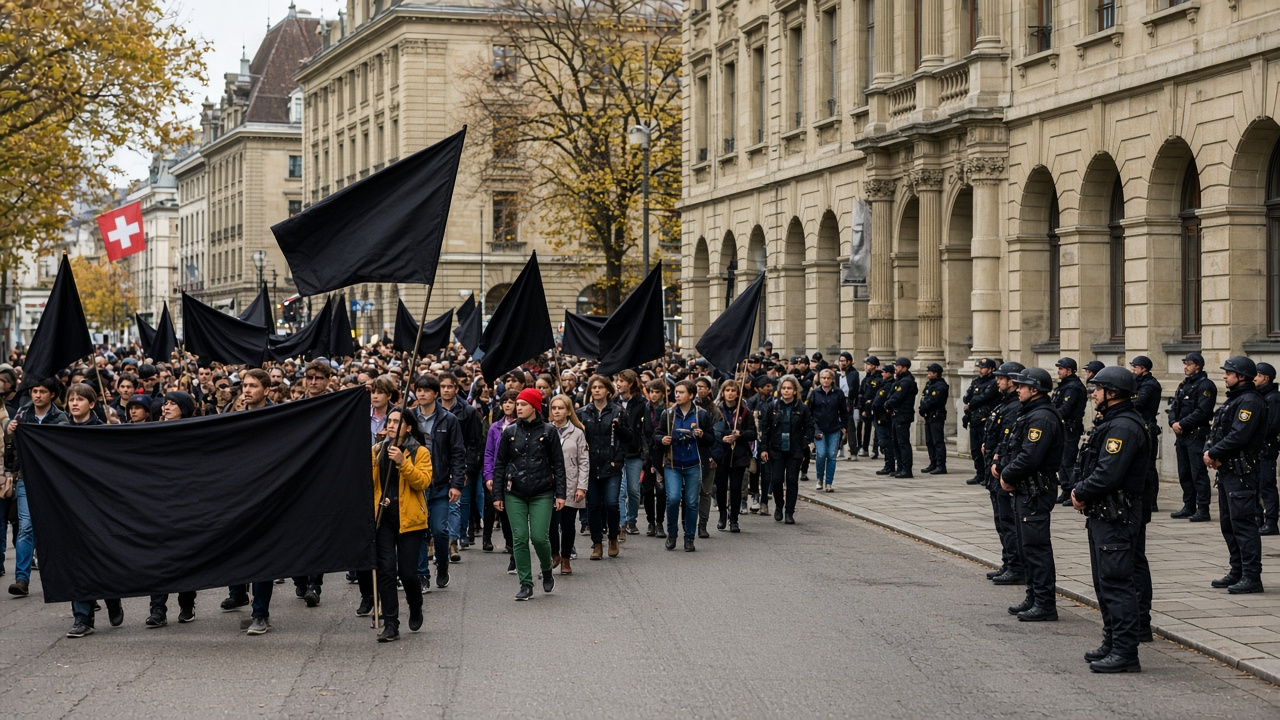
BERN. Around 1,000 people took part in an unauthorised demonstration against capitalism and imperialism in Bern on Sunday, one year to the day after a Gaza protest escalated into one of the worst nights of violence the federal city has seen. This time, the city held. The cantonal police declared in the early evening that the rally had passed without major incident, and all roadblocks were lifted before dark.
The anonymous organisers had called for the gathering under the slogan Smash Imperialism, with the Rosengarten among the meeting points. From there, groups moved through outer districts toward the Reitschule, escorted by a large contingent of Bernese police reinforced by officers from other cantons. Online appeals had named possible targets: UBS, the Raiffeisen bank, the Amthaus, the city hall and the headquarters of the energy company BKW.
The police answered with geography. The Nydegg bridge and the bridge at the Bärengraben were sealed, cutting the old town off from the march, and a water cannon stood ready on the Kornhausplatz. Loudspeaker announcements told the crowd which route would be tolerated and which would not. Targeted identity checks had begun shortly after midday, the force reported on the platform X.
What the police report
The evening balance was short: identity checks carried out, material confiscated, isolated cases of vandalism along the route. One person was detained who, according to the police, felt disturbed by the rally and was carrying several knives; the individual was taken to a station for further investigation. No injuries among demonstrators, officers or bystanders were reported.
The date was the point. On 11 October 2025, a pro-Palestinian demonstration in Bern turned into running battles that left demonstrators, officers and bystanders injured and caused extensive property damage. The police stopped 536 people that night, later identified 101 suspects and filed charges against 75 of them, for breach of the peace, property damage and assault. The operation itself remains disputed, and no verdicts have yet been handed down.
New tactics on both sides
Observers noted that the demonstrators avoided a single large formation, moving in decentralised groups and at points paralysing traffic across the inner city. The police, for their part, declined to kettle the crowd, a tactic that drew heavy criticism last year. One city official who followed the operation summed up the afternoon: the demonstrators avoided encirclement, the police avoided escalation, and both got what they wanted.
The demands, carried on banners through the afternoon, ranged from an end to military occupations and state repression to the protection of indigenous peoples and the restoration of historical land rights. The march dissolved near the Reitschule in the early evening.
Whether the day changes the politics of unauthorised protest in Bern is another question. The city’s security directorate will review the operation this week, and the organisers, whoever they are, have shown they can move a thousand people through the capital without giving the police a head to negotiate with. A year after the night nobody wants repeated, that counts as an outcome both sides can live with.