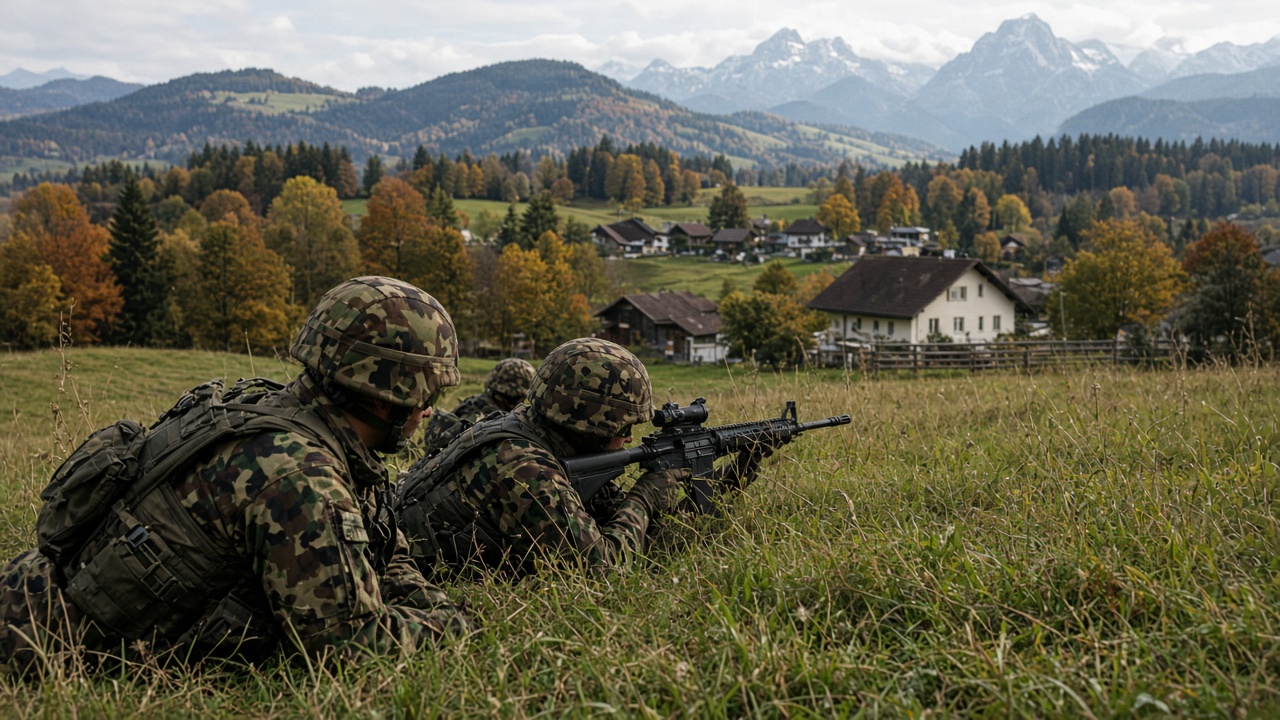
BERN. A Senate committee wants the Swiss army to be allowed to train outside its weapons ranges, in villages, valleys and mountain country, wherever an exercise scenario requires. The Security Policy Committee of the Council of States backed the move by 9 votes to 3. The sponsor is Thomas Burgherr, a People’s Party member of the National Council. The full Council of States is due to decide in December. If it agrees, the Federal Council would have to turn the idea into practice.
Burgherr’s case is that soldiers should leave the ranges and train on the terrain they would have to defend in a real emergency. He is not asking for a single new national exercise area. He wants units to be able to work, in his account, in the middle of the population, in the place the scenario happens to demand. That place might be a village, a valley or a stretch of mountain.
Conservation on the other side of the same map
Hasan Candan, a Social Democrat in the National Council who works on environment and biodiversity in Bern, called the demand critical and said he rejects it. Exercises off the existing ranges, he warned, can mean a massive disturbance of wildlife and of ecosystems. Training on ground that has already been set aside is, in his view, clearly preferable. The objection is not to the army having space. It is to the army treating the rest of the country as spare space.
The collision is a familiar Swiss one, sharpened by the rearmament debate. Bern is buying drones, air defence and cyber tools, and it is doing so while about 12,000 conscripts a year choose civilian service instead of the ranks. An army that is smaller, and told to be more serious, is an army that will ask for more realistic ground. Realistic ground, in a country this dense and this protected, is somebody’s pasture, somebody’s reserve, or somebody’s street.
December, then the ordinance
Nine to three in committee is a strong steer, not a statute. The Council of States can still narrow the motion, attach conditions, or send it back. What it cannot do, if it passes the text in this spirit, is pretend the ranges are enough for the training the sponsor has described. Implementation would sit with the Federal Council, which is where the practical limits usually appear: noise, notice to communes, closed paths, compensation for farmers, and the seasons when wildlife is not to be moved.
Supporters will say a militia army that only ever trains on a range is rehearsing the wrong country. Opponents will say a militia army that can arrive in any valley has forgotten why the ranges were drawn in the first place. December is when the upper house picks a side.