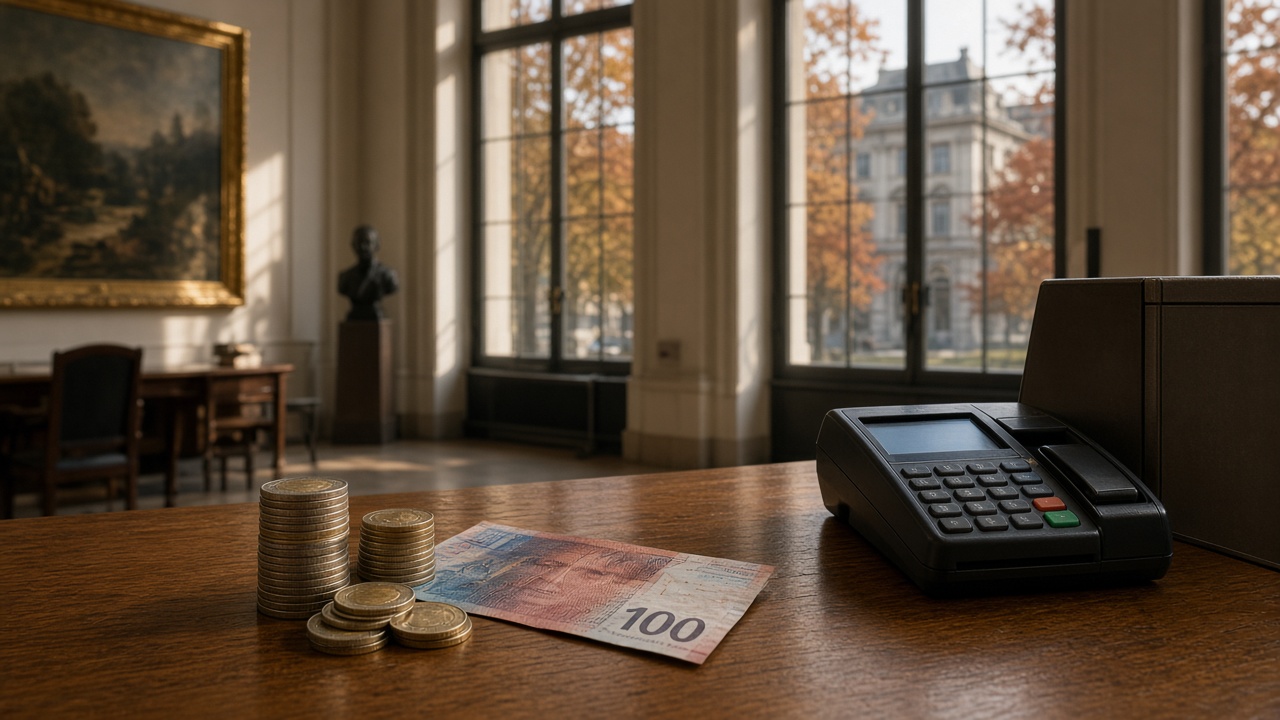
ZURICH. Zurich’s city parliament has ordered the executive to write a cash rule into the municipal order. Businesses run by the city, and businesses the city subsidises, would have to accept notes and coins. The vote on Wednesday was 73 to 44. It went through against the city council, and it was carried by a partnership that does not usually share a lobby: the left, and the Swiss People’s Party.
The row has a short history and a familiar set of places. The Kunsthaus spent about four months taking only cards and Twint, then went back to cash at the start of this year after the complaints arrived. The Polarzauber Christmas market in the main station announced a cashless hall last year and retreated within days. Christmas markets open again in less than four weeks. Parliament decided it did not want to rely on a public fuss to get the same result next time.
A motion that was narrowed, and still passed
The text began with the Alternative List. Tanja Maag argued that people still have reasons not to pay by phone or by card: a technical failure, a wish to stay off a data trail she called surveillance capitalism, or simply being a child who wants to buy something small. “Must children carry a card to buy small things?” she asked. Yves Henz of the Greens offered the picture that stuck: a grandfather at a stall with his grandchild and a twenty-franc note, unable to buy a present.
The SVP had already filed a postulate last November, limited to city-run operations, after the Kunsthaus experiment. Samuel Balsiger welcomed the left to language his party has used for years: independence, sovereignty, and protection from the state. The Alternative List wanted more than the postulate. Its motion covered city operations, subsidised ones, and businesses that merely trade on public land, and it demanded a change to the municipal order rather than another study.
City councillor Andreas Hauri, a Green Liberal standing in for mayor Raphael Golta, asked for proportion. Does it make sense, he said, to bind every organisation that receives even one franc from the city? Public pressure had already moved the Kunsthaus and the market. The executive had rejected the motion in May and pointed to an SVP postulate already in hand. The FDP, the Centre and the Green Liberals stayed with that view. Emanuel Tschannen of the FDP said it is not for the state to prescribe how a business is paid.
What the 73 votes actually cover
The Social Democrats backed the aim and disliked the reach. Sofia Karakostas moved to drop the clause on businesses that only occupy public ground, arguing the clash with economic freedom was too large. The Alternative List accepted. The version that passed covers municipal operations and subsidised ones, not every stall with a city permit. The executive must now draft the amendment it did not want.
Federal currency law already says cash must in principle be accepted, and that the duty can be limited by contract. The city council’s own lawyers have noted that the state, when it performs a public task, is also bound by fundamental rights, and that shutting out cash can be an interference with those rights. Wednesday’s vote decides that Zurich will not leave that question to the next museum that would rather not count coins. The drafting, and the argument about one franc of subsidy, still sit with the executive.