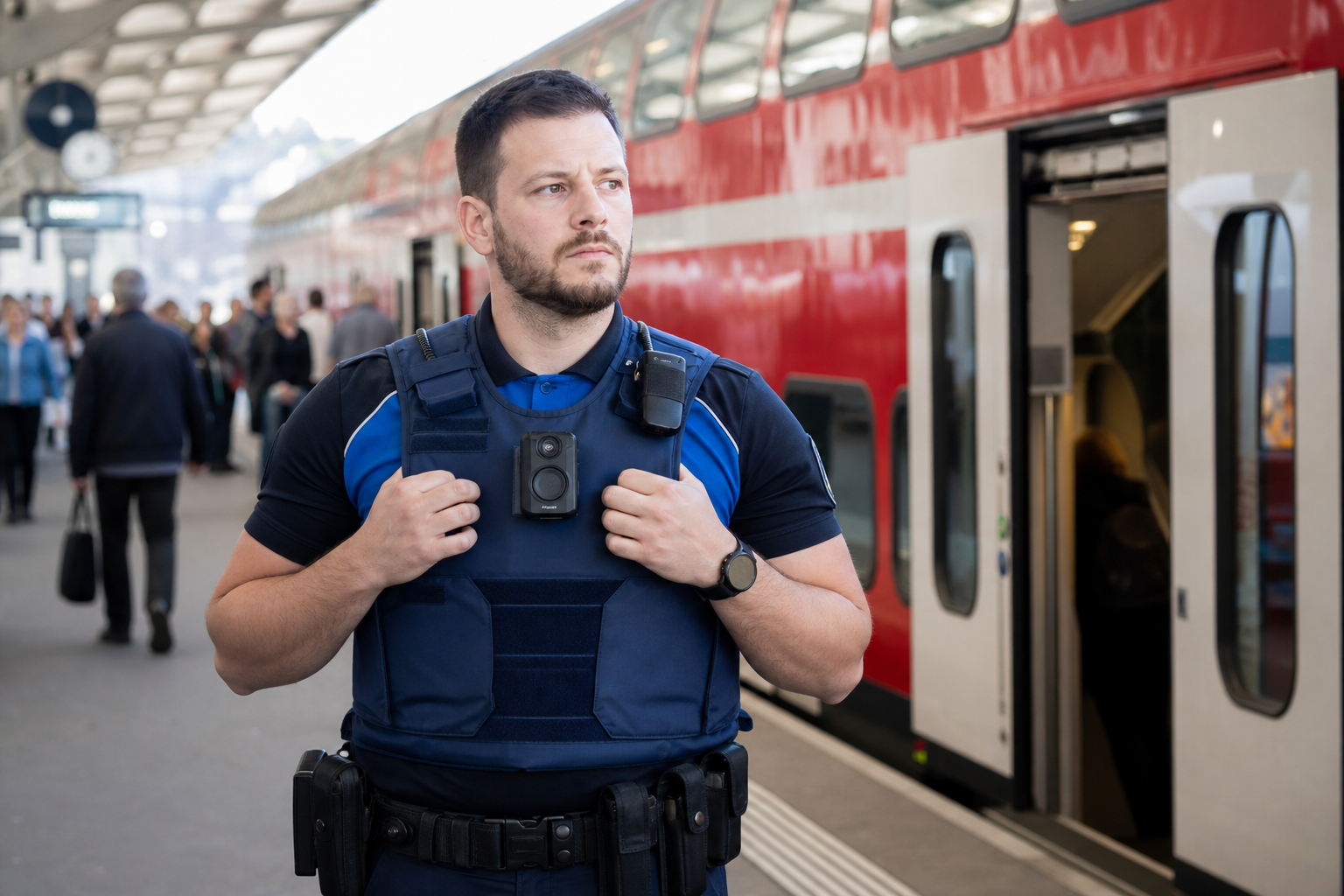
BERN. Switzerland’s transport police are to be armed with tasers, and the country’s trains, buses and trams fitted for a new era of recorded policing. The Federal Council has opened consultation on two ordinance changes that give the Transport Police Unit a legal basis for conducted energy weapons, expand the use of body cameras, and permit live video surveillance inside vehicles under strict conditions.
The trigger is a number that has become impossible to ignore in Bern. According to figures from the transport police and the Federal Railways, staff face around 35 assaults a month, more than one a day, up from 22 a month in 2023. The victims are mostly customer attendants and ticket inspectors, and the trend has survived every awareness campaign the railways have run.
The government’s argument is about the space between two tools. Today a transport officer facing a violent passenger can reach for pepper spray or a baton, or for a service pistol. The taser, which fires darts that deliver a high voltage charge and briefly paralyse the muscles, is meant to close that gap with what officials call proportionate force.
Every use is to be documented. Body cameras become standard for transport police precisely so that the legality of each taser deployment can be reviewed after the fact, and the legal basis is being extended so that drivers, ticket inspectors and escort staff can wear cameras too.
The most delicate change concerns the fixed cameras already installed in carriages. Live monitoring, watching a feed in real time rather than reviewing recordings later, would be allowed only when a data protection impact assessment confirms an overriding interest for a given route and time of day, or when a passenger on board requests help. Passengers must be informed whenever live surveillance is active, and artificial intelligence may be used to evaluate the recordings.
All of it is temporary by design. The taser, bodycam, live monitoring and AI provisions expire after five years, a sunset clause meant to force parliament to write a permanent federal law in the meantime. The consultation runs until 16 November.
The legal path began with a motion from Michaël Buffat, a Vaud member of the National Council from the People’s Party, which parliament adopted as motion 23.4291. The Federal Council’s ordinances implement that decision, and its message repeatedly frames the package as a response to what it calls rising violence against public transport staff.
Reaction so far splits along the expected seam. The railways and the staff unions have long demanded exactly this package, arguing that attendants cannot be asked to enforce rules unarmed against passengers who arrive armed themselves. Privacy advocates and parts of the left are uneasy about the surveillance half of the package: live feeds, AI analysis and body cameras on train crews amount, they argue, to a permanent sensor network in the country’s most public space.
The government’s answer to that unease is procedural: impact assessments, notification duties and the five year clock. Critics reply that a sunset clause is only as strong as the parliament that must act before it lapses, and that the history of temporary security powers, in Switzerland as elsewhere, is a history of renewal.
For passengers, little changes this year. Consultation, ordinance drafting and procurement mean the first tasers would reach transport police belts in 2027 at the earliest. What changes today is the direction of travel: after decades in which the conductor’s whistle was the symbol of order on the Swiss railway, the state is preparing to put a conducted energy weapon behind it.