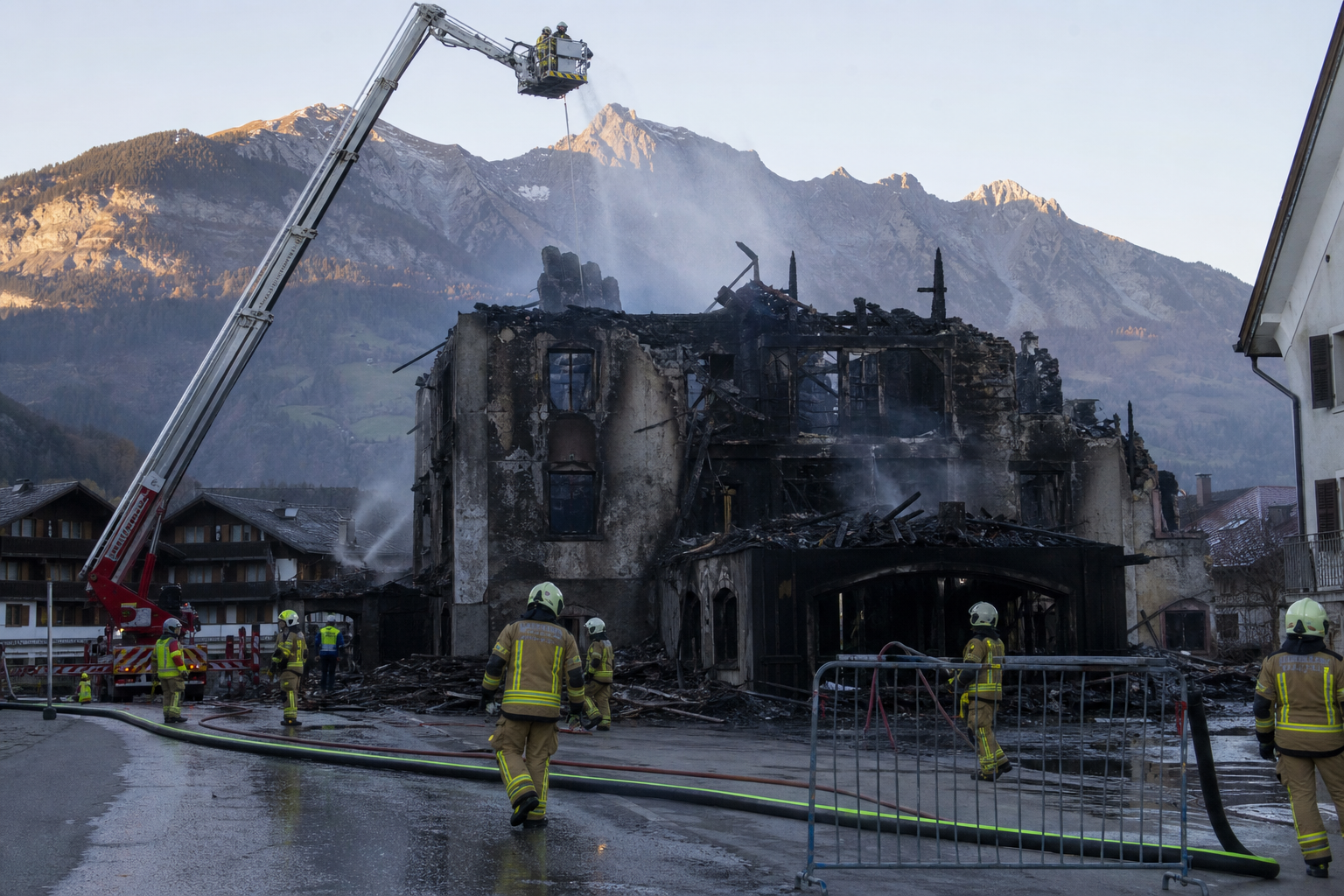
THUSIS. Prosecutors in Graubünden have remanded a person in custody over the house fire in Thusis that killed four people last week, opening criminal proceedings on multiple counts of negligent homicide and negligent bodily harm.
The fire broke out shortly after midnight in the night to Friday, 21 August, in a multi-storey building in Thusis housing a restaurant and several flats. Fourteen people escaped, some injured, but the stairwell collapsed as the fire spread, and firefighters had to peel the roof away layer by layer with a crane to reach those trapped inside.
The prosecutor’s office has now identified the four dead: a 32 year old Portuguese woman, two Romanian men aged 35 and 44, and a 57 year old Bulgarian man. The number of injured has been revised to six. Around a hundred firefighters from Thusis and neighbouring corps, including the Ems Chemie works brigade, fought the blaze through the night.
The arrest marks a shift in the investigation, from the recovery of victims to the question of responsibility. The charges as announced are negligence offences rather than intentional ones: negligent homicide and negligent infliction of bodily harm, counts that point toward a failure of care rather than a deliberate act. The person in custody has not been named, in line with Swiss practice.
What started the fire remains unknown. The first findings placed the outbreak on the building’s second floor, but the public prosecutor told Swiss broadcaster RSI that the investigation is complex and will take time. Fire investigators must work through a structure that partially collapsed, a slow and methodical process.
Thusis, a town of around 3,500 people at the entrance to the Domleschg valley, has spent the week between grief and unease. The victims were residents of the kind of shared building that houses much of the workforce of the region’s hotels, kitchens and building sites, a fact that has not been lost on the town.
The legal path from here is long. The prosecutor must establish the cause of the fire, then whether it was foreseeable, then who bore the duty to prevent it. Custody at this stage signals that investigators have a concrete suspicion, not that they have answers. Those, the prosecutor’s office cautions, are still weeks or months away.