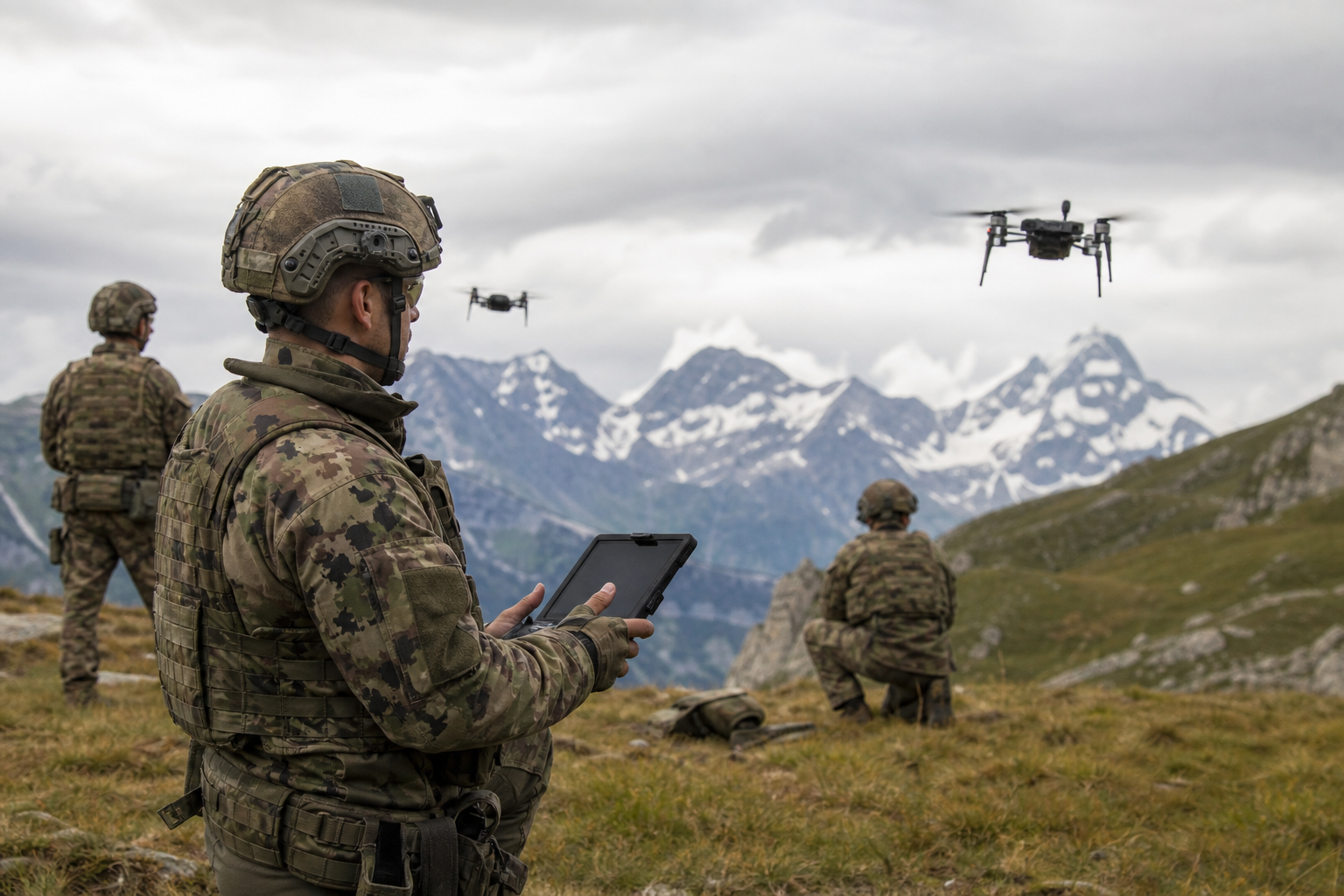
THUN. Switzerland will field its own military drone battalion from 2028, the defence ministry announced on Thursday, the country’s most concrete answer yet to a form of warfare that has reshaped battlefields from Ukraine to the Middle East.
Defence Minister Martin Pfister, armed forces chief Benedikt Roos and armasuisse director Urs Loher presented the package at the Thun parade ground: a battalion for reconnaissance, strike and defence, a dedicated drone recruit school to train its personnel, and a new Centre for Unmanned Systems to pull the technology into the army faster.
The centre is the part officials lingered on. Conceived as a civil-military hub combining a technology base with a military command, it is meant to bring together the needs of the troops, the procurement expertise of armasuisse and the research strength of universities and industry. New systems, the ministry said, are to be developed together, tested and made usable for the army quickly. Other departments, the cantons and the emergency services will also have access.
The threat assessment behind the move is stated plainly in Bern: drones now dominate crises and wars, they are central to hybrid conflict, and the number of drone flights observed over military and critical infrastructure in Switzerland itself is rising. The first Swiss counter-drone systems have already been introduced.
Money follows the rhetoric, in the Swiss manner, on a delay. The Federal Council’s defence guidelines of June and this year’s armaments message set the direction; the 2027 armaments programme allocates funds to protect more infrastructure and units and to equip the new battalion. Because the technology changes faster than procurement cycles, the army says it will buy in smaller quantities and shorter cycles rather than commit to fleets that age in the warehouse.
The groundwork has been laid by Taskforce Drones, an interdepartmental project running since June 2024 with dedicated funding since early 2025. Its work, due to conclude in 2027, has included testing the first Swiss drone systems, training the first soldiers on attack drones and validating training concepts. Candidate testing grounds across the country are under review.
The announcement lands in the middle of a domestic argument about what Swiss security is for. Four weeks before the referendum on writing a stricter neutrality into the constitution, both camps will find material in Thun: the Yes side will read a neutral state arming to defend its own territory, the No side a country quietly aligning its kit and doctrine with the European mainstream.
That mainstream is rearming at speed, and drones are the cheapest way in. For Switzerland, whose defence model still rests on a conscript militia, the recruit school may prove the harder build: drones are bought, but operators, instructors and doctrine are trained, and the battalion’s 2028 date leaves barely two years of training cycles.
The legal framework must move too. The ministry says regulations and responsibilities will be adapted to the threat picture, a phrase that covers everything from airspace rules over barracks to who may jam a drone over a railway line. Parliament’s security committees will want the details in writing before the money flows.
What is no longer argued in Bern is the direction. “Drones, counter-drone defence and robotics are now a strategic priority,” the ministry said on Thursday. The battalion, the school and the centre are the first institutional shape of that sentence. They will not be the last.