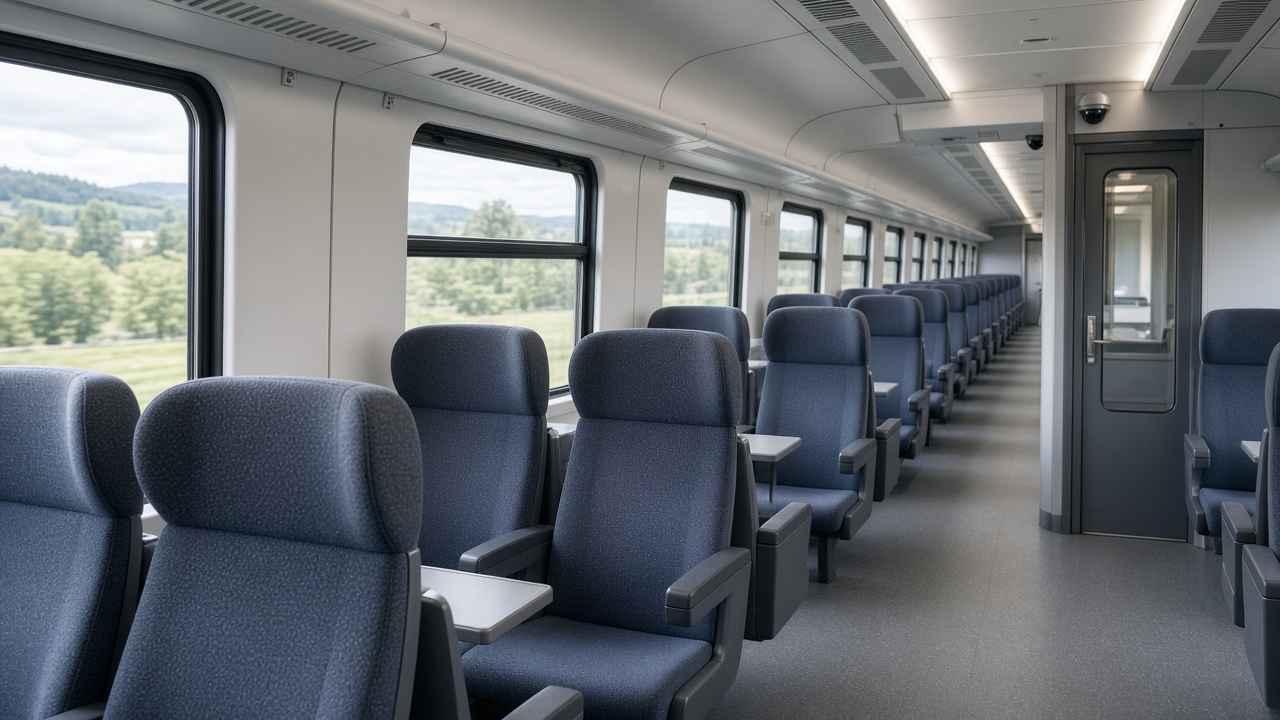
BERN. SBB said on Tuesday that a system for counting passengers with existing security cameras has been examined only as a proof of concept, and that no decision has been taken to use it. The railway’s own statement is narrower than the morning papers, which reported a live test of artificial intelligence and a possible rollout from 2029. Both can be true only if the test is over, and the decision is not.
What passengers see today in the SBB app is a forecast, not a live headcount. The little occupancy markers use the timetable, the day of the week, holidays and known events. They are often wrong, which is why the railway wants better counts. Better counts, it says, would sharpen the forecast, spread people through the train, speed up boarding and help punctuality. That is the benefit. A camera is only one candidate for producing it.
What the railway has actually decided
The system SBB is rolling out is the one regional trains already use. Optical sensors above the doorways into the seating areas count people as they pass. Long-distance services are getting that, step by step. It does not identify anyone. It is not the security-camera project.
On the cameras, the statement of 3 November is careful. A possible new system, using security cameras already in the carriages, “has so far only been examined as a proof of concept”. It is not settled that it will be used at all. If it were, the only permitted purpose would be to count passengers. Identifying a person, or using facial recognition, would be ruled out. Before any introduction, SBB says it would talk early to the federal data protection and information commissioner. The railway adds that data protection compliance is not the whole of its duty: it takes passenger worry seriously.
What Parquery says the cameras can do
The company attached to the idea is Parquery, a spin-off of ETH Zurich. Tamedia newspapers reported on Tuesday that its software, reading the ceiling cameras already installed, counted passengers with 98 per cent accuracy in the trial. Andrea Fossati, Parquery’s chief executive, told them a regular introduction on trains is not planned before 2029 at the earliest. He also said the system takes only a live video stream, stores no image, and does not identify people.
The errors the trial had to train out are ordinary. A passenger who boards in a cap and takes it off before getting off can break a naive count. So can a hood, an umbrella, or a pile of luggage. Low ceilings, around 2.1 metres on some coaches, and doors on both sides mean one sensor is not enough: a tall passenger hides a shorter one. Parquery says the model was trained to treat the same person as the same person when their appearance changes, and to avoid counting them twice when two cameras see the doorway. None of that is a decision by SBB to switch the system on.
Why the privacy question is still open
SBB has a reason to speak softly. In 2023 it wanted cameras in major stations that could recognise faces, and dropped the plan after a backlash from privacy advocates. A carriage camera that the railway now swears will only count heads arrives in the shadow of that retreat. A proof of concept that never stores a face is a different tool from a recognition system. Passengers cannot audit that difference from a seat, which is why the commissioner’s review, if the project proceeds, is the part that matters.
Until then, the occupancy icon in the app remains a forecast. The sensors over the doorways are the count SBB has actually chosen to extend. The cameras are a file on a desk, with a startup’s accuracy claim on one side and the railway’s refusal, this morning, to call it a rollout. A wider rewrite of the data protection rules is already with parliament. A train that knows how full it is, and a train that knows who is on it, are not the same product. Tuesday’s statement is SBB insisting it has not bought the second one.