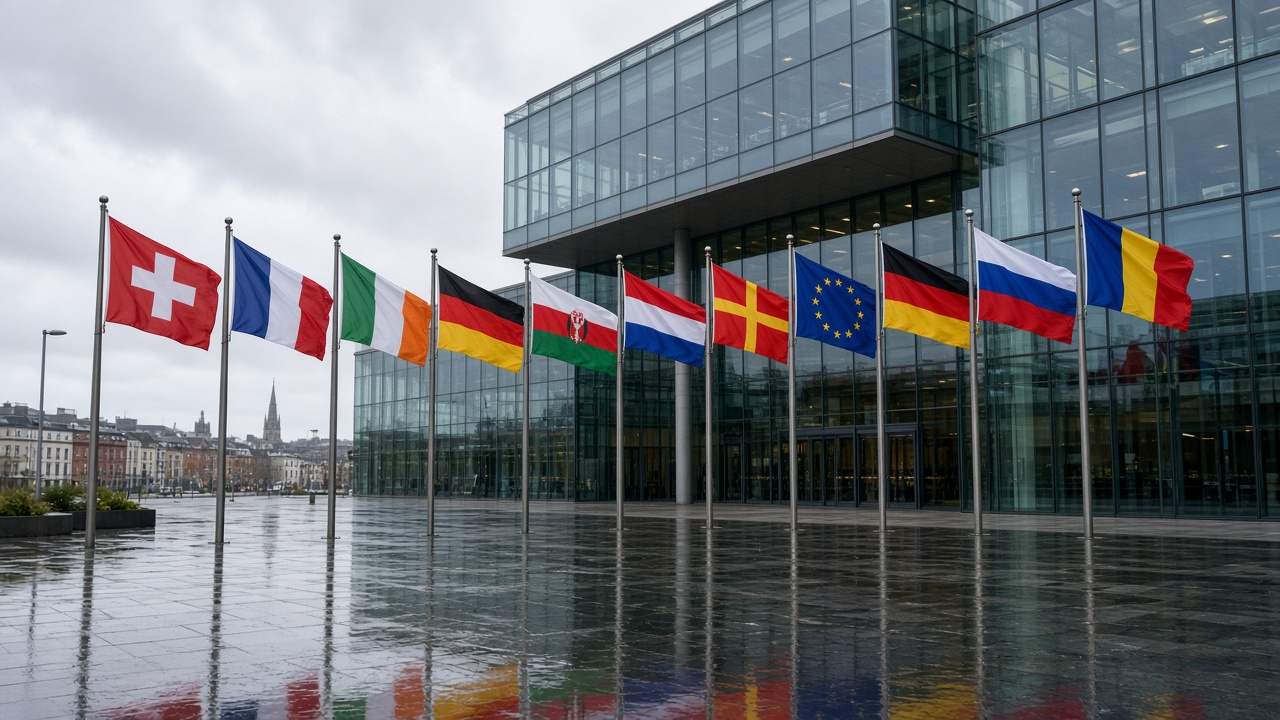
DUBLIN. President Guy Parmelin spent Thursday in Dublin at the ninth summit of the European Political Community, and he spent it partly as the host of the next one. The tenth summit will be in Zurich on 15 April 2027. About 45 heads of state and government met under the title “Europe, strong, secure and connected”. Parmelin co-chaired a discussion on competitiveness through innovation, connectivity and energy security, held bilateral meetings, and joined the closing press conference with Irish prime minister Micheál Martin and European Council president António Costa.
The community is not the European Union. Martin made that the opening point: unlike the EU, it puts leaders from the whole European continent in one room. Canada attends as a guest. The EU, NATO, the Council of Europe and the OSCE are in the circuit. Switzerland can therefore sit at the table without the membership question that dominates every other European meeting it attends. That is the format’s value to Bern, and it is why hosting the next round is more than a catering contract.
Who Parmelin saw, and what he said the room is for
On the margins he met Lithuanian president Gitanas Nausėda, ahead of Lithuania’s turn in the EU Council presidency in the first half of 2027. He also met Hungarian prime minister Péter Magyar, European Commission president Ursula von der Leyen, and British prime minister Andy Burnham. The department’s account of his public line was the one Swiss presidents use when they host: no country can handle Europe’s problems alone, and Switzerland is a place where different views can be put in the same room. He said the Zurich summit should serve a peaceful and prosperous Europe and should carry on the spirit of a format that has met twice a year since Prague in October 2022, alternating between EU and non-EU hosts.
The Dublin conversation itself, in the host’s summary, had four notes. Support for Ukraine. Cooperation against hybrid activity aimed at democratic processes. A determination to use technology to improve Europe’s capacity to innovate. And the energy questions that sit under all three, including interconnection and cost. Parmelin was on the press-conference platform for that summary. A Swiss contribution to Ukraine’s finances was among the questions put in the room. The summit did not publish a treaty. This format rarely does. It publishes a host, a date and a direction.
What Zurich inherits
A summit in Zurich on 15 April 2027 is now a planning fact for the city and for the federal government. Security, traffic and the diplomatic guest list will be closer to a state visit multiplied by forty-five than to a conference at the lake. Politically, the inheritance from Dublin is the agenda Martin listed, plus whatever the war and the energy system do between now and April. Parmelin will no longer be in office then. He has said he will leave the Federal Council at the end of this year. The host in Zurich will be his successor. Thursday’s announcement still binds the country.
For a Swiss reader the immediate significance is limited and precise. The president used his last major European set piece to take the next set piece home. The issues he co-chaired, innovation, connectivity and energy security, are the issues the Zurich meeting will be expected to look competent on. Nothing in Dublin changed a Swiss law. The date in April changed a diary. Between the two, the useful fact is that Switzerland has agreed to be the room, and has agreed to do it in Zurich, on a Wednesday in April, with the continent’s arguments about Ukraine, infrastructure and power still on the table.