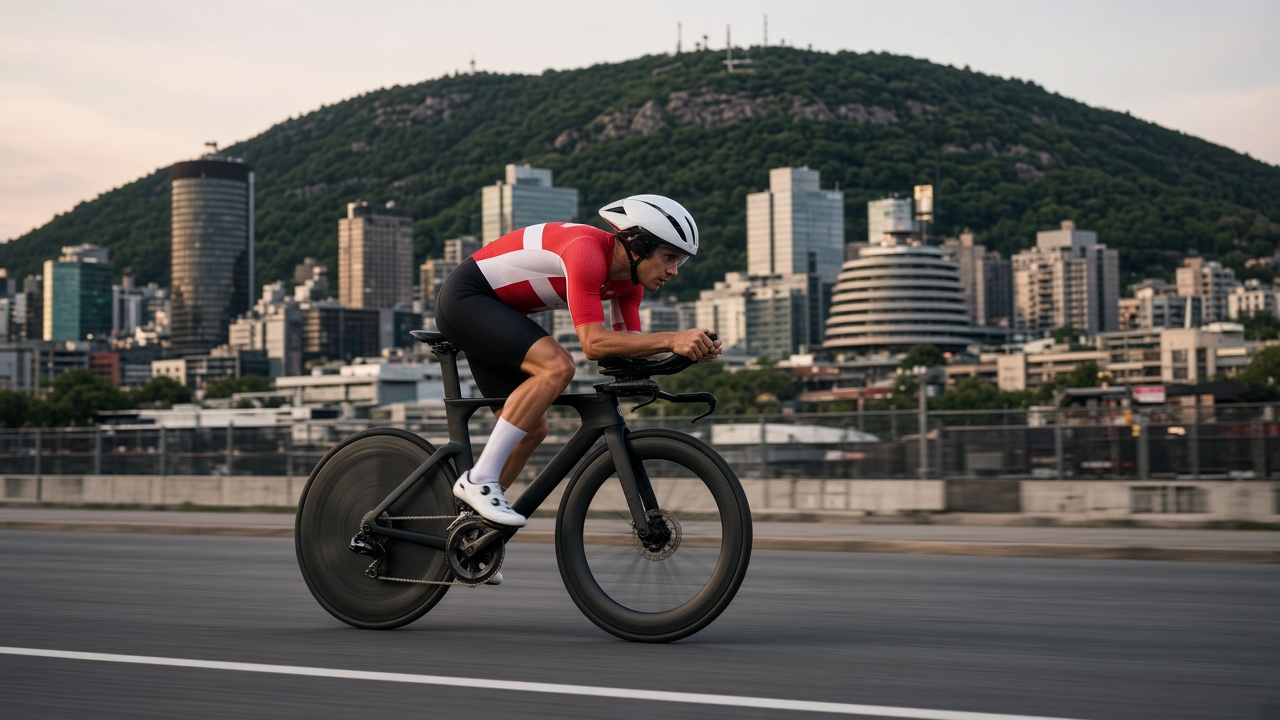
AIGLE. From its headquarters above Lake Geneva, the UCI will send its 99th road world championships across the Atlantic on 20 September. Montreal hosts eight days of racing from 20 to 27 September, 52 years after the city staged the first worlds ever held outside Europe, and Switzerland travels with its strongest time trial generation in decades.
The scale is unusual even by the standards of the sport’s biggest one week event. Thirteen races, around 1,000 riders from more than 80 countries, roadside crowds in the hundreds of thousands and a television audience above 200 million make it the largest sporting event Montreal has staged since the 1976 Olympics. Every race finishes on the Avenue du Parc, in the heart of the city.
The course
The time trials open the championships from 20 to 22 September, with the elite men and women racing 39.2 kilometres on the first day. The road races follow from 24 to 27 September, built around the Mount Royal circuit used by the Grand Prix Cycliste de Montréal since 2010. The elite men cover 273.7 kilometres and 3,803 metres of climbing over twelve laps; the elite women race 180.4 kilometres. The Voie Camillien-Houde and the Chemin de la Polytechnique, with ramps above 11 per cent, are where the races will be decided.
The first Sunday belongs to the specialists, and that is where the Swiss medal map is richest. Stefan Küng, a multiple world championship medallist against the clock, gets a course that rewards his kind of sustained power. Marlen Reusser leads the women’s time trial ambitions, and the mixed team relay on 22 September, an event Switzerland has won at world level, offers a third realistic shot at gold inside the opening three days.
The road races
The Mount Royal circuit is too hard for the pure sprinters and too flat for the pure climbers, which is precisely the terrain on which Swiss one day racing has built its reputation. Mauro Schmid brings the finishing speed for a reduced group, and Jan Christen, still only 22, rides his first elite worlds as the man the federation has marked for the Los Angeles Olympic cycle. The women’s squad is the deepest Switzerland has fielded, with options for an early break and a late attack alike.
Swiss Cycling confirmed its final selection this week, after the last WorldTour races of the summer settled the remaining places. The federation’s performance staff describe the squad as the best balanced of the modern era: genuine medal options in four events, and no passenger in any of them.
The history is not lost on the riders. When Montreal last hosted, in 1974, Eddy Merckx won the rainbow jersey in the city’s colours of late summer. The championships have crossed the ocean only rarely since, and each crossing has produced a race that riders remember as different: bigger crowds, longer transfers, and a circuit that punishes anyone who reads the profile from a hotel bed.
Eleven days out, the time trial bikes are being crated at the UCI’s World Cycling Centre in Aigle, where the federation’s mechanics share a building with the sport’s governors. Switzerland rarely starts a world championships with this much realistic hope. Montreal will measure how much of it was justified.