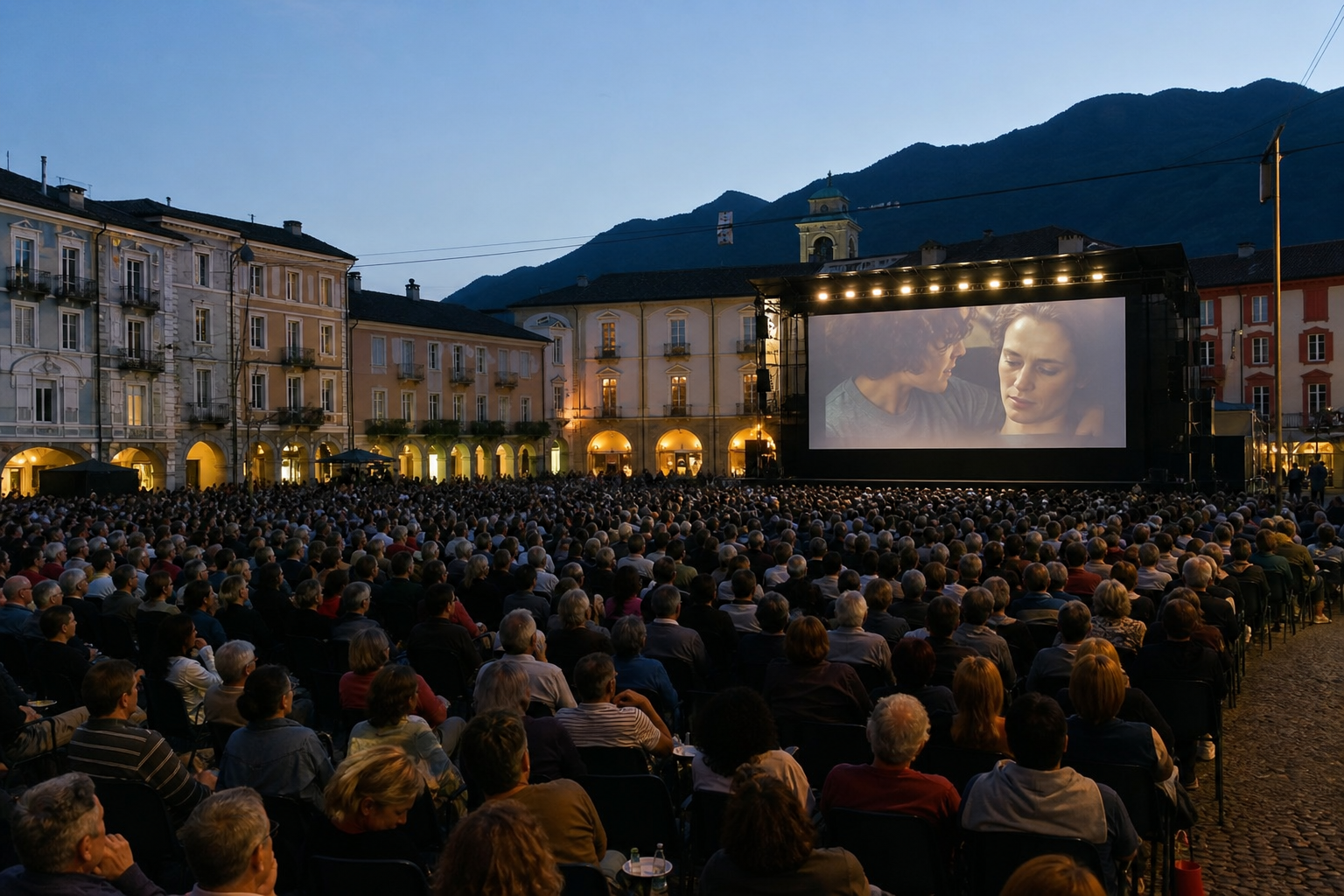
ZURICH. For eleven nights every August, the Piazza Grande in Locarno becomes what its programmers like to call the largest open-air auditorium in Europe, eight thousand seats ranged before a screen that rises between the church towers and the lake. Half a century after the square first served as the festival's emblematic stage, the ritual still feels improbable. A small town at the top of an Italian-speaking lake keeps hosting one of world cinema's most consequential gatherings, and the world keeps coming.
This year's edition followed the familiar, unlikely pattern. In the afternoons, the competition screens austere works by directors few in the audience have heard of; by night, the Piazza roars at premieres that will open the autumn season across the continent. The Pardo d'oro, the golden leopard, remains one of the few major festival prizes that can still make a career rather than merely confirm one.
The festival was founded in 1946, in the first summer of the postwar world, and its instinct for discovery was formed early. It championed directors from cinemas the bigger festivals ignored, from Eastern Europe during the Cold War to the new waves of Asia and Latin America. The move to the Piazza Grande in the early 1970s gave that curatorial seriousness a popular stage, and the combination has been the festival's signature ever since. The archive reads like a history of everything the mainstream missed first.
None of this is cheap, and the finances are a small miracle of Swiss federalism. The annual budget, well above ten million francs, is stitched together from the Federal Office of Culture, the canton of Ticino, the town itself, a roster of sponsors and the tills of the Piazza. Tickets for the big screen start below thirty francs, a deliberate decision to keep the festival's grandest gesture within reach of the town's own residents.
Around the main programme sits an architecture of cultivation. The Pardi di domani section gives emerging filmmakers their first international platform, the industry days connect producers from four continents, and a partnership with the Cinémathèque suisse anchors the retrospectives that have become the festival's quiet glory. Young critics and programmers attend alongside the stars, which is precisely the point.
The reaction this year ran from affection to something closer to awe. Critics noted that the competition felt stronger than those of far richer festivals, and distributors crowded the market screenings in search of the next arthouse sleeper. Several competition titles left with distribution deals in hand before the weekend. The audience award, voted nightly in the Piazza, went to a film without a single recognisable face in it.
The festival's leadership is frank about the formula. “The Piazza is our laboratory and our promise,” says the artistic director, arguing that a film which holds eight thousand people in the open air can hold anyone. It is a claim the festival has been testing, night after night, for five decades.
Locarno's identity is inseparable from its place in Italian-speaking Switzerland, a region whose cultural weight in the nation far exceeds its numbers. Subtitles run in three languages, the announcements in more, and for the German- and French-speaking press the festival is the one week of the year when Ticino sets the national cultural agenda.
The coming months carry the effect outward. The travelling showcase of competition titles will tour Swiss cities through the autumn, the next retrospective is already in preparation, and the industry platform has announced an expanded programme for first features from Africa and Southeast Asia.
The wider lesson of Locarno is that scale is not destiny. In an era when streaming platforms flatten taste into a global average, a festival that programmes against the grain and still fills a town square has become a kind of proof. Smallness, properly used, is a form of freedom. The sponsors and ministries that fund the larger festivals have begun asking what Locarno knows that they do not.
On the final night, the screen comes down and the square returns to its cafes and its pigeons. Waiters stack the chairs where, hours earlier, eight thousand people sat in silence watching a black-and-white film from a country most could not place on a map. The improbability is the tradition.