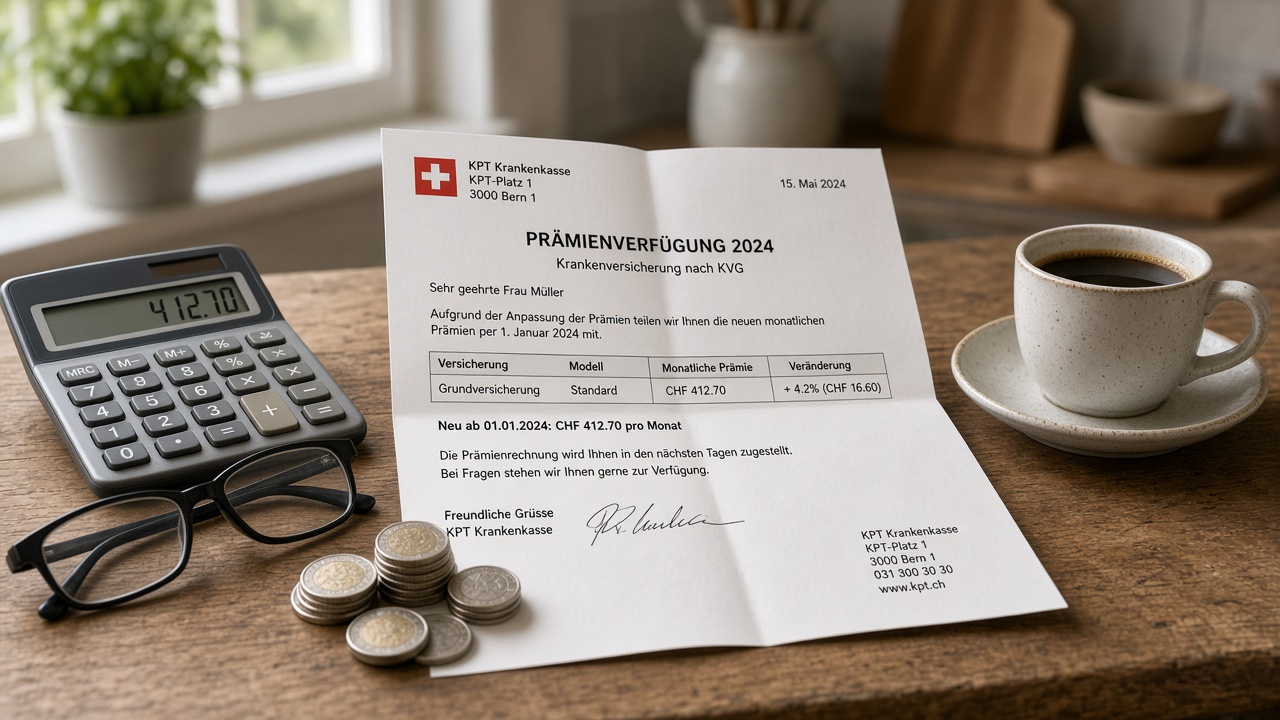
BERN. Health minister Elisabeth Baume-Schneider has confirmed the number the country has been waiting for since May: compulsory health insurance premiums will rise by an average of 4.9 per cent in 2027. The increase, announced at the Federal Office of Public Health on Tuesday afternoon, takes the average monthly premium from CHF 393.30 to about CHF 412.60, and marks the fifth consecutive annual rise. It is steeper than the 4.4 per cent imposed for 2026, and it lands exactly where the government’s own spring forecast said it would.
The figure is a weighted national average, and the office was at pains to say so. Premiums vary by canton, insurer, age and model, and the variation is not decorative. In 2026 the average adult premium ran from CHF 264.50 a month in Zug to CHF 501.50 in Ticino, and the gap between the dearest and the cheapest tariff for identical cover in the same commune routinely exceeds CHF 100 a month. Some households will open letters in October showing rises close to zero. Others will face double digits.
Why the number keeps climbing
The official explanation is the same as last year’s, with updated figures. Health spending rose by CHF 247 per capita in 2025, and the office says the trend has continued through the current year. The drivers are familiar: expensive new medicines and therapies, the shift of treatment from hospital wards to outpatient clinics, psychotherapy and weight loss drugs, and home nursing, whose costs grew faster than any other category at almost 15 per cent. Part of the 2027 rise is also a catch up: the combined ratio for 2026, the share of premiums consumed by costs, is estimated at almost 101 per cent, which means this year’s premiums do not quite cover this year’s bills.
Baume-Schneider paired the announcement with the instrument she controls: a cap limiting growth in the gross costs of outpatient treatment to 4 per cent. Insiders told the Sunday papers they expect the cap to be exceeded, which would not be the first time a cost target in Swiss health care has functioned as an aspiration. The minister called the rise unsatisfactory, as her predecessors have called every rise, and pointed to the reforms parliament is debating this autumn as the answer for later years.
The long view is the uncomfortable one. Since compulsory insurance was introduced in 1996, the average premium has more than tripled, from CHF 128 a month to CHF 393 this year, a rise of 207 per cent. Over the same period general consumer prices rose by about a fifth. Premiums have outrun inflation for three decades, through governments of every composition, and no reform yet passed has broken the pattern for more than a single year.
The cantonal map of the increase
The cantonal spread tells its own thirty year story. Since 1996, premiums have risen fastest in Appenzell Ausserrhoden, up 276 per cent, followed by Graubünden at 265 per cent and Thurgau at 261 per cent. The slowest growth has been in Vaud, up 150 per cent, Zug at 153 per cent and Geneva at 165 per cent. Ticino remains the most expensive canton in absolute terms, and Zug the cheapest. The 2027 cantonal tables, published with Tuesday’s average, will be read line by line in every cantonal government.
Relief is visible, but it is dated 2028. The uniform financing of outpatient and inpatient treatment, approved by voters and known by its German acronym EFAS, takes effect that year and obliges the cantons to share the cost of outpatient care. The health office calculates the shift could lower premiums by around 2 per cent nationwide, the first structural reduction in years. Whether it materialises depends on how fast costs keep rising underneath it, and 2027’s figure is a reminder of the direction of travel.
What households should actually do
The practical calendar is short and unchanged. Insurers must notify every insured person of their individual 2027 premium in writing by 31 October. Anyone who wants to change insurer for basic cover must have their cancellation with the current insurer by 30 November. The same mandatory cover, priced by the same risk pool, can differ by more than CHF 1,200 a year between insurers in one commune, before any change of franchise or model. Fewer than one insured person in ten switches. The system quietly relies on that inertia.
The political reaction arrived before the press conference ended. The trade union federation, which warned two weeks ago that more and more families can no longer put money aside, called the rise proof that parliament’s cost containment package is too slow. The insurers pointed to the cost data and the 101 per cent combined ratio. The parties in the autumn session, which opened with health costs at the top of the agenda, now have their number for the winter’s arguments.
The average announced on Tuesday is built for a press conference. The letter that arrives by the end of October is built for a household, and only one of the two comes with a name and a commune on it. The fifth rise in a row is confirmed. The argument about the sixth begins on Wednesday morning.