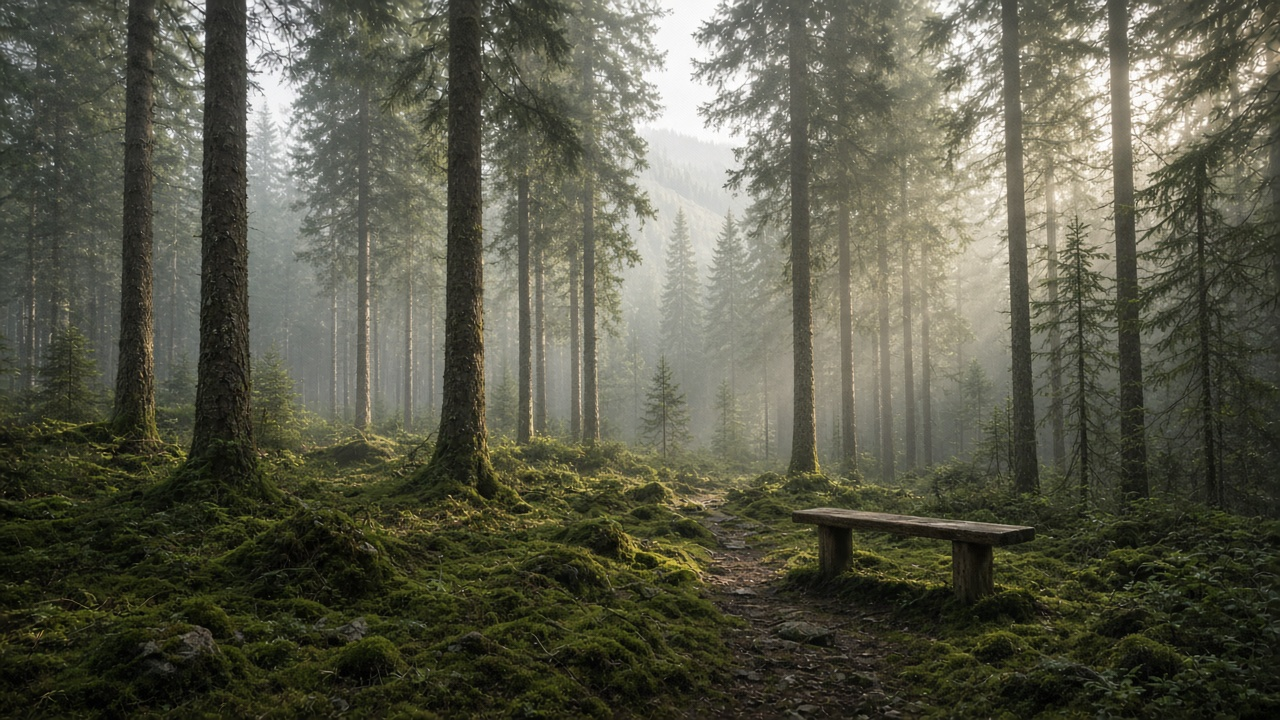
BONADUZ. Fifteen minutes on foot above the village, the forest of Bot Mulins looks like any other stretch of Graubünden woodland: spruce, pine and fir over a floor of deep moss, almost no traffic noise. What makes it a health forest is a modest set of additions, a barefoot and mindfulness path, wooden rest loungers, a hut with a kitchen and a fireplace, and a price tag that surprises every official who hears it. The commune of Bonaduz set the whole thing up for CHF 7,500.
The idea behind it has a Japanese name, Shinrin Yoku, and a German one, Waldbaden: forest bathing, the practice of guided, mindful time among trees as preventive stress medicine. The measured effects are no longer exotic. Studies associate time in the forest with normalised blood pressure and pulse, lower cortisol, better sleep and concentration, and increased activity of the natural killer cells of the immune system. The plenter structure and mossy quiet of Bot Mulins, foresters say, is close to the ideal the research describes.
CHF 55 for two hours of slowing down
The guided offer is deliberately small. Taster courses run two hours, cost CHF 55 a person, take groups of two to six, and are led by a local coach, with dates this autumn on 10 and 25 October and 7 November. Participants are taken through mindfulness and sense exercises rather than kilometres: what you hear, what the bark feels like, how long you can stand still. It is, in the language of the health system, a low threshold intervention, and it asks nothing of a GP.
A second income for the woods
For the forestry enterprise Crestault, which tends the forest, the courses are more than wellness. Timber from steep Graubünden slopes barely covers its costs anymore, and forest owners across the country are looking for income that does not come by the cubic metre. Bonaduz is now the model of a small national catalogue of health forests, alongside the Zurzach therapy forest, the alp pastures of the Diemtigtal, a site in the Val Calanca and a path through the Jorat above Lake Geneva.
Health economists see the appeal. Stress and its consequences are among the fastest growing cost drivers in the basic insurance system, and the political debate this autumn is dominated by premium rises that households cannot escape. A CHF 7,500 forest will not bend that curve. But it asks a question the system struggles to answer: why prevention that works, costs almost nothing and needs no prescription is still the exception.