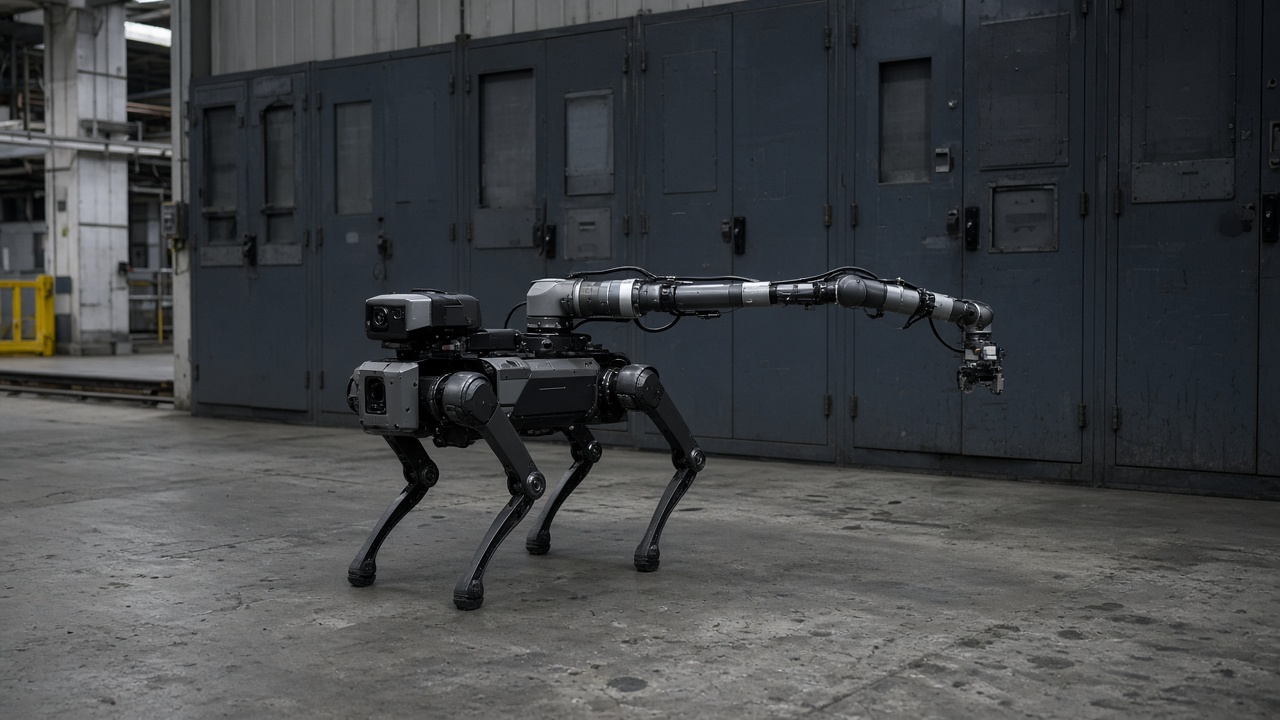
BIASCA. SBB and ETH Zurich showed a remote-controlled robot on Wednesday that is being trained to do simple jobs inside the Gotthard Base Tunnel. The machine was demonstrated at the railway’s maintenance and intervention centre in Biasca. It is not in the tunnel yet. The point of the morning was to show that it can already drive up to a cabinet, throw a switch and shut a door, even if it needed two attempts.
Maintenance in the 57 kilometre tunnel is a logistics problem before it is a robotics problem. Temperatures are high. Trains throw up dust. Much of the work can be done only on the night between Saturday and Sunday, when the timetable thins out. The tunnel is the longest railway tunnel in the world, and it is no longer new, so the list of jobs is growing. SBB’s answer is a machine that can be left inside and woken up from somewhere else, so a technician does not have to drive as far as 30 kilometres into the mountain to open a box.
A dog with an arm, on a joystick
The robot looks like a large dog, with a neck that does not belong on one. The neck is a gripper. In Biasca it has been practising on the same kinds of distribution cabinets and metal doors that stand in the tunnel. An operator drives it with a joystick and uses a separate arm controller for the fine work: walking, turning, then reaching. Max, an American doctoral student on the ETH project, said the controls are less like a finished tool than they look, and that the operator needs a great deal of practice. What resembles a video game is, he said, demanding.
Vaishakh Patil, the ETH scientist leading the work with SBB, said machines of this family are already used on oil platforms, mostly to watch and to diagnose. This one is closer to a prototype, because SBB set a narrower task: copy a tunnel, including light that a camera and an arm handle badly. That lighting problem is the part of the brief his group is built for. The railway did not ask for a robot that identifies passengers, or that replaces a shift. It asked for one that can reach a switch in a dark, dusty concrete tube.
Support, not a smaller workforce
Alberto Bombelli, a simulation engineer, runs the innovation project on the SBB side. Robots are there to support staff, he said, not to replace them. The railway can bring the installation closer to the person. The judgment about what is actually wrong stays with the person. The cost of the single machine on show is about CHF 250,000, and that figure already includes further work to make it fit for the tunnel. Fine motor control is the limit he named. Asked what the robot still has to learn, he answered: “Everything.”
The operational idea is more specific than the prototype. A robot stationed in the tunnel could be switched on for a check, or for a small repair, on a weekday, while trains are running, instead of waiting for the weekend window. Opening one cabinet deep inside currently consumes a crew, a possession of the track and a night. If the arm can do that part, the specialist still decides what the fault means. Bombelli’s line about the logistics is the one that justifies the budget: the effort required to open a box that far in is very high, and the hours available to do it are short.
What is proven, and what is still a hall in Biasca
Wednesday’s demonstration does not put a robot on the Gotthard timetable. It puts a prototype in a hall that has been dressed to look like the tunnel, under researchers who say the light is the hard part and an engineer who says the learning has barely started. SBB has been explicit that the know-how stays human. The gain, if the arm gets reliable, is time: fewer journeys to the middle of the mountain for jobs a switch and a door can describe. Until then the Saturday night possession remains the way the longest tunnel in the world is kept open. The machine in Biasca is a claim that it does not have to stay that way. A day earlier, the same railway was careful to say that another technology, carriage cameras, is still only a test.