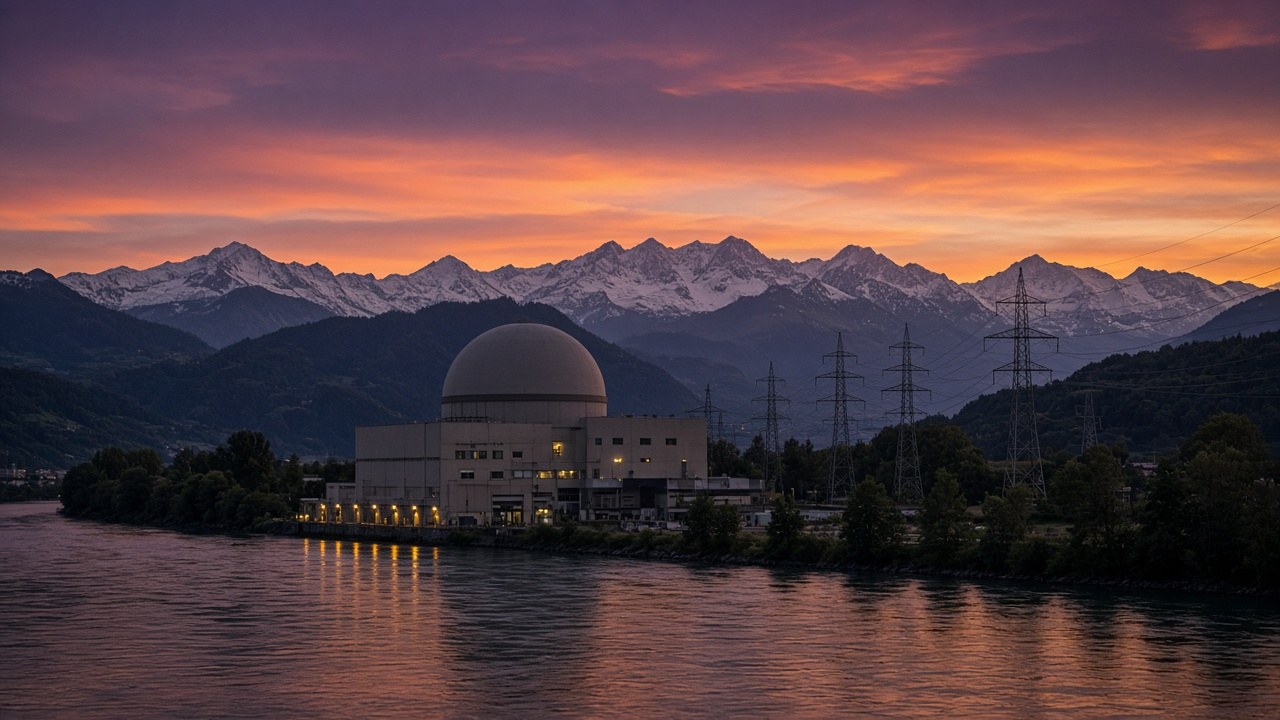
DÄNIKEN. The alarm came at 6.40 on Tuesday morning, in the middle of a routine functional test. An undervoltage registered on the busbars feeding the control rods triggered an automatic reactor scram at Gösgen, the 1,060-megawatt pressurised water reactor on the Aare that has supplied roughly an eighth of Switzerland’s electricity since 1979. The plant behaved exactly as its designers intended: the rods dropped, the chain reaction stopped, and every safety-relevant system responded as planned.
The Federal Nuclear Safety Inspectorate, ENSI, was informed as regulations require. Its MADUK network of automatic dose-rate monitors around the country’s nuclear sites registered no rise in radioactivity, and both the operator, Kernkraftwerk Gösgen-Däniken AG, and the inspectorate stressed that at no point was there any danger to people or the environment. ENSI will analyse the event, as it does every reportable occurrence, before it disappears into the annual safety report.
Back online the same evening
The diagnosis was quick and the fix quicker. By the early evening ENSI had granted authorisation to restart, and at 5.50 pm the generator was resynchronised with the grid. Output was then raised continuously towards 100 per cent. For the grid operator Swissgrid, the episode was a non-event on a mild autumn day, with demand far from its winter peaks and the country’s other three reactors undisturbed.
An old plant in a new debate
The timing is delicate all the same. Gösgen is the second-oldest reactor still running in Switzerland, and the country is in the middle of a fundamental argument about nuclear power: parliament is rewriting the energy law after voters signalled openness to new plants, and the operators are studying life extensions beyond sixty years. Every scram, even a textbook one with zero consequences, becomes ammunition for both camps, proof for one side that the safety systems are bulletproof and for the other that a 47-year-old machine needs watching.
For the record, Tuesday’s event sits at the benign end of the international scale. ENSI classifies such occurrences by their safety relevance, and a scram with all systems responding and no release of radioactivity belongs to the routine. The inspectorate’s analysis will follow in due course, the fuel keeps burning, and the Aare keeps flowing past the plant as it has for nearly five decades.