ZURICH. Switzerland’s glaciers lost 5.5 per cent of their remaining ice volume in a single year, the Glacier Monitoring Switzerland network reported on Thursday, a result second only to the record melt of 2022. The annual survey, published by the Swiss Academy of Sciences, closes the books on a hydrological year that paired an almost snowless winter with the hottest summer ever recorded in the country.
The measurements, taken on 23 glaciers across the Swiss Alps in September, show an average mass balance of minus 2.9 metres of water equivalent. On average, glacier thickness fell by 2.5 to 4 metres over the year, and some glacier tongues lost as much as 10 metres of ice. For individual glaciers, the season set all time records.
A winter without snow, a summer without mercy
The mechanism was brutally simple. Winter snowfall was exceptionally low, above all in the eastern and southern Alps, leaving the ice bare and darkened early in the season. Then the heatwaves arrived: long, intense and repeated between May and September, in the summer that broke every record and pushed Glacier Loss Day to 29 June, the second earliest date ever measured.
The five year picture is the part scientists find hardest to soften. Melt rates from 2022 to 2026 have been more than twice as high as in any previously monitored five year period. Almost 20 per cent of Switzerland’s total glacier volume has disappeared since 2021 alone. The extreme years are no longer exceptions; they are the pattern.
What remains is shrinking fast. Switzerland still held about 42.6 cubic kilometres of glacier ice at the end of the 2026 season, more than 30 cubic kilometres less than in 2000. Glacier area is estimated at 714 square kilometres, a decline of one third since the turn of the century. Several of the country’s smaller glaciers have now disappeared completely and, the report states plainly, permanently.
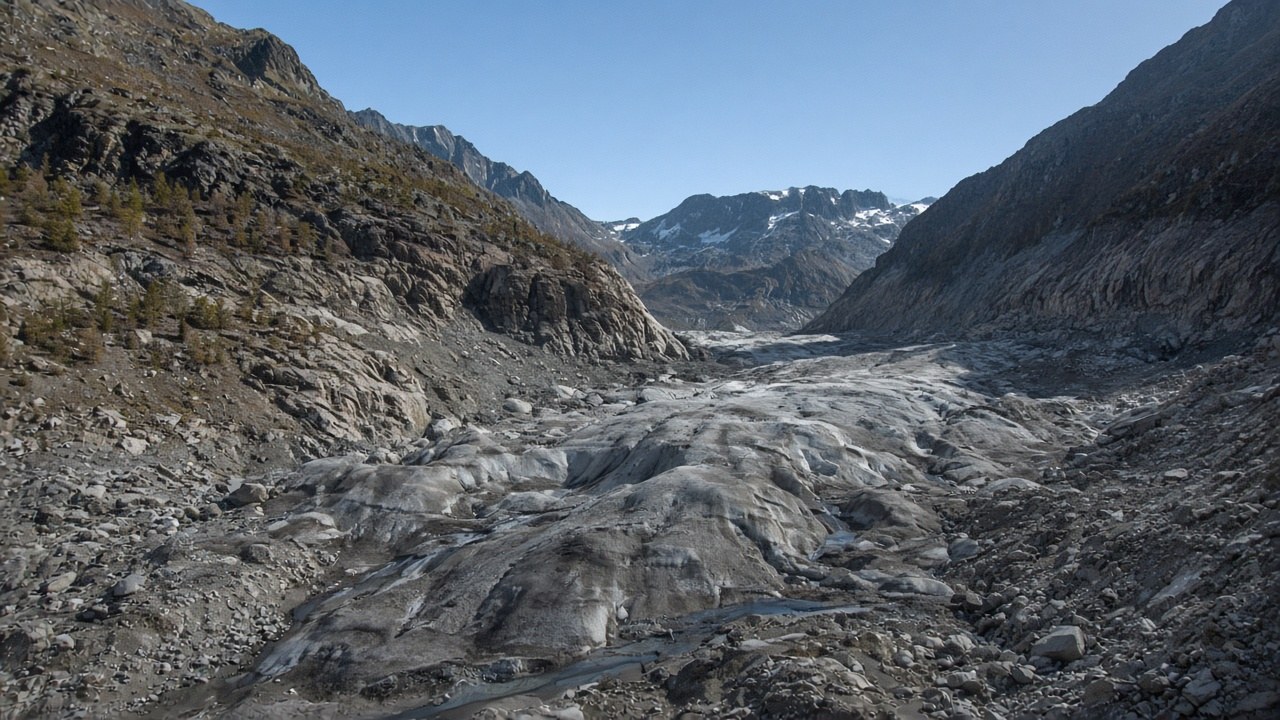
The Claridenfirn in canton Glarus, one of the longest monitored ice bodies in the Alps, stood entirely free of snow in September, its surface the grey of bare, dying ice. Images like it have become the visual shorthand of the annual report, and this year’s edition offers more of them than ever.
What the melt takes with it
The consequences arrive downhill within days. Late summer meltwater feeds the Rhine, the Rhone, the Inn and the Ticino, and its loss is already visible in low rivers across Europe. Hydropower reservoirs depend on the same ice, mountain slopes lose the frozen ground that holds them together, and resorts face another winter season opening with fewer slopes and bigger questions.
GLAMOS, the monitoring network headquartered at ETH Zurich and the universities of Fribourg and Zurich, has measured the ice for well over a century. Its authors note that the long observational series now document decline rather than variability. What the data cannot document is a reversal: nothing in the record suggests the glaciers can recover under current conditions.
The report lands in a political season already shaped by the drought. Parliament is debating heat plans, drought aid and forest strategy, and the glacier figures will be quoted in all three debates. The ice, as one glaciologist put it this week, is the country’s most honest thermometer. It has just recorded its second worst reading in history, and the winter that might slow the next one has not yet begun.