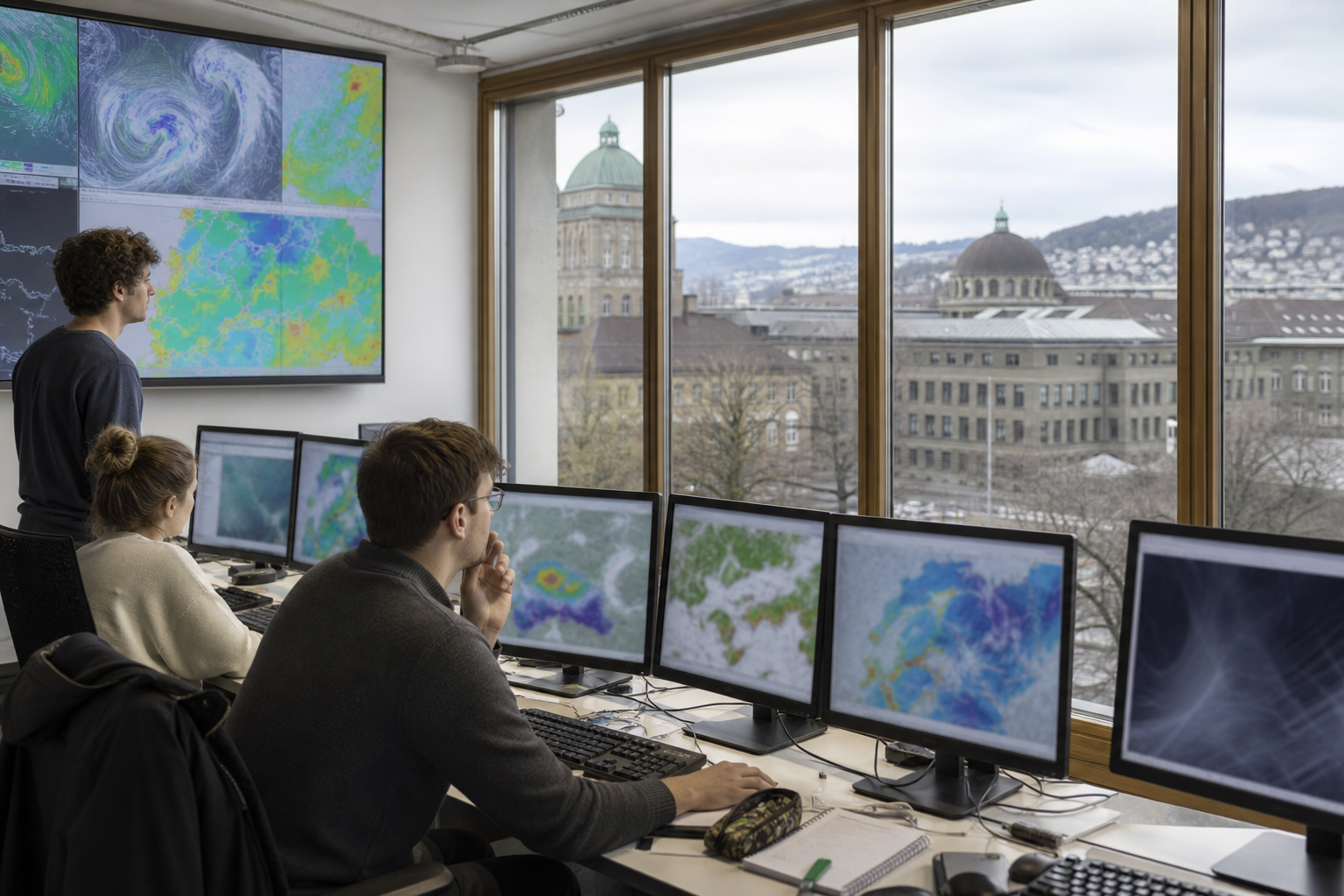
ZURICH. A machine learning model built at ETH Zurich predicted this summer's record heatwave ten days before it arrived, several days earlier than the conventional ensemble forecasts that MeteoSwiss and its European partners rely on. The result, presented at a briefing in Zurich on Wednesday, has prompted the national weather service to begin a formal trial of the system for operational use.
The model, developed over three years by the university's Institute for Atmospheric and Climate Science, was trained on four decades of reanalysis data and on the output of existing physics based models. It does not replace those models. It learns their errors, and in the case of persistent high pressure over central Europe, it learned them well enough to call the heatwave on 5 July, when most operational forecasts still showed a more moderate ridge.
The team is careful about claims. The heatwave was a single event, and a single hit, however striking, is not a verification. What the trial with MeteoSwiss is designed to test is whether the advantage holds across a season of ordinary weather: fronts, föhn, and the unglamorous business of telling a farmer in Thurgau whether to irrigate on Thursday.
MeteoSwiss will run the ETH system in parallel with its existing suite through the winter, comparing forecasts at lead times of 5, 7 and 10 days. A decision on whether to incorporate the output into public forecasts is due in the spring. Officials stressed that the physics based models will remain the backbone, and that any machine learning product will be labelled as such.
The work sits in a crowded international field. Similar systems at the European Centre for Medium Range Weather Forecasts in Reading, and at several American laboratories, have posted comparable gains on certain patterns. The ETH contribution is a specialisation in Alpine terrain, where conventional models still struggle with the interaction of valleys, föhn and persistent highs.
Funding came from a mix of federal grants, the ETH itself and a contribution from MeteoSwiss. The collaboration is part of the story: a university group, a federal office and a computing allocation at the national supercomputer in Lugano, used to train the model over several months last winter.
Commercial applications, if they come, are years away. Energy companies, insurers and agriculture already buy specialised forecasts, and a system that is demonstrably better at 10 days would find a market. The institute has filed no patents and says the science will remain publishable.
Students were involved at every stage, a point the principal investigator raised unprompted. Training the next cohort, she said, is half the output. International reaction has been warm. A group in Reading called the Alpine specialisation useful; a group in Boulder called the verification honest, which in this field is a compliment.
The next phase is the winter trial, with a larger sample and a stricter protocol. Results are expected by April. “The finding opens a door. It does not yet show what is behind it,” the principal investigator said. For a country that has just lived through its hottest summer on record, the door is one that MeteoSwiss is willing to walk through, carefully, and with the physics still running alongside.