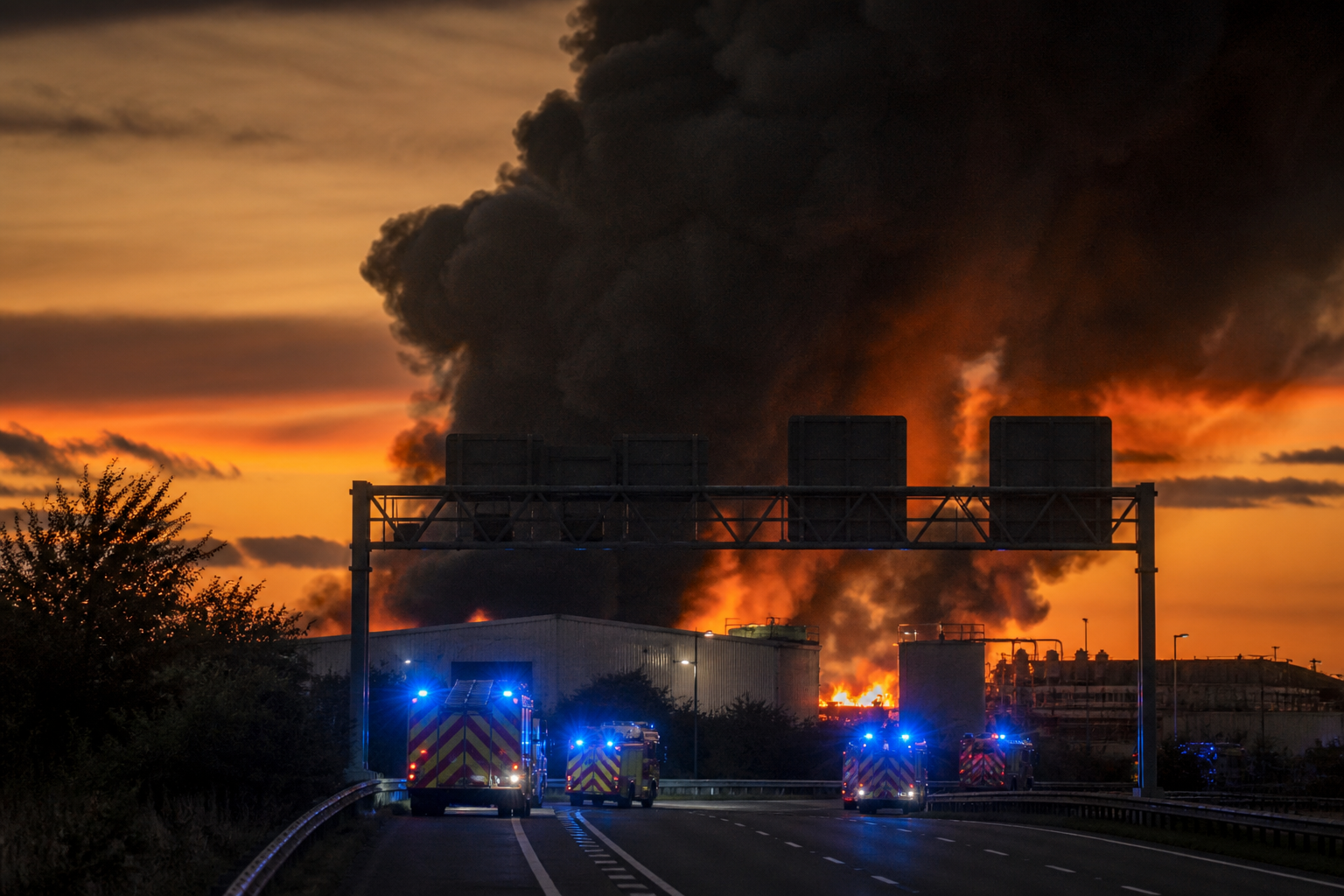
ECUBLENS. A major fire at a metal recycling plant in Ecublens, on the western edge of Lausanne, was brought fully under control on Saturday evening, almost 24 hours after it broke out and shut down one of the busiest transport corridors in French-speaking Switzerland.
The blaze started shortly before 7pm on Friday at the Thévenaz-Leduc plant, a recycler of metals and industrial waste, and took hold in a stockpile of vehicles stored under a vast covered structure. A thick column of black smoke rose over the Lausanne agglomeration, and the Alertswiss system told residents to stay indoors, close windows and switch off ventilation.
The location did the damage. The plant sits beside the A1 motorway and the Lausanne to Geneva railway, and both were sacrificed to the smoke. The motorway closed in both directions between Morges-Crissier and Morges-Malley, triggering kilometres of tailbacks, while trains between Renens and Denges-Echandens were stopped through the night. Rail traffic resumed at 5am on Saturday.
More than 200 firefighters with some 50 vehicles worked through the night, supported by high-capacity water pumps, a drone and the railway’s fire and rescue train. By Saturday morning the fire was contained within the damaged structure; by about 6pm it was declared fully under control, though extinguishing and shredding the waste to kill residual hot spots will continue for hours.
The collateral casualties mounted through Saturday. The Lausanne Triathlon, due to take place at the weekend, was cancelled outright, organisers citing the health and safety of participants. The motorway’s Geneva-bound carriageway reopened around midday, with two of three Lausanne-bound lanes following in the afternoon.
As to the cause, investigators are cautious but not silent. The fire “in all likelihood” started in a car wreck, said David Guisolan of the cantonal police, and fire safety inspector Florian Cuche noted that lithium batteries are the habitual suspect in fires at vehicle recycling sites. The public prosecutor has opened an investigation, and the scientific brigade is at work on the site.
The lithium question gives the fire a wider resonance. Switzerland’s recycling sector is handling a fast-growing stream of batteries hidden inside end-of-life vehicles and devices, and fires like Ecublens, intense, complex and difficult to access, in the inspector’s words, are becoming the industry’s defining risk. The same plant already experienced a fire in September 2025.
No injuries have been reported, which the authorities describe as the one piece of fortune in a bad night. The clean-up, the investigation and the argument over battery rules now begin, along with a familiar lesson for the region’s infrastructure: a fire that begins in a car wreck can close a motorway, a railway and a triathlon before breakfast.