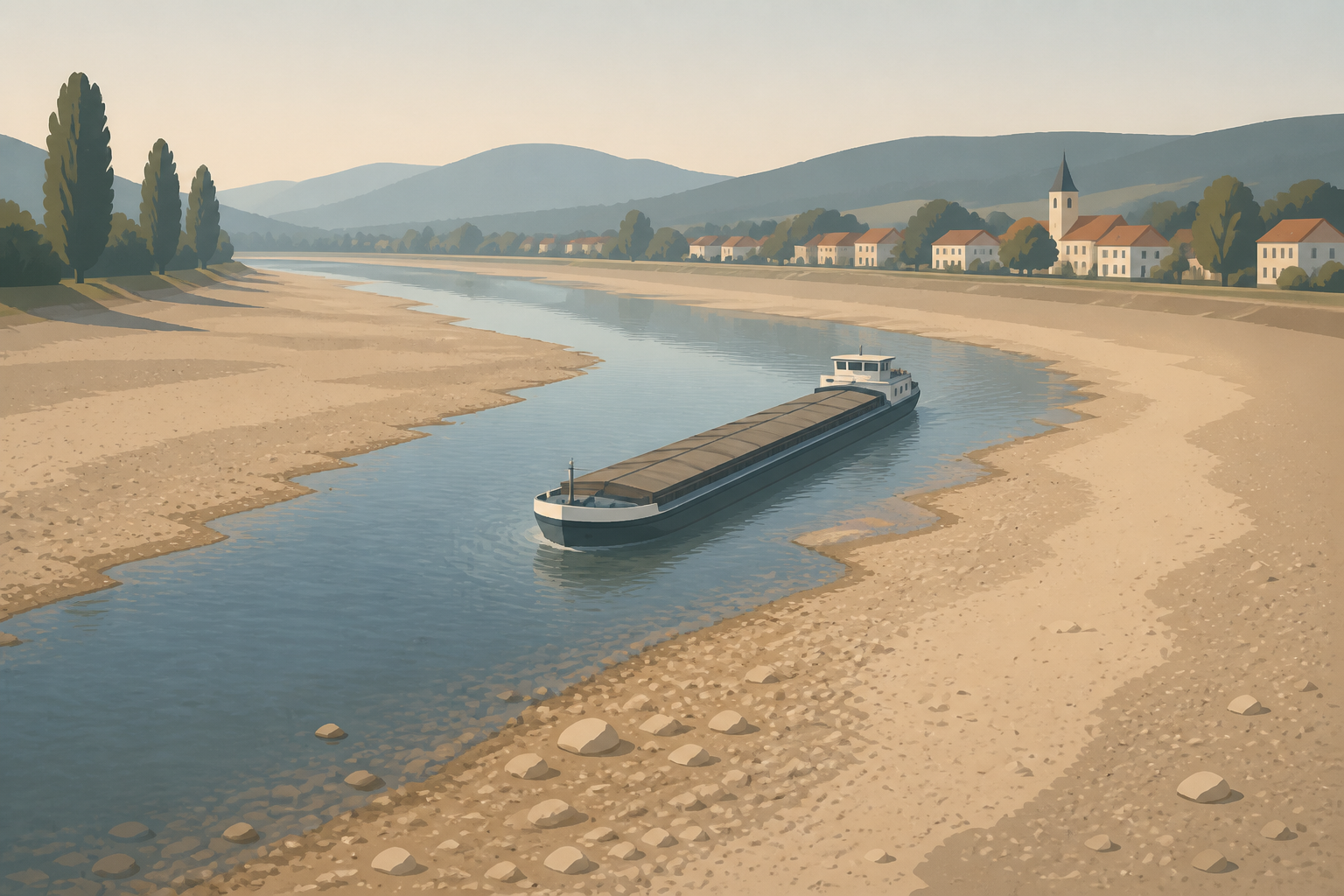
BRATISLAVA. The barges on the Danube are sailing half empty, and the captains blame a mountain range hundreds of kilometres upstream. Rivers across central Europe are running at historic lows this August, and hydrologists increasingly trace the shortage to the Alps, where the summer's record glacier melt is nearly spent and the snow that should replace it fell months too little.
The numbers from this stretch of the river are stark. Average monthly flow at Bratislava in July fell to roughly 35 per cent of the long term July average, according to the Slovak hydrometeorological institute. On 2 August, gauges downriver at Sturovo registered a record low for the date.
Low water is an economic fact before it is a scenic one. Shipping companies must lighten their vessels to keep them off the gravel, so the ports of Bratislava and Komarno are moving the same cargo in more journeys at higher cost. At the Gabcikovo hydropower plant, Europe's largest run of river station, seven of eight turbines stand idle; output is down 12 to 15 per cent on the year and losses run into the millions.
The chain of causation runs back up the Inn, which rises in the Engadin valley in southeastern Switzerland and joins the Danube at Passau. In a normal August, glacier melt from the Alps tops up exactly these tributaries through the driest weeks. This year the protective snow vanished from the ice on 29 June, the second earliest date on record, and the melt pulse came early, violent and brief.
What is happening downstream converts an abstract Swiss problem into a concrete European one. The loss of the Alps' natural water reservoir is shifting from a long term climate risk to a line item: freight surcharges on the Danube, cooling constraints at power stations on the Rhine, and irrigation restrictions from Bavaria toward the Black Sea.
Switzerland feels the same physics at home. The Rhine at Basel has spent weeks at levels that revive the old argument about river cooling for industry, and Valais farmers have watched streams that ran milky with meltwater in July run clear and thin by late August. Clear water, in a glacier fed August, is the sound of the tank emptying.
There is no engineering fix at the scale of a mountain range. Protective covers can slow the melt on small, sensitive patches of ice, and reservoirs can capture part of the spring runoff. Neither replaces the year round volume of ice built up over millennia, which is why water managers from four countries have started using the same phrase: demand management.
For Bern, the drought is also a diplomatic file. Switzerland has spent years building a quiet practice in water mediation, offering neutral ground and technical expertise to states that share river basins. The summer's flows have filled the diary: delegations from the Danube basin and the Rhine commissions are both due in Geneva this autumn.
The weather, at least in the short term, is about to change. Forecasters see Atlantic fronts reaching the Alps next week, and the first high altitude snow of the season is possible by mid September. What falls will help the rivers. It will do nothing for the glaciers, which now require a run of cold, snowy years that nobody forecasts.
The water tower of Europe is still standing. The tank inside it is shrinking, and this August, from the Engadin to the Slovak lowlands, the continent got a preview of what happens downstream when it runs low.